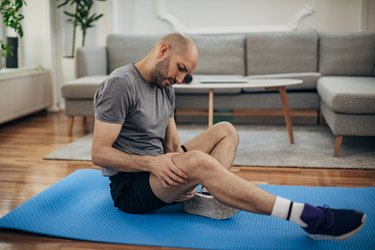
Sore after a workout? You might wondering (maybe even a little desperately) how to speed up muscle recovery — delayed-onset muscle soreness (DOMS) is no joke. Good news: You can help your body recover faster by doing some specific things post-workout.
Muscle damage and soreness is inevitable if you're trying to build strength and fitness. "Our body gets stronger only when there is a signal to do so. Training is that signal, in the form of a certain amount of physical stress to the body. This stress is productive, but it is still a stress that the body needs to recover from," Cameron Yuen, DPT, CSCS, director of physical therapy and training at Bespoke Treatments in New York City, tells LIVESTRONG.com.
Video of the Day
Video of the Day
"When you introduce a new physical stress, the body generally gets sore and it takes a few days for this soreness to resolve," Yuen says. That novel stress can be from a new type of workout, ramping up your routine after taking some time off or simply adding more load or reps to your workout session.
"You may be sore even when trying a new activity, like pickleball," Theresa Marko, PT, DPT, clinical specialist in orthopedic physical therapy and spokesperson for the American Physical Therapy Association Media Corps, says. Anytime you're using your muscles in new ways, you're likely to end up with some amount of DOMS.
Post-workout, your body works hard to repair muscle damage. "The way the body recovers from damage is through a healing response that comes with inflammation," Yuen says. "This is a natural and important part of the process that you don't want to stop. This also tends to cause soreness."
The inflammatory process works on its own natural timeline, Yuen says. However, there are some things we can do to facilitate the process and make it more effective. There are also some things that we can do that hinder the process and accidentally slow down recovery.
Related Reading
8 Ways to Speed Up Muscle Recovery
While true muscle recovery simply takes time ("The body requires time to recover from a new demand on its system," Marko says), there are some things you can do to minimize DOMS and potentially feel better quicker post workout.
1. Hydrate Sufficiently
When we exercise, we lose a lot of fluids and salts known as electrolytes (sodium, potassium, magnesium). "The salts that we lose are essential in providing a certain electrical gradient across our muscle cells, maintaining the correct fluid balance inside and outside of our cells and for bringing nutrients into our muscle cells," Yuen says.
"Water is the medium where all of our metabolic chemical reactions take place, it forms the solution for our blood and it is vital for many of the filtering processes in our body," he adds.
Because of this, hydrating properly — both after a tough workout and just regularly throughout the day — is essential for giving your muscles what they need to repair themselves. "Without enough hydration, your circulation of blood will suffer, which will slow down blood and oxygen being delivered to your muscles to help them recover," Marko says.
The American College of Sports Medicine (ACSM) recommends drinking 17 ounces of fluid two hours before exercise. There's no hard-and-fast rule for how much to drink during exercise, but ACSM says you should drink at regular intervals to replace the water you lose through sweating.
The exact amount you should drink will depend on how much you lose. If you're exercising for over an hour, make sure to add electrolytes to your water to replenish any lost salts.
2. Get Enough Sleep
"Sleep is so important because it is during sleep that our cells regenerate," Marko says. "Without a good number of hours of sleep, you are depriving your body of healing itself and recovery." So if you want to recover faster from workouts, prioritize a solid 7 or more hours of sleep every night, which is the minimum The American Academy of Sleep Medicine (AASM) recommends for adults.
Poor sleep can also impact your perception of pain, making you feel more sore than you really are. One small study published December 2019 in PLOS One found after just one night of sleep deprivation, subjects were more sensitive to both cold and pressure pain.
3. Refuel With Protein and Carbs
"Getting in the right nutrients is one way to either facilitate or hinder the recovery process," Yuen says. Protein and carbs are the two main macronutrients that are key for muscle recovery.
"Protein is the literal building block for both muscle repair and growth," Yuen says. "If you train hard and sleep well, but don't consume an adequate amount of protein, you simply will not grow and adapt." Our bodies can't store excess protein to use later, so it's important to eat it throughout the day instead of just packing it all in at one meal.
"Protein is the literal building block for both muscle repair and growth. If you don't consume an adequate amount of protein, you simply will not grow and adapt."
Carbohydrates are important because they are our muscles' primary source of fuel, Yuen says. "Building muscle is an active process, and the body needs energy to do this." Unlike protein, our bodies do store carbs, as glycogen. We tap into our glycogen stores during intense workouts when we need more energy to push through.
Our muscles also use it to fuel recovery, Yuen says. Replenishing these stores is important for both facilitating recovery and preparing our bodies for the next tough workout.
So, what should you eat after your workout to optimize muscle repair? The American Council on Exercise (ACE) recommends consuming 15 to 25 grams of protein and 1 to 2 grams of carbs per 2.2 pounds of body weight per hour of glycogen-depleting exercise. A little fat is good, too, to help you feel satisfied and full.
For a 150-pound person, that might look like a whole-wheat English muffin with 4 ounces of deli turkey, a slice of cheese and some mustard, with 1.5 cups of grapes. (Read more about why post-workout nutrition is so important here.)
4. Do Some Active Recovery
Active recovery can be any sort of low-intensity movement that you do on rest days after intense exercise. The goal, Yuen says, is to get oxygen, carbon dioxide and blood moving throughout the body so that the muscles have the nutrients they need to recover. "Active recovery should be very low-intensity, cyclical and restorative," he says. "It's very common to turn a recovery session into a workout session, so be careful with intent."
Walking, cycling, swimming and yoga are all great options for active recovery. "These sessions should focus on deep breathing with a slightly raised heart rate, usually below 110 to 120 bpm for 20 to 40 minutes," says Yuen.
5. Foam Roll
Foam rolling is a type of passive recovery, which encourages and facilitates the body in its healing and recovery process, Yuen says. When done immediately after a workout, it can also signal to the body that it's time to start repairing, he adds.
According to a November 2015 research review in the International Journal of Sports Physical Therapy, foam rolling and roller massage 10 to 20 minutes after high-intensity exercise reduces perceived pain. What's more, continued foam rolling for 20 minutes per day over 3 days may further decrease pain. Researchers suggest it could be thanks to the effects of foam rolling on damaged connective tissue, or the way it increases blood flow.
6. Use a Neuromuscular Electrical Stimulation Device
Neuromuscular electrical stimulation (NMES) is another passive recovery modality. A device has attached electrodes that are placed on the skin and transmit an electrical impulse to the muscles. It's used in medical settings to rehab muscle weakness and improve muscle control after things like surgery or stroke.
It also shows some promise for improving muscle recovery post workout: One May 2015 study in the Journal of Science and Medicine in Sport found that NMES improved recovery after intense training and reduced perceived soreness in professional team sports players. And a research review published in September 2014 in the Journal of Strength and Conditioning Research found NMES may reduce subjective measures of post-workout muscle pain, though it's not likely to improve performance as a result. As it's a medical device, you'll likely have to go to a PT's office to use one.
7. Try a Massage
Massage is another form of passive recovery that can help relax the body and potentially help speed up muscle recovery. "Being in a relaxed state, or a parasympathetic state, is required for the body to begin rebuilding," Yuen explains. It's hard to find something more relaxing than a massage.
A May 2020 research review in BMJ Open Sport & Exercise Medicine looked at 29 studies on manual massage and exercise performance and recovery and found that the recovery method seems to improve DOMS (and flexibility) to an extent. (Unfortunately, it's not likely to improve your performance.)
8. Take a Dip in a Hot Tub or Sauna
Heat therapy, via hot bath or some time in a sauna, may also help speed up sore muscle recovery by upping circulation, Marko says. And research backs her up: An October 2020 research review in Exercise and Sport Sciences Review found that heat therapy may accelerate recovery of muscle contractile function and endurance following intense exercise by reducing muscle soreness, stimulating protein synthesis and having other positive effects on the vascular and cellular level.
Of course, it's important to make sure you're hydrating and fueling properly so that your muscles have the raw materials they need to circulate during your time relaxing in the hot tub.
- American College of Sports Medicine: "ACSM Position Stand: Exercise and Fluid Replacement"
- The American Academy of Sleep Medicine: "Recommended Amount of Sleep for a Healthy Adult: A Joint Consensus Statement of the American Academy of Sleep Medicine and Sleep Research Society"
- PLOS One: "Total sleep deprivation increases pain sensitivity, impairs conditioned pain modulation and facilitates temporal summation of pain in healthy participants"
- American Council on Exercise: "Meal Timing: What and When to Eat for Performance and Recovery"
- International Journal of Sports Physical Therapy: "The effects of self‐myofascial release using a foam roll or roller massager on joint range of motion, muscle recovery, and performance: a systematic review"
- Science Direct: "Neuromuscular Electrical Stimulation"
- Journal of Science and Medicine in Sport: "The impact of neuromuscular electrical stimulation on recovery after intensive, muscle damaging, maximal speed training in professional team sports players"
- Journal of Strength and Conditioning Research: "Neuromuscular Electrical Stimulation During Recovery From Exercise"
- BMJ Open Sport & Exercise Medicine: "Regulation of Muscle Glycogen Repletion, Muscle Protein Synthesis and Repair Following Exercise"
- Exercise and Sport Sciences Review: "Local Heat Therapy to Accelerate Recovery After Exercise-Induced Muscle Damage"