
What does fact checked mean?
At SportsRec, we strive to deliver objective content that is accurate and up-to-date. Our team periodically reviews articles in order to ensure content quality. The sources cited below consist of evidence from peer-reviewed journals, prominent medical organizations, academic associations, and government data.
The information contained on this site is for informational purposes only, and should not be used as a substitute for the advice of a professional health care provider. Please check with the appropriate physician regarding health questions and concerns. Although we strive to deliver accurate and up-to-date information, no guarantee to that effect is made.
Circuit Training for Swimming
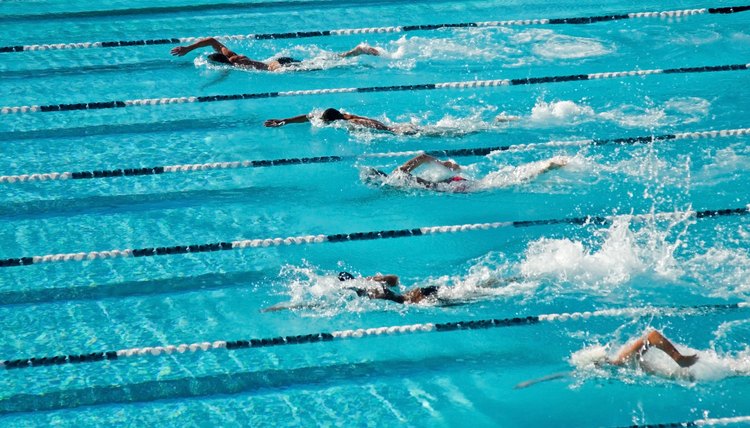
Circuit training is a type of exercise that requires performing a variety of workouts in a single session in rapid succession. The swimmer will do each individual exercise for five seconds to as many as 60 seconds and will then immediately move onto the next exercise in the circuit. This type of training can significantly boost performance, promote weight management, increase muscle mass and encourage better flexibility.
Cardiovascular Circuits
Cardiovascular exercise benefits swimmers in a number of ways, including better athletic performance, more energy, better mood, better sleep and weight control. This involves varying several forms of cardiovascular exercise for a set amount of time, such as jogging for 30 seconds, sprinting for 30 seconds, high knees for 30 seconds, jumping jacks for 30 seconds and walking for 60 seconds to break before repeating the circuit up to three times. This should be done at least five days per week to enhance your cardiovascular fitness and to improve overall endurance both in the pool and when on land.
Lower Body Circuits
It is much easier to tone and strengthen your lower body on land than it is in a pool, and a strong lower body is necessary for injury prevention. Lower body exercises that can be included in a circuit include squats, plie squats, lunges, side lunges, reverse lunges, wall sits, calf raises, bridges, reverse leg lifts and side leg lifts. Each exercise should be done for a period of five to 60 seconds and then move onto the next until all have been completed, then take a 60-second break and repeat the circuit, and do lower body circuits three days per week.
Upper Body Circuits
A strong upper body is necessary for speed and endurance in the pool and those who are lacking upper body strength will not be able to adequately compete. Upper body exercises that can be included in a circuit include tricep dips, pushups, shoulder flies, bicep curls, chest presses, bench presses, one arm rows and lateral raises. Each upper body exercise should be done for five to 60 seconds and then go to the next exercise until all are done, then take one full minute to break and repeat the circuit, and do this circuit three days per week.
Core Circuits
There is no arguing that swimmers need a very strong and stable core to ensure proper swimming technique and to improve swimming endurance. Core circuits will include exercises like crunches, planks, situps, leg lifts, twisting crunch, side plank, glute pushups and V-sit hold. All of these should be done for five to 60 seconds, depending on the swimmer's current core strength and the swimmer should do two sets of each. Each exercise is performed once and then you go right onto the next without stopping until all exercises are done, take a 60-second break and repeat the circuit, and do this three days per week.
References
- Harvard School of Public Health: The Benefits of Physical Activity
- Swimming World Magazine: Weight Training and Its Impact on Swimming
- Wilke J, Kaiser S, Niederer D, et al. Effects of high-intensity functional circuit training on motor function and sport motivation in healthy, inactive adults. Scand J Med Sci Sports. 2019;29(1):144-153. doi:10.1111/sms.13313
- Feito Y, Heinrich KM, Butcher SJ, Poston WSC. High-Intensity Functional Training (HIFT): Definition and Research Implications for Improved Fitness. Sports (Basel). 2018;6(3):76. doi:10.3390/sports6030076
- Cardozo DC, DE Salles BF, Mannarino P, et al. The Effect of Exercise Order in Circuit Training on Muscular Strength and Functional Fitness in Older Women. Int J Exerc Sci. 2019;12(4):657-665.
- Mayorga-Vega D, Viciana J, Cocca A. Effects of a Circuit Training Program on Muscular and Cardiovascular Endurance and their Maintenance in Schoolchildren. J Hum Kinet. 2013;37(1):153-160. doi:10.2478/hukin-2013-0036
- McGlory C, Devries MC, Phillips SM. Skeletal muscle and resistance exercise training; the role of protein synthesis in recovery and remodeling. J Appl Physiol (1985). 2017;122(3):541-548. doi:10.1152/japplphysiol.00613.2016
- Shaw BS, Shaw I. Compatibility of concurrent aerobic and resistance training on maximal aerobic capacity in sedentary males. Cardiovasc J Afr. 2009;20(2):104-106.
- Chiara M, Chamari K, Chaouachi M, Chaouachi A, Koubaa D, Feki Y, Millet GP, Amri M. Effects of intra-session concurrent endurance and strength training sequence on aerobic performance and capacity. British Journal of Sports Medicine. 2005 Aug; 39 (8):555-60.
- Fleck SJ and Kraemer WJ. (2004) Designing Resistance Training Programs: 3rd Edition. Champaign, IL: Human Kinetics.
- Gettman LR, Pollock ML. Circuit weight training: a critical review of its physiological benefits. The Physician and Sports Medicine. 1981 9:44-60.
- Glowacki SP, Martin SE, Maurer A, Baek W, Green JS, Crouse SF. Effects of resistance, endurance, and concurrent exercise on training outcomes in men. Medicine and Science in Sports and Exercise. 2004 Dec; 36 (12):2119-27.
Writer Bio
AJ Carpenter has a bachelor's degree in P=physical education and a master's in Journalism from Missouri State University. He has written for various publications on topics ranging from health and fitness to education and gardening.