How Much Fiber Do Walnuts Have?
Walnuts are a convenient source of dietary fiber 2. You can eat walnuts on their own as a snack or enjoy them in salads, cooked dishes or baked goods. Including a handful of walnuts in your daily diet is a good way to increase your fiber intake; however, keep in mind that walnuts are also high in calories with about 185 calories per ounce.
Fiber
Plant-based foods contain dietary fiber, which your body can't digest. Fiber is grouped into two main types: soluble and insoluble. Soluble fiber absorbs water in your digestive tract and turns into a gel-like substance. It can help lower cholesterol and blood glucose levels. Insoluble fiber doesn't absorb water, but instead passes through the digestive tract unchanged, sweeping along the intestinal lining as it goes through. Insoluble fiber helps prevent constipation and supports bowel regularity.
- Plant-based foods contain dietary fiber, which your body can't digest.
- Insoluble fiber doesn't absorb water, but instead passes through the digestive tract unchanged, sweeping along the intestinal lining as it goes through.
Walnuts
Are Walnuts Good Fiber?
Learn More
A 1-ounce serving of walnuts contains about 2 grams of fiber. This is about half the entire carbohydrate content of these nuts. The majority of the fiber in walnuts is insoluble, but they do contain trace amounts of soluble fiber as well.
Other Health Benefits
An ounce of walnuts contains 4 grams of protein, as well as healthy fats. That 1-ounce serving has 13.3 grams of polyunsaturated fat and 2.5 grams of monounsaturated fat. Included in the polyunsaturated fat content of walnuts is 2.6 grams of omega-3 fatty acids, an essential type of fat not produced by the body. Walnuts are also high in vitamins and minerals including manganese, thiamine, vitamin B-6, vitamin E, magnesium, zinc, potassium, folate and phosphorus.
- An ounce of walnuts contains 4 grams of protein, as well as healthy fats.
- Included in the polyunsaturated fat content of walnuts is 2.6 grams of omega-3 fatty acids, an essential type of fat not produced by the body.
Considerations
How Much EPA & DHA Are in Chia Seeds?
Learn More
The combination of fiber, healthy fats and protein in walnuts makes them good for dieters since this combination promotes satiety, a feeling of fullness that can help prevent overeating. The soluble fiber in walnuts may also work in concert with the polyunsaturated and monounsaturated fats to lower cholesterol levels and help prevent cardiovascular disease. Walnuts should not be your only source of dietary fiber, but can be a healthy fiber-rich snack choice that adds to your daily total.
Related Articles
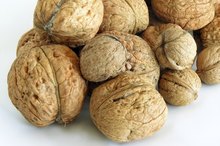
Are Walnuts Good Fiber?
Learn More
How Much EPA & DHA Are in Chia Seeds?
Learn More
Good Nuts Vs. Bad Nuts
Learn More
Can Almonds Raise Your Cholesterol?
Learn More
Shelled Peanuts: Nutrition Facts
Learn More

Octopus and Omega 3s
Learn More

Which Amino Acids Help Clean Arteries?
Learn More
English Walnuts vs. Black Walnuts
Learn More

List of Roughage Foods
Learn More
Can Flax Seeds Be Eaten Whole?
Learn More
References
- USDA National Nutrient Database
- Tufts University: Fiber Content of Selected Foods
- Nuts, walnuts, English. FoodData Central. U.S. Department of Agriculture. Published April 1, 2019.
- Clifton PM, Keogh JB. A systematic review of the effect of dietary saturated and polyunsaturated fat on heart disease. Nutr Metab Cardiovasc Dis. 2017;27(12):1060-1080. doi:10.1016/j.numecd.2017.10.010
- Li H, Li X, Yuan S, Jin Y, Lu J. Nut consumption and risk of metabolic syndrome and overweight/obesity: A meta-analysis of prospective cohort studies and randomized trials. Nutr Metab (Lond). 2018;15:46. doi:10.1186/s12986-018-0282-y
- Rock CL, Flatt SW, Barkai HS, Pakiz B, Heath DD. Walnut consumption in a weight reduction intervention: Effects on body weight, biological measures, blood pressure and satiety. Nutr J. 2017;16(1):76. doi:10.1186/s12937-017-0304-z
- O'Neil CE, Fulgoni VL, Nicklas TA. Tree nut consumption is associated with better adiposity measures and cardiovascular and metabolic syndrome health risk factors in U.S. adults: NHANES 2005-2010. Nutr J. 2015;14:64. doi:10.1186/s12937-015-0052-x
- Oregon State University. Essential fatty acids. Updated 2019.
- Raygan F, Taghizadeh M, Mirhosseini N, et al. A comparison between the effects of flaxseed oil and fish oil supplementation on cardiovascular health in type 2 diabetic patients with coronary heart disease: A randomized, double-blinded, placebo-controlled trial. Phytother Res. 2019;33(7):1943-1951. doi:10.1002/ptr.6393
- Jackson CL, Hu FB. Long-term associations of nut consumption with body weight and obesity. Am J Clin Nutr. 2014;100 Suppl 1(1):408S–11S. doi:10.3945/ajcn.113.071332
- Miketinas DC, Bray GA, Beyl RA, Ryan DH, Sacks FM, Champagne CM. Fiber Intake Predicts weight loss and dietary adherence in adults consuming calorie-restricted diets: the pounds lost (preventing overweight using novel dietary strategies) study. J Nutr. 2019;149(10):1742-1748. doi10.1093/jn/nxz117
- Poulose SM, Miller MG, Shukitt-Hale B. Role of walnuts in maintaining brain health with age. J Nutr. 2014;144(4 Suppl):561S-566S. doi:10.3945/jn.113.184838
- Yang J, Liu RH, Halim L. Antioxidant and antiproliferative activities of common edible nut seeds. LWT - Food Science and Technology. 2009;42(1):1-8. doi:10.1016/j.lwt.2008.07.007
- de Souza RGM, Schincaglia RM, Pimentel GD, Mota JF. Nuts and human health outcomes: A systematic review. Nutrients. 2017;9(12):1311. doi:10.3390/nu9121311
- Toner CD. Communicating clinical research to reduce cancer risk through diet: Walnuts as a case example. Nutr Res Pract. 2014;8(4):347–351. doi:10.4162/nrp.2014.8.4.347
- Kim H, Yokoyama W, Davis PA. TRAMP prostate tumor growth is slowed by walnut diets through altered IGF-1 levels, energy pathways, and cholesterol metabolism. J Med Food. 2014;17(12):1281–1286. doi:10.1089/jmf.2014.0061
- Tree Nut Allergy. American College of Allergy, Asthma, and Immunology.
- California Walnuts. How to buy, care & store. 2019.
Writer Bio
Bridget Coila specializes in health, nutrition, pregnancy, pet and parenting topics. Her articles have appeared in Oxygen, American Fitness and on various websites. Coila has a Bachelor of Science in cell and molecular biology from the University of Cincinnati and more than 10 years of medical research experience.