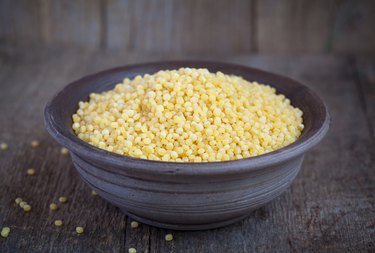
Israeli couscous, also sometimes called pearl couscous, is a pasta. The Israeli company Osem lays claim to inventing it in the 1950s, but it in fact existed long before then, in North Africa, Palestine, Jordan, Syrian and Lebanon. Made from a blend of semolina and wheat flour, Israeli couscous is larger than the small-grained yellow couscous of North Africa. Israeli couscous is toasted to give it a nutty flavor, which also makes it a sturdier pasta, so it withstands liquids and longer cooking times better.
Calorie Content
Video of the Day
Israeli couscous is made with whole-wheat or white flour, the latter being the more common and traditional variety. The calorie content in the original Israeli couscous is 180 grams in a 1/3-cup serving. For the whole-wheat Israeli couscous, the calorie count drops to 170 grams in a 1/3-cup serving.
Video of the Day
Macronutrients
Both types of Israeli couscous have only 1 gram of total fat per 1/3-cup serving, and neither variety contains sodium or cholesterol. However, each variety has 39 grams of carbohydrates. The white-flour Israeli couscous has 6 grams of protein, while the whole-wheat variety has 7 grams. According to the Institute of Medicine, the daily recommended intake, or DRI, for carbohydrates is 130 to 210 grams for men and women. The DRI for protein is 46 to 71 grams for men and women. A 1/3-cup serving of Israeli couscous provides between 8.5 percent and 15 percent of the DRI for protein, and between 18.6 percent and 30 percent of the DRI for carbohydrates.
A Source of Dietary Fiber
Both varieties of Israeli couscous contain dietary fiber, with 2 grams per 1/3-cup serving in the white-flour variety, and 6 grams per serving in the whole-wheat couscous. Dietary fiber is important to provide bulk to your diet, making you feel full and reducing the risk of overeating. It is also important for keeping your gut healthy, encouraging food to pass through your intestines as it adds bulk to your stools. According to Colorado State University Extension, most Americans do not consume enough dietary fiber. A 1/3-cup serving of white-flour couscous provides between 9.5 percent and 5.3 percent of the DRI for dietary fiber, while the whole-wheat variety has between 15.9 percent and 28.6 percent of the DRI for dietary fiber.
Vitamin and Mineral Content
Both varieties of Israeli couscous contain iron, although the whole-wheat variety has 10 percent of the daily value per 1/3-cup serving, while the white-flour variety has only 4 percent of the daily value per serving. Iron is an essential mineral, helping create hemoglobin and myoglobin, which are proteins that transport oxygen throughout your body. Iron is also needed to form blood cells. The white-flour variety of Israeli couscous has no calcium, but the whole-wheat variety has 2 percent of the daily value for calcium per serving. Calcium is needed to keep your bones and teeth strong, as well as to help your blood vessels dilate and constrict.
- Cookthink: What Is Israeli Couscous?
- MyFitnessPal: Israeli (Pearl) Couscous, Original, Toasted
- MyFitnessPal: Israeli (Pearl) Couscous, Whole Wheat
- Colorado State University Extension: Dietary Fiber
- Linus Pauling Institute: Calcium
- MedlinePlus: Iron in Diet
- Institute of Medicine: Dietary Reference Intakes - Macronutrients