
Do You Get Hurt More in Soccer or Football?
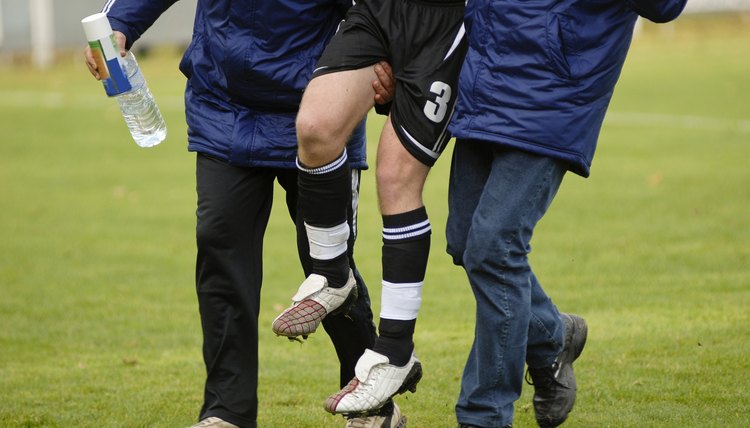
Soccer and football involve aerobic exercise that can help to develop and maintain a strong and healthy body, but players in both sports run considerable risk of serious injury. The risk of injury, and the types of injury most typically sustained, vary between the two sports.
Mode of Play
The mode of play differs in football and soccer, which affects the likelihood and type of physical injuries suffered by players. Soccer is a considered a noncontact sport, but there's plenty of contact between players during games. Soccer players jog or run constantly throughout a game, in which a round ball is kicked around a field measuring approximately 140 by 100 yards. By contrast, football is a contact sport in which players can kick, throw or carry the ball in their hands. Players push, block and tackle one another and the flow of the sport is play-by-play. However, football players are not in constant motion throughout a game.
Injuries in Soccer
In 2011, the Bleacher Report ranked soccer at sixth place in the top 10 most dangerous sports. The U.S. Consumer Product Safety Commission's statistics for 2009 reveal that 88,000 soccer players between the ages of 5 and 14 were seen in emergency rooms for sports injuries. In 2011, Safe Kids Worldwide reported that 104,190 soccer players between ages 12 and 17 were seen in emergency rooms, with 13 percent of those injuries involving concussions. The types of injuries most commonly sustained by soccer players are musculoskeletal injuries to the lower body.
Injuries in Football
Football was ranked as the third most dangerous sport in 2011 by the Bleacher Report, due to the sheer numbers of football related injuries. The U.S. Consumer Product Safety Commission reports that in 2009, 212,000 children were seen in emergency rooms for football injuries. By 2011, there were 275,050 emergency room visits for football players between ages 12 and 17, with 13 percent involving concussions. Knee injuries are relatively common among football players, with lower-extremity injuries overall accounting for half of all injuries. Thirty percent of other injuries involve the upper body. Strains, sprains, contusions, fractures and concussions are the most common types of injury sustained.
Comparing the Two Sports
Both sports carry a risk of injury, and it is impossible to quantify an individual player's overall risk of injury during a game of a season. In general, both sports take a relatively heavy toll on the knees and lower extremities. The risk of injury to the upper extremities is much higher in football than in soccer -- with the exception of the goalkeeper, soccer players do not use their hands and arms to handle the ball. However, concussion injuries are equally likely in soccer and football players. Football players are more likely to suffer injuries to the cervical spine, which can be catastrophic or life-threatening.
References
Writer Bio
Jae Allen has been a writer since 1999, with articles published in "The Hub," "Innocent Words" and "Rhythm." She has worked as a medical writer, paralegal, veterinary assistant, stage manager, session musician, ghostwriter and university professor. Allen specializes in travel, health/fitness, animals and other topics.