What does fact checked mean?
At Healthfully, we strive to deliver objective content that is accurate and up-to-date. Our team periodically reviews articles in order to ensure content quality. The sources cited below consist of evidence from peer-reviewed journals, prominent medical organizations, academic associations, and government data.
The information contained on this site is for informational purposes only, and should not be used as a substitute for the advice of a professional health care provider. Please check with the appropriate physician regarding health questions and concerns. Although we strive to deliver accurate and up-to-date information, no guarantee to that effect is made.
Micronutrients & Macronutrients in Grains
Grains are seeds of various grass plants. Examples include wheat, rice, corn, rye, barley, quinoa and oats. The U.S. Department of Agriculture recommends that whole grains should make up at least half of your daily consumption of grain foods. Whole grains have more natural nutrients because they have the outer bran and inner germ layer. Refined grains made with just the starchy, white endosperm layer are fortified with vitamins, but they contain less fiber.
Carbohydrates
Macronutrients provide energy, and humans need them to live. Carbohydrates, fats and proteins are considered macronutrients, and these three components make up the human diet. Grains are naturally low in fat and a rich source of carbohydrates, which are used as the main fuel for the body. Whole grains are a rich source of fiber because they contain the fibrous outer bran layer. For example, oats, whole wheat, brown rice, bulgur and millet are all high-fiber whole grains. Fiber may help reduce cholesterol, risk for type 2 diabetes and provide bulk for bowel movements. Whole grains provide complex carbohydrates, meaning they do not raise blood sugar rapidly because the fiber slows the release from the intestines into the blood. However, refined grains such as white bread can raise blood sugar rapidly and do not provide significant fiber.
- Macronutrients provide energy, and humans need them to live.
- Grains are naturally low in fat and a rich source of carbohydrates, which are used as the main fuel for the body.
Protein
Micro & Macro Nutrients in Bread
Learn More
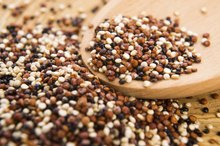
Grains are incomplete proteins, meaning they are low in at least one essential amino acid. Eating a balanced, varied diet ensures that you eat all the essential amino acids at an adequate level. This is especially important for vegetarians, who rely on grains and legumes for protein sources. Quinoa is one of the highest grains for protein content 1. One cup of cooked quinoa provides around 8 g of protein.
- Grains are incomplete proteins, meaning they are low in at least one essential amino acid.
- This is especially important for vegetarians, who rely on grains and legumes for protein sources.
B Vitamins
Micronutrients include vitamins and minerals. Humans need these in smaller quantities than macronutrients, and micronutrients do not provide energy. Grains are a rich source of the B vitamins, which include:
- thiamin
- riboflavin
- folate
- niacin
- vitamin B6
B vitamins are important for the metabolism of proteins, fat and carbohydrates for energy. Folate is also especially important for pregnant females, as the fetus requires extra folate for growth and development. Whole grains contain these vitamins naturally, and refined grains are fortified with B vitamins.
- Micronutrients include vitamins and minerals.
- Whole grains contain these vitamins naturally, and refined grains are fortified with B vitamins.
Minerals
Vitamins for Building Red Blood Cells & Immune System
Learn More
Grains provide minerals such as iron, magnesium and selenium. Iron is a mineral used in oxygen transportation in the blood. Iron deficiency, called anemia, is common in adolescent females and females in childbearing years. Those at risk for anemia should eat foods high in iron, such as grains and red meat. Magnesium is used in the body for muscle contractions and energy production. Selenium acts like an antioxidant in the body to fight off free radical production.
- Grains provide minerals such as iron, magnesium and selenium.
- Iron is a mineral used in oxygen transportation in the blood.
Related Articles

Micro & Macro Nutrients in Bread
Learn More
Vitamins for Building Red Blood Cells & Immune System
Learn More
How Long Does Iron Stay in Your System?
Learn More

Body Systems & Nutrition
Learn More

Folic Acid for Teens
Learn More

How to Remove Excess Iron in Blood
Learn More
List of Grains With Low GI
Learn More
Choline Rich Vegetables
Learn More

Magnesium Deficiency Symptoms in Women
Learn More

Rice & Bean Diet
Learn More
References
- Mayo Clinic: Whole Grains -- Hearty Options for a Healthy Diet
- Mother Nature Network: Quinoa Nutrition Facts
- 2015-2020 Dietary Guidelines for Americans. United States Department of Agriculture.
- Appendix 7. Nutritional Goals for Age-Sex Groups Based on Dietary Reference Intakes and Dietary Guidelines Recommendations. United States Department of Agriculture.
- Roager HM, Vogt JK, Kristensen M, et alWhole grain-rich diet reduces body weight and systemic low-grade inflammation without inducing major changes of the gut microbiome: a randomised cross-over trialGut 2019;68:83-93. doi: 10.1136/gutjnl-2017-314786
- Ross, A. B., van der Kamp, J. W., King, R., Lê, K. A., Mejborn, H., Seal, C. J., … Healthgrain Forum (2017). Perspective: A Definition for Whole-Grain Food Products-Recommendations from the Healthgrain Forum. Advances in nutrition (Bethesda, Md.), 8(4), 525–531. doi:10.3945/an.116.014001
- Tester, J. M., Leung, C. W., Leak, T. M., & Laraia, B. A. (2017). Recent Uptrend in Whole-Grain Intake Is Absent for Low-Income Adolescents, National Health and Nutrition Examination Survey, 2005-2012. Preventing chronic disease, 14, E55. doi:10.5888/pcd14.160540
- USDA Economic Research Service. "Wheat's Role in the U.S. Diet Has Changed Over the Decades." 2009.
Writer Bio
Holly Klamer began writing in 2010. She works in the health field as a registered dietitian and personal trainer. Klamer specializes in weight loss, sports nutrition and disordered eating articles for various websites. She received her Master of Science in nutrition from Colorado State University and her Bachelor of Science in dietetics and health fitness from Central Michigan University.