
Bikram Yoga to Alleviate Sciatica
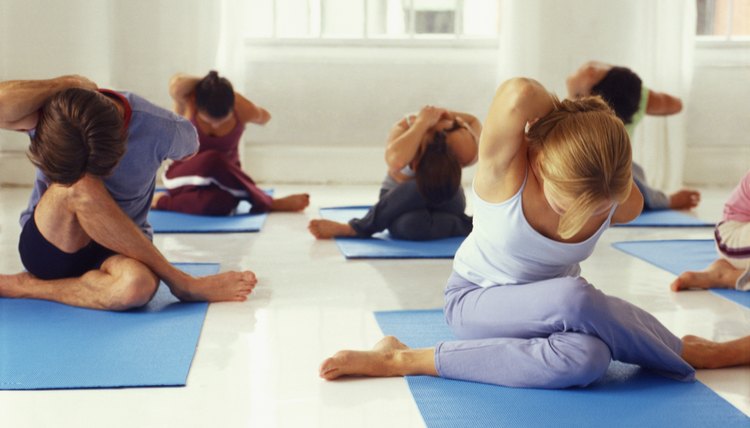
The sciatic, which is the longest nerve in your body, travels from your spinal cord down through each leg. Anything from a herniated disk to a fall down the stairs can irritate the sciatic nerve and cause you months of pain. For relief, try Bikram yoga for sciatica. Bikram Choudhury drew from the hatha yoga tradition to develop his "hot yoga" system of 26 poses, which are performed in studios heated to 105 degrees Fahrenheit. The heat makes muscles more pliable to enable gentler, deeper stretches.
Standing Separate Leg Stretching Pose
From a standing position jump or spread your legs three to four feet apart. Keep your feet parallel with each other. Inhale, and then on the exhale bend forward from your waist with a flat back. At the same time, as you’re folding forward, reach out with your hands to grasp the outer sides of your feet. Without forcing it, let your head rest on the floor or as close to it as you can. Take five breaths in this pose.
Standing Head-to-Knee
Stand with your feet a couple of inches apart. Transfer your weight to your left foot and lift your right foot off the floor. Bend your right knee until your upper thigh is parallel to the floor. Slowly straighten your right leg. Bend at the waist over your right leg and reach out and clasp your right foot with your hands. Make your back rounded and attempt to touch your forehead to your right knee. Take five breaths and then switch sides.
Standing Separate Leg Head-to-Knee Pose
Step your legs four feet apart. Turn your right foot out 90 degrees and turn your back or left foot in about 60 to 75 degrees. Twisting at the waist to the right, square your hips towards your right foot. On your next exhale, fold forward from your waist and lay your torso against the stretched out length of your right leg with your head resting against your knee. Reach your arms forward and lay your hands atop your right foot. Spend five breaths here and then switch sides
Locust Pose
Lie face down on the floor atop a yoga mat or towel. Turn your head to one side with your cheek resting on the floor while you prepare the rest of your body for the Locust pose. Hug your arms against your sides, palms on the floor. Activate your legs by tensing the muscles of the upper backs and fronts of your thighs. Point your toes. Lift your head and rest your chin on the floor. Exhale and while pressing down on the floor with your hands, lift both legs off the floor at the same time. Take up to five breaths and then lower back to the floor.
References
- University of Maryland Medical Center: Back Pain and Sciatica
- Sawane MV, Gupta SS. Resting heart rate variability after yogic training and swimming: A prospective randomized comparative trial. Int J Yoga. 2015;8(2):96-102. doi:10.4103/0973-6131.154069
- Gupta SS, Sawane MV. A comparative study of the effects of yoga and swimming on pulmonary functions in sedentary subjects. Int J Yoga. 2012;5(2):128-133. doi:10.4103/0973-6131.98232
- Baptiste B, Finn Mendola K. Yoga for swimmers: A new approach to dryland training. Yoga Journal. Updated April 5, 2017.
- Hakked CS, Balakrishnan R, Krishnamurthy MN. Yogic breathing practices improve lung functions of competitive young swimmers. J Ayurveda Integr Med. 2017;8(2):99-104. doi:10.1016/j.jaim.2016.12.005
Writer Bio
Linda Kaban is a certified yoga teacher and professional life coach who specializes in helping people achieve their fitness goals. With a bachelor's degree in the humanities, Kaban has been writing since 1998 and has been published in YOGALife magazine along with other healthy living publications.