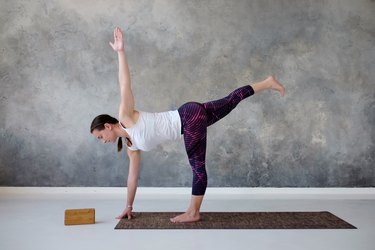
The first two styles of yoga many yogis are introduced to are Hatha and Vinyasa. That's because Hatha and Vinyasa are rooted in using your breath — one of the basic principles of yoga — to strengthen the body and mind.
But it might surprise you to learn that these two styles of yoga are, in many ways, opposites. Hatha yoga is much slower-paced and more meditative, so you'll hold poses longer to really deepen their stretch. Meanwhile, Vinyasa yoga links movement to breath and is a dynamic, fast-paced practice.
Video of the Day
Video of the Day
So, how do you figure out which practice is best for you? A good place to start is to learn more about the similarities and differences between these two popular styles and consider your fitness goals. Here, we break down the different benefits of Hatha and Vinyasa yoga, and the best ways to incorporate them into your workout routine.
Hatha vs. Vinyasa Yoga
According to Harvard Health Publishing, Hatha yoga begins with breath-controlled exercises, known as pranayamas, and are followed by a series of yoga postures, called asanas. The idea is that by centering your breath, you are strengthening your body and mind.
"Hatha yoga focuses on slow and deep breathing while holding the postures," says Hilery Hutchinson of The Flexibility Guru, who is certified in different styles of yoga.
"A good instructor will still guide you how to breathe when moving into and out of the stretch, but because you are holding stretches for prolonged periods of time, the focus is more on using your breath and visualization to help you relax the muscles further," Hutchinson says.
While Hatha has become an umbrella term for any style of yoga that has stretching and breathing in tandem, that's not its original meaning. "The main difference between classical Hatha and modern Hatha yoga poses is that the classical focus is on the physiological benefit to the internal organs instead of the benefit on the muscles," Hutchinson says.
On the other hand, Vinyasa yoga is much more dynamic and fluid, so you'll get your heart pumping. "In most classes, you will be continually moving from one position to the next, oftentimes very quickly," Hutchinson explains.
Both Vinyasa and Hatha yoga styles put an emphasis on breathing, but it's sped up while practicing Vinyasa yoga. "Vinyasa is a dynamic style of yoga where you link one breath and one movement," meaning each time you change postures, you take a breath, says registered yoga instructor Lucile Hernandez Rodriguez.
If You Want to Lose Weight
Yoga might not be the first exercise you think of when it comes to losing weight, but it can definitely turn into a calorie-burning workout, according to the National Academy of Sports Medicine (NASM).
But some styles of yoga burn more calories than others, specifically ones that are faster-paced like Vinyasa. Because you're constantly moving in Vinyasa yoga, your body will demand more out of your cardiovascular and metabolic systems. The faster you move at a higher intensity, the harder your body will work to supply oxygen and fuel to your muscles.
While there are a few short breaks in Vinyasa, they consist of held postures, Rodriguez says, so your body is still working and burning calories.
Research examining just how many calories yoga burns is limited. However, a small September 2005 study sponsored by the American Council on Exercise (ACE) looked at the number of calories burned during Hatha and power yoga, which is similar to Vinyasa. Researchers found that a 50-minute session of Hatha yoga burns 144 calories — the equivalent of a slow walk. On the other hand, power yoga burned 237 calories.
For the best weight-loss results, the Mayo Clinic recommends combining yoga with regular aerobic exercise, such as running, biking or swimming, resistance training and a healthy, calorie-controlled diet.
While yoga can help you strengthen and build muscle, which will increase your overall calorie burn, it doesn't have the same calorie-burning power as other workouts, like high-intensity interval training.
Ultimately, losing weight requires either reducing the number of calories you consume or burning more calories with physical activity than you take in, and doing yoga alone likely won't be enough.
If You Want to Build Muscle
Yoga is a full-body workout, and transitioning into and sustaining the poses takes some serious muscle strength. Vinyasa is the better choice for building muscle, Hutchinson says, because you're continuously moving from one pose to the next. Additionally, she says the challenging poses in Vinyasa yoga help increase your overall strength.
Vinyasa yoga is also a solid choice if you want to work on your balance. "This constant movement between different positions helps to challenge your balance and proprioception," Hutchinson explains.
However, you shouldn't rule out Hatha yoga entirely if you want to build strength. After 12 weeks of Hatha yoga, participants in a June 2015 study in Evidenced-Based Complementary and Alternative Medicine improved muscular strength and endurance, as well as cardiorespiratory endurance and flexibility, compared to other adults who didn't do any yoga.
If You Want to Gain Flexibility
Tight muscles and stiff joints can lead to pain and injury, but by practicing yoga, you can make everyday tasks easier and improve your flexibility, or the ability of your joints to move through unrestricted, pain-free range of motion, according to the ACE.
Yoga can improve your flexibility because it involves lengthening the muscles and moving in different ranges of motion, with poses such as twists, side bends and forward folds. But in order to increase flexibility, you have to hold a stretch long enough for your body to relax into it, Hutchinson says, which Hatha yoga allows you to do.
While Vinyasa classes will still have some slower stretches near the end of a class, those typically only last about 10 minutes — not enough time to really sink deep into the poses.
"The Hatha yoga that you'll see in modern yoga studios focuses on holding poses for five breaths per pose, moving deliberately and slowly," adds Melodie Johnson, a certified yoga instructor.
So, Is Hatha or Vinyasa Yoga Right For You?
No matter which style of yoga you choose, regular practice can lead to an increase in mindfulness, better cardiovascular health and improved fitness.
However, when you get down to it, the best style of yoga for you depends on your goals. If you're looking for an energetic, fast-paced session that will get your heart rate going and cause you to sweat, then Vinyasa yoga is probably the right choice for you. But if you prefer to take things slower, really stretch out your muscles and experience deeper relaxation, try Hatha.
- Harvard Medical School: "Yoga—Benefits Beyond the Mat"
- Mayo Clinic: "Can Yoga Help Me Lose Weight?"
- National Academy of Sports Medicine: "Calorie Burn and Beyond: Yoga Benefits Unearthed"
- American Council on Exercise: "Does Yoga Really Do the Body Good?"
- Evidence-Based Complementary and Alternative Medicine: "Effects of a 12-Week Hatha Yoga Intervention on Cardiorespiratory Endurance, Muscular Strength and Endurance, and Flexibility in Hong Kong Chinese Adults: A Controlled Clinical Trial"
- American Council on Exercise: "The Impact of Flexibility Training on Performance"