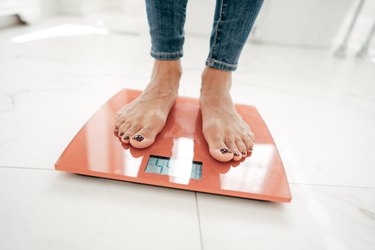
If you're wondering how much you should weigh, there's no simple answer. A person's weight is influenced by a variety of factors, including your genes, how you eat, your activity level and the environment where you live. Some of these things are under your control, while others are not.
You'll sometimes hear about an "ideal" weight by height, but there's really no such thing. That's a notion that originated with insurance companies, says Mir Ali, MD, bariatric surgeon and medical director of MemorialCare Surgical Weight Loss Center at Orange Coast Medical Center in Fountain Valley, California.
Video of the Day
Video of the Day
"When patients developed certain conditions, they'd record their height and weight. It came out like a bell-shaped curve, so most people were in the middle," Dr. Ali says. This, he says, was a poor strategy that led to unrealistic weight expectations.
Determining Your Healthy Weight Range
Still, it's important to aim for a healthy weight — weighing too little or too much is linked with increased risk of many serious health conditions. To that end, it's helpful to know what weight range is reasonable for you, considering your height, frame, background, age and other factors that make you who you are.
Many techniques are available to calculate whether your weight falls in a healthy zone. Each one offers potentially useful insights, but each also has its flaws.
Take a look at some of the options available for determining if your weight is considered healthy or not, along with details about why weight can be an important consideration when it comes to your overall health.
Key Takeaways
- There are several methods used to assess a person’s weight, including BMI, waist circumference, waist-to-hip ratio, waist-to-height ratio and body fat percentage.
- Each of these techniques comes with pros and cons, as they're largely measured against male and female weight averages. To get the best picture of your healthy weight, you may want to use several options together. And of course, a doctor can help you evaluate your weight.
- There are serious, life-threatening health conditions associated with having underweight, overweight or obesity.
How Much Should You Weigh? BMI Height and Weight Chart
It's not perfect, but you can use this weight and height chart based on body mass index (BMI) from the National Heart, Blood and Lung Institute (NHBLI) to find the intersection of your height and weight and get a general idea of how much you should weigh. (Read more on how to determine and use BMI below.)
Height | Weight (in lbs) | ||||
|---|---|---|---|---|---|
Underweight | Healthy | Overweight | Obesity | Severe Obesity | |
4'10" (58") | 88 and below | 89 to 119 | 120 to 143 | 144 to 191 | 192 and up |
4'11" (59") | 91 and below | 92 to 123 | 124 to 148 | 149 to 197 | 198 and up |
5' (60") | 94 and below | 95 to 127 | 128 to 153 | 154 to 204 | 205 and up |
5'1" (61") | 97 and below | 98 to 132 | 133 to 158 | 159 to 211 | 212 and up |
5'2" (62") | 100 and below | 101 to 136 | 137 to 163 | 164 to 218 | 219 and up |
5'3" (63") | 104 and below | 105 to 140 | 141 to 169 | 170 to 225 | 226 and up |
5'4" (64") | 107 and below | 108 to 145 | 146 to 174 | 175 to 232 | 233 and up |
5'5" (65") | 110 and below | 111 to 149 | 150 to 179 | 180 to 240 | 241 and up |
5'6" (66") | 114 and below | 115 to 154 | 155 to 185 | 186 to 247 | 248 and up |
5'7" (67") | 117 and below | 118 to 159 | 160 to 191 | 192 to 255 | 256 and up |
5'8" (68") | 121 and below | 122 to 164 | 165 to 196 | 197 to 262 | 263 and up |
5'9" (69") | 124 and below | 125 to 168 | 169 to 202 | 203 to 270 | 271 and up |
5'10" (70") | 128 and below | 129 to 173 | 174 to 208 | 209 to 278 | 279 and up |
5'11" (71") | 132 and below | 133 to 178 | 179 to 214 | 215 to 286 | 287 and up |
6' (72") | 136 and below | 137 to 183 | 184 to 220 | 221 to 294 | 295 and up |
6'1" (73") | 139 and below | 140 to 189 | 190 to 227 | 228 to 302 | 303 and up |
6'2" (74") | 143 and below | 144 to 194 | 195 to 233 | 234 to 311 | 312 and up |
6'3" (75") | 147 and below | 148 to 199 | 200 to 239 | 240 to 319 | 320 and up |
6'4" (76") | 151 and below | 152 to 204 | 205 to 246 | 247 to 328 | 329 and up |
Average Heights and Weights in the U.S.
In the U.S., the average height for people assigned male at birth (AMAB) is 5'9", according to the CDC, and the average weight is 197.9 pounds. Here's the breakdown on weight for someone AMAB who is 5'9" (69 inches), according to BMI:
- Healthy weight: 126 to 169 pounds
- Overweight (higher risk for health problems): 170 to 203
- Obesity (highest risk for health problems): 204 pounds or more
The average height for people assigned female at birth (AFAB) in the U.S. is 5'4", per the CDC, and the average weight is 170 pounds. Based on BMI, someone AFAB who is 5'4" (64 inches) would fall into these weight categories:
- Healthy weight: 108 to 145 pounds
- Overweight (higher risk for health problems): 146 to 174 pounds
- Obesity (highest risk for health problems): 175 pounds or more
Average Weight by Age
Although people are often curious about whether their weight is in the healthy range for their age, the truth is that there's no good answer to that question. There is no true "healthy" or "normal" weight for a particular age because weight is determined by so many other factors.
That said, weight can change with age. After age 30, body fat increases, and then for people AMAB, weight gain tends to continue until age 55, while for people AFAB, it continues until around age 65, according to Mount Sinai. At this point, the age-related weight gain tends to stop, and people go on to lose weight, per Mount Sinai.
While there's no "normal" weight to target, there are weight averages by age that you can use as a very general guideline. But keep in mind that comparing your weight to these numbers (provided by the Centers for Disease Control and Prevention and National Center for Health Statistics) will not give you the best indication of your overall health.
Weight Averages by Age
Age | People AMAB | People AFAB | ||||
|---|---|---|---|---|---|---|
Lower Percentile (lbs) | "Average" Percentile (lbs) | Upper Percentile (lbs) | Lower Percentile (lbs) | "Average" Percentile (lbs) | Upper Percentile (lbs) | |
Toddler (ages 2-3) | 27-31 or lower | 27-34 | 30-34 or higher | 26-30 or lower | 26-33 | 29-33 or higher |
Preschooler (ages 3-5) | 31-43 or lower | 31-47 | 35-47 or higher | 30-41 or lower | 30-46 | 34-46 or higher |
Middle Childhood (ages 6-11) | 45-83 or lower | 45-96 | 50-96 or higher | 44-87 or lower | 44-100 | 50-100 or higher |
Young Teen (ages 12-14) | 88-112 or lower | 88-129 | 102-129 or higher | 91-109 or lower | 91-125 | 106-125 or higher |
Teen (ages 15-17) | 123-145 or lower | 124-163 | 141-163 or higher | 114-122 or lower | 115-139 | 131-140 or higher |
Young Adult (ages 18-20) | 147-155 or lower | 148-174 | 166-175 or higher | 123-128 or lower | 124-145 | 140-145 or higher |
Adults ages 20-29 | 153 or lower | 153-216 | 217 or higher | 128 or lower | 129-191 | 192 or higher |
Adults ages 30-39 | 171 or lower | 171-230 | 231 or higher | 139 or lower | 140-201 | 202 or higher |
Adults ages 40-49 | 176 or lower | 176-229 | 229 or higher | 142 or lower | 143-203 | 203 or higher |
Adults ages 50-59 | 169 or lower | 169-224 | 225 or higher | 140 or lower | 141-198 | 199 or higher |
Adults ages 60-69 | 168 or lower | 169-226 | 227 or higher | 141 or lower | 142-196 | 197 or higher |
Adults ages 70-79 | 167 or lower | 167-216 | 216 or higher | 138 or lower | 139-184 | 185 or higher |
Adults ages 80 and over | 152 or lower | 153-198 | 198 or higher | 127 or lower | 127-168 | 168 or higher |
How to Use the Body Mass Index
The easiest way to answer your "how much should I weigh?" question is to know your BMI. While BMI doesn't tell the entire story, it's one of the most well-known metrics to assess weight.
"It's a simple calculation. You put in your height and weight and you get a BMI number," Dr. Ali says.
BMI offers a sense of your total body fat, which is more revealing than the number on the scale. With higher amounts of body fat, a person's risk of certain diseases — such as heart disease, high blood pressure and type 2 diabetes — increases, according to Winchester Hospital.
"There are a lot of good studies that show that if a person maintains their weight in that BMI range, then they're less likely to develop health problems because of their weight, and more likely to achieve the typical normal lifespan for this country," Dr. Ali says.
How to Calculate Your BMI
Calculate your BMI using this formula provided by the U.S. National Library of Medicine (NLM):
- Take your weight (in pounds) and multiply it by 703.
- Divide that answer by your height (in inches).
- Divide that result by your height in inches once again.
For example, for someone who is 5’4” (aka 64 inches) and weighs 170 pounds, the three-step calculation goes as follows:
- Step 1: 170 [weight in pounds] x 703 = 119,510
- Step 2: 119,510/64 [height in inches] = 1,867.34
- Step 3: 1,867.34/64 [height in inches] = 29.17
If we round to the nearest decimal point, this person’s BMI is 29.2.
There are plenty of online calculators available to spare you from doing this math, such as LIVESTRONG.com's BMI Calculator. The Centers for Disease Control and Prevention (CDC) offers a calculator that does not ask for your age or sex. You can also use a chart (see below) to determine your BMI.
Once you have your BMI, you can see which category it falls into. The categories, according to the NLM, include the following:
BMI Categories
BMI | Category | Disease Risk |
|---|---|---|
Below 18.5 | Underweight | Low to increased |
18.5 - 24.9 | Healthy | Low |
25 - 29.9 | Overweight | Increased |
30 - 39.9 | Obesity | High to very high |
Over 40 | Severe or high-risk obesity | Extremely high |
BMI Advantages
Doctors and other health experts have been relying on BMI since 1972, according to a June 2014 paper in the International Journal of Epidemiology, when it replaced the insurance charts mentioned earlier. (The scientist who established BMI based it on work done by a Belgian mathematician in the 1800s.)
There are a few big advantages to assessing weight with BMI:
- It's easy and cheap. Many free online calculators and charts are available to do the math for you.
- BMI helps predict a person's risk of disease. Compared to other methods (more on those later), BMI is an easy, accessible way to get a sense of a person's total body fat. As noted, that's important because there is a strong link between high body fat and obesity-related diseases. That's why BMI can be useful for predicting disease risk, per the Harvard T.H. Chan School of Public Health.
- Many health organizations use BMI. It's "accepted by essentially all major national and international health organizations," according to a July-August 2016 feature in ACSM's Health & Fitness Journal. That means doctors rely on it, and the metric is incredibly common in health-related studies.
BMI Disadvantages
The metric is not without its flaws:
- It may overestimate body fat for athletes or muscular people. "The problem with BMI is it doesn't really take into account body composition," Dr. Ali says. Because muscle weighs more than fat, athletes or other muscular folks may fall into the overweight or obesity categories of the BMI chart, according to the American Council on Exercise (ACE).
- BMI underestimates body fat for older adults. BMI is also known to be inaccurate for older adults, according to the NHLBI. With age, a person's body composition shifts — to a higher weight with less muscle mass. If an older and younger person both have the same BMI, the older person (on average) will have more body fat, per the CDC.
- BMI doesn't take into account ethnic backgrounds. Part of the strength of BMI is that only two metrics — height and weight — are required. But treating everyone the same, regardless of ancestry, is a weakness, too. People of Asian descent, for instance, may have a low BMI, but high body fat percentage, per the Mayo Clinic. That means for this population, the tool isn't accurately predicting risk. (The World Health Organization recommends different BMI cutoffs for people of Asian descent.) There are differences in other populations, too — compare a Black and white person with the same BMI, and the Black person will tend to have less body fat, according to the CDC.
- BMI also doesn't take a person's sex into account. The classic BMI calculator will only look at two calculations: weight and height. But sex matters when it comes to BMI, because people AFAB tend to have more body fat than people AMAB, even if their BMI is the same, per the CDC. To adjust for this problem, some calculators — including LIVESTRONG.com's — also ask people to plug in their age and sex.
- If you're self-reporting, you can make errors. If your height and weight are taken at the doctor's office, you can probably count on accurate measurements. At home, though, many of us will round up our height while underreporting weight, according to an August 2013 review in Current Research in Nutrition and Food Science.
- BMI can give a false sense of good health. In medical terms, some people are classified as having metabolic obesity, normal weight (MONW) — or, more casually (and controversially), "skinny fat." Basically, this means that a person's BMI indicates a healthy weight, but their percentage of body fat is high — which is linked to all the same increases in health risks as obesity, per the Mayo Clinic.
Tip
BMI for children is a bit more complicated than for adults. Doctors will incorporate a child’s age and sex as well as their height and weight, according to the Nemours Foundation. Do not use the chart above to assess a child or teenager’s BMI.
How to Use the Waist Circumference Technique
Sometimes medical professionals will encourage people to measure their waist, either as a solo way of assessing whether their weight is healthy or in conjunction with calculating their BMI.
That's because when it comes to fat, location matters. Measuring your waist helps reveal your amount of belly fat — this consists of both subcutaneous fat, which is soft and lies below the skin, and the visceral fat that's found between your internal organs, according to the Mayo Clinic.
Of these two types of fat, it's visceral fat that's more concerning: Having it is linked to an increased risk of heart disease, type 2 diabetes and high blood pressure, along with other health problems, per the Mayo Clinic.
How to Calculate Waist Circumference
Follow these steps to measure the circumference of your waist, according to Harvard Health Publishing:
- Take off your shoes. Remove your top, or wear one that reveals your belly.
- Stand with your feet together.
- After an exhale, measure your waist across the navel. Use a soft, fabric measuring tape (not a retractable metal measuring tool), and wrap it around your waist, parallel to the ground.
The number on the measuring tape is your waist circumference.
Harvard Health Publishing groups people's waist sizes into the following risk levels for chronic conditions such as heart disease and type 2 diabetes:
Waist Circumference and Risk for Health Problems
Assigned Male at Birth | Assigned Female at Birth | |
|---|---|---|
Low risk | 37 inches and below | 31.5 inches and below |
Intermediate risk | 37.1-39.9 inches | 31.6-34.9 inches |
High risk | 40 inches and above | 35 inches and above |
According to the CDC, the average person in the U.S. has a waist circumference that puts them in the "high risk" category:
Average Waist Circumference
- People assigned male at birth: 40.2 inches
- People assigned female at birth: 38.7 inches
Waist Circumference Advantages
Some of the benefits of using this method are:
- It's cheap and simple. As with BMI, few tools are required for the task. So long as you have a flexible tape measure, you can take this measurement.
- Waist circumference is a good way to predict key health risks. Your risk for developing heart disease and type 2 diabetes increases if fat sits at your waist instead of hips, per the NHLBI.
Waist Circumference Disadvantages
Some of the flaws of this metric include:
- It's easy to get it wrong. Determining where precisely to measure (at your bellybutton? Just above?) and ensuring the tape measure isn't tangled can be surprisingly challenging, particularly if you're doing the measurement yourself. Compared to BMI, this method is more likely to be inaccurate, per Harvard Health Publishing.
- It's not accessible for everyone. For people with a very large waist or mobility issues, taking this measurement may be more challenging, and it may not be as accurate, according to the Harvard T.H. Chan School of Public Health.
How to Use the Waist-to-Hip Ratio Technique
While BMI compares a person's weight to their height to get a sense of body fat, the waist-to-hip ratio (WHR) compares a person's waist size to their hip size, with the goal of determining how much fat is stored in this key area.
WHR offers a gauge for your health, Dr. Ali says. "It doesn't really tell you what weight you should be at," he notes. But your WHR can bring context to your weight, giving you a clearer picture of your overall health and letting you know if you're carrying too much belly fat, which, as noted earlier, is linked to serious health risks.
A bigger WHR measure means a person is at higher risk — that is, it's healthier for a person's waist to be smaller than their hips.
Calculating WHR
Here's how to do it, according to Dr. Ali:
- Measure your waist circumference using a soft, fabric measuring tape across your bellybutton after an exhale.
- Measure your hip circumference at their widest point.
- Divide the waist measurement by the hip measurement.
For example, a person with a 35-inch waist and 45-inch hips would have a 0.78 waist-to-hip ratio.
"If your waist is much larger than your hips, then you're at a higher risk for cardiovascular disease or diabetes," Dr. Ali says, noting that people AMAB tend to carry weight around the belly, while those AFAB usually carry more weight in their hips.
Healthy WHR Numbers
According to the World Health Organization (WHO), a healthy WHR number depends on your sex:
- People assigned female at birth: Less than 0.8
- People assigned male at birth: Less than 0.9
WHR Advantages
There are a few benefits to assessing whether you're at a healthy weight based on your WHR:
- WHR is simple and cheap. This is an easy calculation — it only requires two measurements and some division.
- It's a good predictor of disease, according to the Harvard T.H. Chan School of Public Health. In fact, it may be a better predictive tool than BMI: A waist-to-hip ratio was a better predictor for heart attacks than BMI, particularly for people AFAB, according to a January 2018 study in the Journal of the American Heart Association. And it's also a preferable predictor for prostate cancer, compared to BMI, according to a March 2017 study in Scientific Reports, which looked at more than 1,000 Chinese people who had prostate biopsies.
WHR Disadvantages
There are some limitations to this method, such as:
- It's easy to make mistakes with measurements. Measuring your own body can lead to errors. In this case, two measurements need to be taken, so the opportunity to mess up here is doubled. Because studies point to the waist-to-hip ratio and waist circumference being equally effective at predicting disease risk, it may be preferable to stick to measuring just the waist, per the Harvard T.H. Chan School of Public Health.
- There may be differences across ethnicities that aren't reflected. Per the WHO, cutoffs for WHR are often determined through studies of people with European ancestry, but it's possible that in people from different ethnicities, thresholds at a different point might be more effective at predicting health outcomes.
How to Use the Waist-to-Height Ratio Technique
As you can likely gather from its name, the waist-to-height ratio (WtHR) looks at the relationship between a person's waist size and height. The goal: "Keep your waist to less than half your height," per a November 2014 opinion piece in BMC Medicine.
Again, this can't tell you whether your weight is average or "ideal," but it can serve as a way to put your weight and BMI into context. If you have a high BMI because you're very muscular, for example, your WtHR could potentially indicate whether you're at a healthy weight for your body composition.
How to Calculate the Waist-to-Height Ratio
- Measure your waist size (in inches) using a soft, fabric measuring tape across your bellybutton after an exhale.
- Measure your height (in inches).
- Divide your height by your waist size.
If the number you get is more than 2, your waist-to-height ratio is considered healthy. If it is 2 or less, your risk for health problems is higher, and the risk increases as the number decreases.
For example, a person who is 5'4" (aka 64 inches) with a waist circumference of 30 inches would have a WtHR of 2.1 (64/30 = 2.1), which is considered healthy. If that same person had a waist circumference of 38.7, as the average person AFAB does, their WtHR would be 1.65, which is considered unhealthy.
WtHR Advantages
Some of the benefits of using WtHR are:
- It reveals risk for serious diseases. WtHR "may be a simpler and more predictive indicator" than BMI or waist circumference, per a March 2016 study in BMJ Open that looked at four years' worth of data from the UK National Diet and Nutrition Survey. A February 2017 study in Nature that looked at more than 25,000 middle-aged Chinese people who identified as men found that WtHR was better correlated to heart health than waist circumference.
- It's easy and cheap. Taking these two measurements and performing the calculation is a relatively simple task, and only requires a tape measure. Plus, no charts are required to know what the ratio indicates.
- WtHR works for all ethnic groups. For non-white people, BMI isn't always an effective method. In contrast, WtHR (and the philosophy of keeping waist size less than half of height) is "suitable for all ethnic groups," according to the BMC Medicine opinion piece.
WtHR Disadvantages
The drawbacks of this method mirror those of other methods that require measurements of waist and height: Where you measure matters. If you measure the wrong spot on your waist, it could make the end ratio inaccurate.
How to Calculate Body Fat Percentage
Health care providers are eager to know a person's body fat percentage because it's closely linked with many serious (and often chronic) illnesses. The measures above serve as a stand-in for body fat; that is, a high BMI typically (but not always) indicates a high body fat percentage.
Here are a few of the common ways to measure body fat directly, according to the University of Michigan Health:
- Skinfold thickness: After pinching the skin, calipers (think: clamps) are used to measure the skinfold thickness (SFT) in several key areas, including the thigh, back of the arm and waist. Different areas are measured depending on a person's sex. This method is fairly accurate, according to the American Council on Exercise (ACE). The accuracy likely decreases if you attempt to measure on yourself, rather than having a professional use the calipers.
- Underwater weighing: After being weighed normally, a person is then lowered into water and weighed there. The difference between these two measurements reveals body density, per the University of Michigan Health. Another version of this — air displacement plethysmography — compares the air pressure of a sealed chamber when you're in it to when you're not to identify body density, according to the University of Michigan Health.
- DXA: Dual-energy x-ray absorptiometry — a special type of X-ray — reveals the amount and location of fat tissue.
Body Fat Percentage Calculator
In general, measuring body fat requires a professional — either to take the measurements or to supply the tools and technology. While there are commercially available body fat analyzers, such as body fat scales, these tools are easily affected by several factors, including how hydrated you are, according to the Mayo Clinic.
To get a general idea of your body fat percentage, plug your measurements into LIVESTRONG.com's Body Fat Calculator.
Once you've assessed your body fat, you'll want to know what your number means. The Cleveland Clinic recommends following guidelines laid out in September 2000 in The American Journal of Clinical Nutrition (although keep in mind that there isn't total agreement in the health community about these numbers):
Healthy Body Fat Percentages by Age
Age | People Assigned Female at Birth | People Assigned Male at Birth |
|---|---|---|
20-40 years old | 21-33% | 8-19% |
41-60 years old | 23-35% | 11-22% |
As a more general guideline, the ACE offers the following percentages for everyone, regardless of age:
Body Fat Percentage Categories
Category | People Assigned Female at Birth | People Assigned Male at Birth |
|---|---|---|
Essential Fat | 10-13% | 2-5% |
Athletes | 14-20% | 6-13% |
Fitness | 21-24% | 14-17% |
Acceptable | 25-31% | 18-24% |
Obesity |
|
|
Body Fat Percentage Calculation Advantages
- It has a strong link to increased risk of serious diseases. Most of the other measures medical professionals use — like the ones detailed on this list, including BMI, WTH, waist circumference and WtHR — are aimed at trying to get a sense of a person's body fat. For instance, one observational study of more than 50,000 older adults in Canada measured both their BMI and body fat percentage. A low BMI and high body fat percentage were associated with increased mortality, per the April 2016 research in Annals of Internal Medicine. This reveals the limitations of BMI — a person with a small frame can still be unhealthy, and BMI isn't always the most accurate of measurements.
- It's a more helpful measure than BMI when it comes to diabetes. Having abnormal blood sugar (an indicator of diabetes or prediabetes) is more common in people with a normal BMI and high body fat percentage than among those who have overweight with a low body fat percentage, according to an April 2018 study in BMJ Open that drew on information from adults over age 40 from the National Health and Nutrition Examination Survey.
Body Fat Percentage Calculation Disadvantages
While understanding your body fat percentage may help reveal more about your disease risk than BMI or other measures, it's not without its flaws.
- It's not easy to measure. Many body fat analyzers available for you to buy aren't very accurate, according to the Mayo Clinic. And the more accurate measures — such as getting weighed underwater — are complex and also typically require professionals along with their equipment.
- There isn't a consensus on healthy body fat percentage, according to the University of Michigan Health — that is, unlike other methods with straightforward categories and rules, there isn't always a clear sense of what is (and isn't) a healthy percentage of body fat.
Weight and Health Risks
Health professionals, as well as health organizations around the world, focus a lot of attention on weight. That's not simply because it's readily visible: Weight is a key indicator of a person's health.
Since 1975, the rate of obesity around the world has tripled, according to the WHO — as of 2016 (the most recent year with available WHO data) there are more than 1.9 billion adults who have overweight and 650 million who have obesity.
There's typically less attention given to people who have underweight, but that condition is also associated with certain diseases and conditions.
What Does It Mean to Have a High Risk of a Health Condition?
As you review the risks associated with different weight categories, keep in mind that a risk factor is not a certainty.
“I see this in my practice as a weight-loss surgeon all the time — I see patients with very high BMIs, but they don't have high blood pressure, they don't have diabetes, they're not on any medication,” Dr. Ali notes.
That is, being a certain weight may be associated with a higher chance of having certain diseases and conditions — but it doesn't mean you will have them.
In most cases, working to change your weight (whether by gaining or losing) changes your risk profile.
Health Risks Linked to Overweight or Obesity
"Obesity affects every organ, but diabetes and cardiovascular disease are the ones most likely to cause health issues," Dr. Ali says.
According to the National Institute of Diabetes and Digestive and Kidney Diseases (NIDDK), the health risks of having obesity or carrying too much weight include:
- Cancer
- Type 2 diabetes
- High blood pressure
- Heart disease
- Stroke
- Sleep apnea
- Metabolic syndrome
- Fatty liver disease
- Osteoarthritis disease
- Gallbladder disease
- Kidney disease
- Mental health problems, such as depression
- Pregnancy risks
Having slight overweight puts someone at risk for these health problems, per the WHO — and with more weight, the risk increases.
Reassuringly, the reverse can also be true: For instance, for people at risk of type 2 diabetes, losing about 5 percent of your body weight can help prevent the disease, according to the NIDDK. For some people, this could mean aiming to lose 1 to 2 pounds per week.
And, while it's challenging to know if losing weight will reduce a person's cancer risk, it's possible there's a relationship there — for instance, people who have bariatric surgery may have a lower risk of obesity-related cancers than people with obesity who do not have this surgery, according to the National Cancer Institute (NCI).
The major diseases — cancer, diabetes and so on — get a lot of attention when it comes to weight. But it's not just these conditions. Having overweight or obesity can reduce the quality of someone's life, per the CDC. It can make everyday things like traveling on an airplane stressful and expensive. It can lead to pain, trouble sleeping, changes to mood and energy levels and difficulty moving.
With more weight, people may have shortness of breath or decrease their activity, Dr. Ali says, which can in turn lead to other concerns.
Health Risks Linked to Underweight
There's less attention paid to people who have underweight compared to those who have obesity. Makes sense, when you consider the prevalence of the two: Only an estimated 1.5 percent of U.S. adults have underweight, according to the CDC. In comparison, 42 percent of adults in the U.S. have obesity, per the CDC.
But falling in the underweight category is not good for your health (despite many cultural cues, which tend to glorify leanness). It's associated with an increased risk of death compared to people who have normal weight, according to an April 2014 study in BMJ Open, which looked at more than 30,000 people over several decades.
And, in an observational study of nearly half a million people, people who had underweight had a greater risk of heart disease than those with normal weight, according to research in the December 2017 issue of Medicine. It's worth noting that the increased risk of people with underweight having heart disease was lower than that of people with overweight or obesity.
Using data from the 2012 Behavioral Risk Factor Surveillance System (BRFSS) from the CDC, researchers looked at the effects of having underweight for the May 2017 issue of the Journal of Diabetes and Obesity and concluded there were "similar negative health effects" for having underweight or obesity.
People who have underweight might not be getting the nutrients they need. Being malnourished can lead to many health problems, according to the American Academy of Family Physicians (AAFP), including:
- Fragile bones and osteoporosis
- A weakened immune system
- Anemia
- Fertility issues
- Hair loss
Some causes of underweight mirror the reasons for overweight: Genetics and medications, for instance, can be contributing factors. Other factors include being very active and psychological issues, such as depression or eating disorders. Having underweight can also be an early indicator of an illness, such as thyroid problems, diabetes or cancer, per the AAFP.
When to See a Doctor
If you are concerned about your weight, speaking with a health care professional is the best way to assess your weight and potential health risks. But consider reaching out even if you're comfortable with your weight and feel otherwise healthy because there are certain health conditions associated with having under- or overweight. By taking a family history and checking other health markers (such as your cholesterol, blood pressure and so on), your physician can gain insight into your overall health and assess if you have other risk factors to be aware of.
As you can see, many methods are available to help you get a sense of whether your weight is healthy, but each method also comes with its own limitations and disadvantages.
When asking yourself "how much should I weigh?" remember that there is no such thing as an "ideal weight" based solely on your height, age or sex. So try to avoid holding yourself to a specific weight goal without the input of a trained medical professional who knows you and your individual health circumstances.
- Winchester Hospital: "Your Body Fat Percentage: What Does It Mean?"
- U.S. National Library of Medicine: "Body mass index"
- Centers for Disease Control and Prevention: "Adult BMI Calculator"
- National Heart, Blood and Lung Institute: "Body Mass Index Table 1"
- NHLBI: "Body Mass Index Table 2"
- International Journal of Epidemiology: "Commentary: Origins and evolution of body mass index (BMI): continuing saga "
- Harvard T.H. Chan School of Public Health: "Why Use BMI?"
- ACSM's Health & Fitness Journal: "THE BENEFITS OF BODY MASS INDEX AND WAIST CIRCUMFERENCE IN THE ASSESSMENT OF HEALTH RISK"
- American Council on Exercise: "BMI Calculator"
- NHLBI: "Assessing Your Weight and Health Risk"
- CDC: "About Adult BMI"
- Mayo Clinic: "Mayo Clinic BMI and waist circumference calculator"
- WHO: "Appropriate body-mass index for Asian populations and its implications for policy and intervention strategies"
- Current Research in Nutrition and Food Science: "Pitfalls Of Using Body Mass Index (BMI) In Assessment Of Obesity Risk"
- Mayo Clinic: "Normal weight obesity: A hidden health risk?"
- Nemours Foundation: "Body Mass Index (BMI)"
- Mayo Clinic: "https://www.mayoclinic.org/healthy-lifestyle/mens-health/in-depth/belly-fat/art-20045685"
- Harvard Health Publishing: "Abdominal obesity and your health"
- Harvard T.H. Chan School of Public Health: "Measuring Obesity"
- WHO: "Waist circumference and waist-hip ratio: report of a WHO expert consultation"
- BMC Medicine: "A proposal for a primary screening tool: `Keep your waist circumference to less than half your height’"
- Korean Journal of Pediatrics: "Waist-to-height ratio as a screening tool for obesity and cardiometabolic risk"
- BMJ Open: "Waist-to-height ratio as an indicator of ‘early health risk’: simpler and more predictive than using a ‘matrix’ based on BMI and waist circumference "
- Nature: "Waist-to-height ratio is an effective indicator for comprehensive cardiovascular health"
- University of Michigan Health: "Estimating Body Fat Percentage"
- ACE: "Percent Body Fat Calculator: Skinfold Method"
- Cleveland Clinic: "Body Mass Index and Body Fat"
- The American Journal of Clinical Nutrition: "Healthy percentage body fat ranges: an approach for developing guidelines based on body mass index "
- Annals of Internal Medicine: "Relationship Among Body Fat Percentage, Body Mass Index, and All-Cause Mortality"
- BMJ Open: "Informational value of percent body fat with body mass index for the risk of abnormal blood glucose: a nationally representative cross-sectional study"
- WHO: "Obesity and overweight"
- National Institute of Diabetes and Digestive and Kidney Diseases: "Health Risks of Overweight & Obesity"
- WHO: "Obesity: Health consequences of being overweight"
- National Cancer Institute: "Obesity and Cancer"
- CDC: "Prevalence of Underweight Among Adults Aged 20 and Over: United States, 1960–1962 Through 2015–2016"
- CDC: "Adult Obesity Facts"
- BMJ Open: "Mortality risk associated with underweight: a census-linked cohort of 31,578 individuals with up to 32 years of follow-up"
- Medicine: "Underweight another risk factor for cardiovascular disease? A cross-sectional 2013 Behavioral Risk Factor Surveillance System (BRFSS) study of 491,773 individuals in the USA"
- Journal of Diabetes and Obesity: "Is Being Underweight as Bad for Your Health as Being Obese? Evidence from the 2012 Behavioral Risk Factor Surveillance System"
- American Academy of Family Physicians: "ealthy Ways to Gain Weight If You’re Underweight"
- Centers for Disease Control and Prevention: "National Health Statistics Reports, Number 122"
- CDC: "The Health Effects of Overweight and Obesity"
- Centers for Disease Control and Prevention: "Data Table of Weight-for-age Charts"
- National Center for Health Statistics: "Anthropometric Reference Data for Children and Adults: United States, 2015–2018"
- Mount Sinai: "Aging changes in body shape"