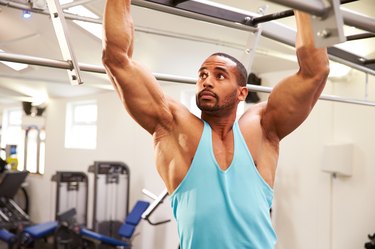
Pullups and chinups build strength in your upper body, especially the lats and biceps. They are both very difficult to start doing but they are excellent ways to train for boxing. Pullups are harder because your arm muscles can't help your back muscles as much in this position. Although both exercises should be part of a well-rounded training plan, pullups will develop more strength in your back than chinups, and that will provide more power in every punch you throw.
Differences
Video of the Day
With both types of exercises, you start off standing on the ground in front of a mounted bar. You grab onto the bar so that your arms are fully extended -- you should be fully stretched out or even hanging. If doing a pullup, your palms face away from you. If doing a chinup, your palms are toward you. Chinups work your biceps more and tend to be slightly easier. Pullups work your back more and tend to be harder.
Video of the Day
Benefits
According to the American Council on Exercise, chinups primarily work the latissimus dorsi, or lats, and biceps. This exercise also works the trapezius, rhomboids, serratus anterior, transverse abdominus and obliques.
Pullups primarily work the lats but also work the trapezius, rhomboids, biceps, serratus anterior, transverse abdominus and obliques. Every one of these muscles is essential in throwing a punch.
Boxing
Boxing is an intense workout and not just about throwing punches: It requires the ability to fight hard for two minutes at a time. It requires speed, agility, power and mental focus. To train properly for any sport, your training program has to mimic the sport itself. For boxing, this means short bouts of intense work and skill practice like sparring with a partner or hitting a heavy bag.
Boxing uses every muscle in the body, but especially the muscles of the trunk. It might seem like the power of a punch comes from the arms, but it actually comes from the accumulated force of your leg taking a step, your abdominals twisting and your shoulder swinging forward. The arm is just the icing on the cake.
The benefit of these exercises is that they work the lats effectively and stabilize the whole shoulder. Pullups isolate the lats better than chinups, but chinups build the strength you need to do a pullup in the first place.
Getting Started
The only way to get better at doing pullups or chinups is to do them. If you can do a single one unassisted, you are way ahead of the majority of adults. If you can't do one yet, there are a few things you can do to make the process easier. Start with chinups, since these are a little easier. If you can't do a chinup, find a low bar that is about 3 or 4 feet off the ground and sit under it. Pull your chest toward the bar, like a normal chinup, but with part of your weight on the floor. You will get stronger with time.
Partnering
If you have a workout buddy or a spotter to work with, you can ask him to help you do negatives, or assisted chinups. In a negative, you bear your weight only on the way down. The spotter helps lift you up and you control the downward phase. You will definitely feel sore the day after you do this. Your spotter can assist you both up and down by holding onto your hips and pushing. Over time, your spotter supports less of your weight until you can do the whole move on your own.