What does fact checked mean?
At Healthfully, we strive to deliver objective content that is accurate and up-to-date. Our team periodically reviews articles in order to ensure content quality. The sources cited below consist of evidence from peer-reviewed journals, prominent medical organizations, academic associations, and government data.
The information contained on this site is for informational purposes only, and should not be used as a substitute for the advice of a professional health care provider. Please check with the appropriate physician regarding health questions and concerns. Although we strive to deliver accurate and up-to-date information, no guarantee to that effect is made.
What Is a Routine Venipuncture?
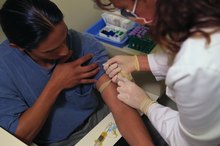
Venipuncture is the technical term used to describe the routine removal of blood from a vein for subsequent laboratory testing 1. You may undergo this procedure as part of the observation or diagnosis of a wide range of medical conditions. The specifics of any given venipuncture can vary based on a doctor’s instructions and the particular type of blood testing required 1.
If you are experiencing serious medical symptoms, seek emergency treatment immediately.
Basics
Health professionals who routinely perform venipunctures are called phlebotomists. They typically begin a venipuncture by identifying an appropriate vein in your body 1. Veins commonly used for this purpose include the veins in the crook of your arm and the small veins on the back of your hand. After identifying the chosen vein, the person drawing blood will clean the overlying skin with an antiseptic wipe. If blood is drawn from the inside of your elbow, an elastic band placed on your upper arm will help fill the target vein with blood.
- Health professionals who routinely perform venipunctures are called phlebotomists.
- If blood is drawn from the inside of your elbow, an elastic band placed on your upper arm will help fill the target vein with blood.
Drawing Blood
Venipuncture Methods
Learn More
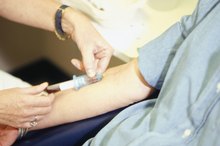
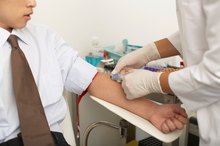
To draw blood during a routine venipuncture, your health care provider will attach a hollow needle to a syringe, vacuum tube or vial, then gently insert the needle through the skin and into the center of the vein 1. Blood drawn from your vein will flow through the needle into the attached receptacle. After obtaining the necessary amount of blood for the tests required, your provider will release the elastic band on your arm, remove the needle and place absorbent material on the puncture site to help stop any residual bleeding.
Lab Testing
After performing the venipuncture, your health care provider will send your labelled blood sample to a laboratory for testing 1. In addition to your personal information and test order form, a color-coded top on most sample vials helps indicate to the laboratory the types of testing your doctor has ordered. After testing has been completed, the laboratory will relay the results to your doctor, who will then interpret the lab’s findings and discuss them with you.
- After performing the venipuncture, your health care provider will send your labelled blood sample to a laboratory for testing 1.
- In addition to your personal information and test order form, a color-coded top on most sample vials helps indicate to the laboratory the types of testing your doctor has ordered.
Considerations
Venipuncture Complications
Learn More
As an alternative to venipuncture, for some tests you may have a small blood sample drawn from your finger by a method called a fingerstick 1. Similarly, If your infant or young child needs to provide a blood sample, his doctor might use a device called a lancet to withdraw blood directly from the skin. Depending on the tests to be performed, your doctor may ask you to fast, modify your medication usage or avoid certain drinks or foods before a venipuncture 1. Potential risks associated with venipuncture include:
- difficulty drawing a sample from your vein
- blood accumulation under your skin called a hematoma
- lightheadedness
- fainting
- excessive bleeding
- rarely infection at the testing site 1
Consult your doctor for more information.
Related Articles
Venipuncture Methods
Learn More

Venipuncture Complications
Learn More
Vacutainer Advantages & Disadvantages
Learn More

What Is a Biometric Screening?
Learn More

How to Improve Blood Circulation in Hands
Learn More
How to Finger Prick to Check Iron Levels
Learn More

How to Discontinue Plavix Before Surgery
Learn More

Common Venipuncture Sites
Learn More
Types of Surgical Staples Used Internally
Learn More
High Liver Enzymes, Fasting and Blood Tests
Learn More
References
Writer Bio
M. Gideon Hoyle is a writer living outside of Houston. Previously, he produced brochures and a wide variety of other materials for a nonprofit educational foundation. He now specializes in topics related to health, exercise and nutrition, publishing for various websites.