
You're rushing out the door in the morning — maybe you grab a granola bar, a cup of coffee or skip breakfast altogether. If that sounds like you, you're not alone. About 25 percent of adults regularly skip breakfast, according to the Center for Science in the Public Interest.
Whatever your reason for missing out on your morning meal — lack of appetite, lack of time or perhaps you're a fan of intermittent fasting and plan to eat later in the day — you may want to rethink your breakfast game plan, especially if you're trying to lose or even manage your weight.
Video of the Day
Video of the Day
A Higher-Calorie Breakfast May Help You Burn More Calories
When we eat significantly affects the thermogenic effect of food — aka the increase in metabolism after eating — according to a February 2020 study in the Journal of Clinical Endocrinology & Metabolism.
This effect, also called diet-induced thermogenesis (DIT), along with your basal metabolic rate (the number of calories your body needs at rest) and your level of physical activity determines how many calories you burn.
In this small clinical trial, researchers broke the subjects into two groups:
- Big-dinner group: Consumed 11 percent of calorie needs at breakfast, 20 percent at lunch and 69 percent at dinner
- Big-breakfast group: Consumed 69 percent of total calorie needs at breakfast, 20 percent at lunch and 11 percent at dinner
The researchers found that the big-breakfast group had a 2.5 times higher DIT compared to the big-dinner group. They also found that the big-dinner group had an increased appetite, specifically for sweets.
Related Reading
Science-Backed Reasons to Eat a Bigger Breakfast
This recent study adds to the growing body of research in support of eating a big breakfast and smaller dinner, especially when it comes to managing your weight.
A March 2013 clinical trial in Obesity looked at how calories are distributed throughout the day and the affect this has on weight over the course of 12 weeks. Researchers in the study fed two groups of women a weight-loss diet of 1,400 calories, but one group of women received 700 calories for breakfast, 500 for lunch, and 200 for dinner, while the other received the reverse. After 12 weeks, the group that consumed more calories earlier in the day lost 2.5 times more weight — 19 pounds versus the 8-pound average weight loss by the group who consumed calories later in the day.
Another small pilot study published August 2018 in Physiology & Behavior concluded eating earlier in the day, according to our circadian rhythm, is beneficial for weight loss. This eight-week study had two groups, consuming two different conditions of calorie distribution throughout the day — 50 percent at breakfast, 30 percent at lunch and 20 percent at dinner versus 20 percent at breakfast, 30 percent at lunch and 50 percent at dinner. The amount of weight loss was significantly greater for the group that consumed more calories earlier in the day, and they were also found to have better sleeping patterns.
Related Reading
The 40/40/20 Big-Breakfast Meal Plan
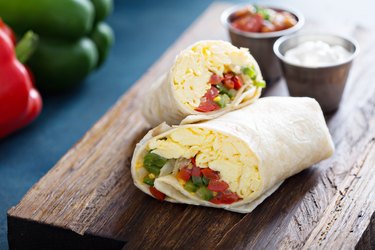
Now that you're convinced breakfast is a must and that you might want to eat a bigger breakfast and smaller dinner, here's a three-day meal plan to help get you started.
The studies mentioned above provided 50 to 70 percent of calories at breakfast and 10 to 20 percent of calories at dinner. This can be a big jump for most people, though, considering we currently eat our largest meals at dinner, then lunch, followed by breakfast, according to the USDA.
To make the change more manageable, this meal plan includes 40 percent of calories at breakfast, 40 percent at lunch and 20 percent at dinner. This plan will help you begin reversing the current trend, and perhaps the way you eat, by consuming a larger breakfast and smaller dinner.
Day One
Breakfast
- Spicy Breakfast Burrito
- 1 medium orange
- 1 small unsweetened soymilk latte
Lunch
- Shirataki Noodle and Tofu Bowl
- 15 baby carrots with 2 tablespoons hummus
- 1 small apple
Dinner
Total Calories: 1,596
Day Two
Breakfast
- Swiss Chard, Squash and Sausage Breakfast Superfood Bowl
- 1 medium banana
- 1 small unsweetened soymilk latte
Lunch
- Chicken Salad Pizza
- Arugula and Cherry Tomato Salad
- 1 medium apple
Dinner
Total Calories: 1,603
Day 3
Breakfast
- Make-Ahead Vegetarian Breakfast Salad with Eggs
- Everyday Green Smoothie
- 1 cup raspberries
Lunch
- Greens and Beans Tacos
- ¼ cup almonds
Dinner
Total Calories: 1,662
- Center for Science in the Public Interest: "To Skip or Not to Skip Breakfast: That Is the Question"
- Journal of Clinical Endocrinology & Metabolism: "Twice as High Diet-Induced Thermogenesis After Breakfast vs Dinner On High-Calorie as Well as Low-Calorie Meals"
- Obesity: "High Caloric Intake at Breakfast vs. Dinner Differentially Influences Weight Loss of Overweight and Obese Women"
- Physiology & Behavior: "Daily Pattern of Energy Distribution and Weight Loss"
- USDA: "Frequency and Time of Day That Americans Eat: A Comparison of Data From the American Time Use Survey and the National Health and Nutrition Examination Survey"