
What does fact checked mean?
At SportsRec, we strive to deliver objective content that is accurate and up-to-date. Our team periodically reviews articles in order to ensure content quality. The sources cited below consist of evidence from peer-reviewed journals, prominent medical organizations, academic associations, and government data.
- Harvard Health Publishing: The Health Benefits of Tai Chi
- Harvard Health Letter: Best Exercise for Balance
- ACE: What Exactly is Tai Chi
The information contained on this site is for informational purposes only, and should not be used as a substitute for the advice of a professional health care provider. Please check with the appropriate physician regarding health questions and concerns. Although we strive to deliver accurate and up-to-date information, no guarantee to that effect is made.
The 8 Best Tai Chi Movements for Health
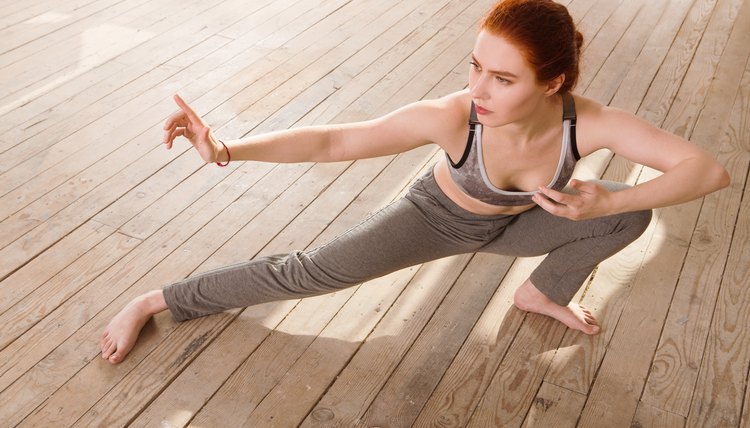
Tai chi is an ancient form of movement that holds a lot of promise for good health. Developed in the 14th century AD in China as a martial art, it consists of lengthy, complex movements designed to circulate your energy. Regularly participating in tai chi has positive effects on your bone density, fall risk, quality of life, mental health, immune function and heart health, showed a review of the research published in The American Journal of Health Promotion.
Tai chi requires regular practice, daily if possible, for the most benefit. Honing in on just eight moves that are best is almost impossible. However, consider the following basic moves and forms as you practice and how they are truly changing your body for the better.
1. Beginner Posture
The beginner posture is, as the name suggests, the first move you should master. It helps you develop good posture in tai chi, which translates to real life. That means a stronger back and core.
HOW TO DO IT: Stand with your feet shoulder-distance apart. Pigeon your toes slightly toward one another and soften your knees. Round your back slightly and gently tuck your hips. The position feels as if you're about to sit onto a bar stool.
2. One-leg Balance
Perhaps the most valuable health benefit of tai chi is it's ability to improve balance. For older adults, this is life altering as it decreases the risk of falls, which can cause debilitating broken bones. The one-leg balance develops leg strength that helps keep practitioners upright. In tai chi, you slowly transfer this balance from one leg to the other in a fluid movement that also improves reflexes.
HOW TO DO IT: Stand with your feet stacked under your hips. If you're balance is shaky, hold the edge of a chair or counter. Slowly lift one leg so the thigh is parallel to the floor and the knee bent. Hold for 30 seconds, then slowly shift your weight to the other leg. Work your way up to 1-minute holds.
3. Horse
Horse is another basic stance in tai chi. It looks a lot like a squat, building leg strength as well as back strength. You create a strong foundation for your body, improving your overall daily function.
HOW TO DO IT: Stand with your feet wider than your hips and bend your knees to squat as low as your knees allow. Keep your spine perpendicular to the floor. Gently firm through your pelvic floor as you squat deeper to support the posture and build additional strength.
4. Brush Knee
Tai chi offers the health benefit of improved flexibility and greater range of motion in the arms and shoulders. It combats the stiffness that can make it hard to raise your arms overhead as you age. Brush knee is an example of a movement that helps with this benefit.
HOW TO DO IT: Stand with your feet approximately hip-distance apart and center your weight. Hold your arms out to the sides of the room. Turn the right palm toward the sky as you raise the arm up. Simultaneously turn the left palm face down as you float the arm downward. You fluidly step forward, turn your torso and change the arm positions in a rolling motion.
5. Raising Power
Tai chi provides psychological benefits in terms of centering your mind and enhancing concentration. Raising Power encourages you to focus on the energy of your body. It's often used as an opening or closing to a series of forms.
HOW TO DO IT: Stand in the basic starting position. Rub your hands together and then pull them apart slowly. Gradually draw them toward one another again, but pause before they actually touch. Focus to feel the energy generated between your hands as you repeat.
Tai chi has the potential to improve cardiovascular fitness, especially in seniors who were previously sedentary. It can have the same benefits as a regular walking habit when practiced consistently. Basic stepping creates the movement of tai chi that's essential to the cardio benefits. Plus, the weight shift involved in the movement further enhances balance and proprioception.
HOW TO DO IT: Stand with one foot slightly in front of the other. Maintain a low center of gravity, then step and roll your entire foot from the heel to the ball. The stepping movement may go forward, sideways or backwards, depending on the form being practiced.
7. Single Whip
The single whip offers arm strengthening benefits and enhances circulation to the fingers. This offers health benefits if you have arthritis, carpal tunnel syndrome, tennis elbow or other connective tissue injuries in the arms and hands.
HOW TO DO IT: Form a beak hand by placing the hand, palm face downward, and curling the four fingers softly toward the thumb. Extend one leg forward and face to the side as the beak hand and arm move forward and the wrist bends up and down as your open and close your fingers.
8. White Crane Spreads Wings
White crane spreads wings is a quintessential tai chi form that hones balance as you shift your weight from one side to the next. The unified movement of the form requires concentration and enhances the mental benefits provided by tai chi.
HOW TO DO IT: Stand in the beginning posture. Step forward onto your right foot and turn your waist slightly to the right. Raise your right hand, with the palm facing the body. Simultaneously press your left hand toward the floor as you peel the left foot off the floor. Sweep the left arm and hand around your abdomen as you move the left foot toward the side wall. Finish the form by turning completely to the side, with your right hand just above your head and let the left hand float toward your thigh.
Explore In Depth
References
Writer Bio
Andrea Boldt has been in the fitness industry for more than 20 years. A personal trainer, run coach, group fitness instructor and master yoga teacher, she also holds certifications in holistic and fitness nutrition.