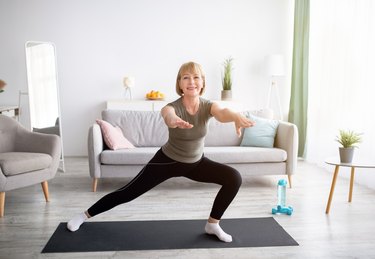
When you have achy, sore knees, working out is probably the last thing you want to do. But generally speaking, exercising bad knees can actually help them feel better.
"While you might not feel like exercising when you have knee pain, moving your knee can promote circulation and blood flow," Melissa Prestipino, DPT, clinical director of an outpatient clinic in Sparta, New Jersey, tells LIVESTRONG.com. Yep, strength training for knee pain is key.
Video of the Day
The best exercises for knee pain have two important things in common: They strengthen the muscles that surround your knee, and put little-to-no impact on the joint.
Focusing on moves that bolster the surrounding muscles — specifically, the quads — will make sure your knee gets the support it needs and that it doesn't take on too much strain itself when you exercise or go about your daily movements.
"Strengthening your quadriceps after knee injury can help to promote increased joint stability and help to improve joint function and even decrease knee pain," she says. It's common to be prescribed quad exercises after knee injury, but anyone with problem knees should be doing them, too.
Other than the quads, the hamstrings, glutes and other small muscles in the hips and upper leg all play a role in keeping your knees happy.
To help you get started, here are the 18 best exercises for sore knees from Prestipino to add to your workout routine.
Warning
If you're experiencing knee pain, the number-one thing to watch for is increased discomfort during exercise. In general, if you're doing a workout for bad knees, your pain level shouldn't increase by more than 2 points on a scale from 1 to 10 during or after any given exercise.
If you feel any pain while strength training for bad knees — either during or immediately after exercise — it's best to cut that move from your routine or do a different variation so that it no longer causes pain, says Adam Rivadeneyra, MD, a sports medicine specialist with the Hoag Orthopedic Institute in Irvine, California.
If any exercise causes swelling or pain that lasts for more than two days, talk to a physical therapist or a physician with experience in sports medicine or orthopedics. It’s never a bad idea to play it safe and talk to a specialist if your knee issues are nagging or ongoing.
Move 1: Straight-Leg Raise
"Straight leg raises help to strengthen your quadriceps muscles, which are the main muscles supporting the knee joint," Prestipino says. "The quadriceps muscles' action is to flex your hip and to extend your knee."
You use your quads doing most everyday activities, like walking, squatting and even simply standing. In general, doing any quad exercise for knees can really help ease the pain.
- Lie flat on your back. Bend one of your knees at a 90-degree angle so that your foot is flat on the floor and extend your other leg.
- Lift the extended leg until it reaches the height of your bent knee.
- Slowly lower your leg back down to the floor.
Tips:
- Keep your quads contracted throughout the entire movement. This helps maintain the knee in an extended position so that you get the most muscle-strengthening benefits out of the move.
Modifications:
- If you have a difficult time lifting your leg against gravity, use a stretch/yoga strap to help assist the motion.
Move 2: Standing Hamstrings Curl
The hamstring muscles do just the opposite of the quads: They help to extend your hip and to flex your knee.
"Increasing hamstring strength can help to promote increased stability around your knee joint, which can help you avoid injury and limit pain," she says.
- Stand with your feet close together in front of a bar or countertop that you can lightly hold onto for support.
- Bend one knee to curl the leg backward until your knee forms a 90-degree angle, or as close to it as your range of motion allows. Keep your knees in line with each other.
- Hold this contraction for a second or two.
- Straighten your knee to lower the foot back to the floor.
- Switch sides.
Tips:
- Keep your core engaged the entire time so that your spine stays neutral. That means your lower back doesn’t arch, and your pelvis stays stationary the entire time.
Modifications:
- You can also perform the hamstring curl in a side-lying or prone (on your stomach) position.
Move 3: Clamshell
Clamshells are great for strengthening your glute medius and glute minimus, also known as the "side butt" muscles.
"When your glutes are weak, your thigh tends to rotate inward," Prestipino says. "This is an abnormal position that puts a lot of stress on the knee, increasing the risk of injuries. Strengthening your glutes normalizes hip and thigh position, reduces the loading force on the knee joint and prevents the knees from caving in on each other when landing."
- Lie on one side. Stack your legs on top of one another, knees and hips bent at 90 degrees.
- Press your bottom leg into the floor and, with your heels pressed together, squeeze your glutes to raise your top knee toward the ceiling.
- Raise your knee as high as you can without letting your pelvis rock forward or backward.
- Pause, then slowly lower back to the starting position.
Tips:
- Keep your core engaged and tuck your tailbone to make sure your lower back doesn't end up over-arched in this position.
Modifications:
- To make this more challenging, loop a mini resistance band above your knees.
Move 4: Wall Sit
Wall sits, also known as wall squats, build strength and endurance in your glutes, calves, quads and even your abdominals, she says. All those muscles play a role in keeping the knees stable and strong.
Plus, because this is an isometric exercise in which you hold a single position, it tends to be comfortable on even the crankiest of knees.
- Stand with your back pressed firmly against a wall and your feet hip-width apart and a foot or two in front of you.
- Keeping your back pressed into the wall, slide down and bend your knees until your thighs are parallel to the floor. Your ankles should be directly under, or in front of, your knees. Place your hands on your lap or in front of your chest. (Don't cheat by pressing your arms into the wall.)
- Tighten your core and press your lower back into the wall. Hold this seated position for a few seconds, then, slide up the wall to stand back up. Repeat.
Tips:
- Keep your toes, knees and hips pointed forward.
Modifications:
- To make the move easier or reduce pressure on your knees, don’t lower down as far.
- Place a stability ball in between your back and the wall.
Move 5: Seated Heel Slide
The focus here is the hamstring muscles. "Strengthening the posterior muscles of the lower extremities helps to balance out the anterior quad muscles, which can better help protect the knee from injury, such as ACL tears," Prestipino says.
The sliding movement also helps to increase circulation in the knee, she adds, which might help with inflammatory conditions like arthritis in the knees.
- Sit in a chair with your knees bent and feet flat on the floor. Place a towel or slider under one foot.
- Press into the slider and slide your foot forward as far as you can without moving your hips.
- Press into the slider and slide your foot back.
Tips:
- Don’t sit too far back in the chair, as it will limit how far you can slide your foot against the floor.
- Avoid sliding your foot too far backward, as this can put increased tension on the knee.
Modifications:
- Reduce the range of motion if the full range aggravates your knee.
- You can also do this lying on your back instead if that feels more comfortable for you.
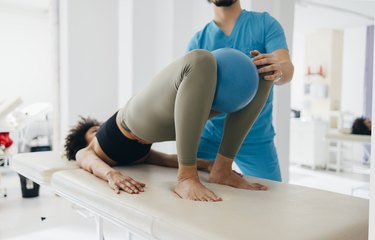
Move 6: Bridge With Ball
"Adding the ball to the glute bridges recruits your hip adductors [inner thigh muscles] and your hip extensors [glutes and hamstrings], mainly your gluteal muscles," she says. Stabilizing and strengthening these areas helps to protect your knees.
- Lie on your back with your arms at your sides, feet flat on the ground and knees bent. Place a Pilates ball in between your knees and squeeze enough to keep it from falling.
- On an exhale, squeeze your glutes, press into your heels and drive your hips up toward the sky.
- Raise your hips until you form a diagonal line from your knees to your hips to your chest.
- Pause here for a moment.
- Reverse the motion and return to the starting position.
Tips:
- Avoid hyperextending your spine in the bridge position. Instead, only lift your glutes until your low back is flat, stopping before it arches.
Modifications:
- Skip the bridge motion and do ball squeezes isometrically instead.
- You can also use a pillow if you don't have a ball.
Move 7: Standing Terminal Knee Extension With Resistance Band
Another great quad exercise for painful knees, this exercise helps to increase quadriceps muscle strength, which ultimately supports the knee and helps decrease pain.
- Wrap a resistance band around an anchor. Walk far enough away from it so that there’s very little slack left in the band. Facing the anchor, wrap the other end of the band around one knee.
- Bend that knee, moving in a slow and controlled way so that you don’t just give into the pull of the band but rather control the resistance fully with your knee.
- Straighten your knee again.
Tips:
- “Avoid hyperextending the knee when pulling it into the extended position,” she says.
- Don't let you hips rock or your heels raise off the floor.
Modifications:
- If this is too challenging, ditch the resistance band and instead, focus on tightening the quad isometrically.
Move 8: Reverse Lunge
Reverse lunges are great knee pain exercises because they strengthen both your quadriceps and glutes. If you have knee pain, reverse lunges are better than forward lunges because they put less forward stress on the knee. Most people also find it easier to maintain stability in the front leg doing reverse lunges vs. forward lunges.
"Keep both feet pointed straight ahead and keep the front foot planted firmly so the heel is down on the ground," Prestipino says. Keep your back straight and neck in a comfortable, neutral position looking straight ahead.
- Stand with your feet about hip-width apart with your arms at your sides.
- Step with your right leg 3 feet behind you and bend your knees until they form 90-degree angles. Your back knee should hover an inch above the ground and your front thigh should be parallel to the ground.
- Keep most of your weight in your front leg as you press into your left heel and straighten your left leg.
- Bring your right leg back to the starting position and stand up.
Tips:
- “Keep both feet pointed straight ahead and keep the front foot planted firmly so the heel is down on the ground,” she says.
- Keep your back straight and neck in a comfortable, neutral position looking straight ahead.
- If you need to, hold onto a counter or railing for support.
Modifications:
- If a full range of motion feels uncomfortable, don't bend as deeply. Stop before the point where you start to feel discomfort.
- Keep the back leg straight and only bend the front knee.
Move 9: Hip Adduction With Ball
The goal here is to strengthen your hip adductor muscles. "By keeping the hip muscles strong, it prevents improper positioning of the knees, which avoids necessary strain," Prestipino says.
- Lie on your back with your arms at your sides, feet flat on the ground and knees bent. Place a Pilates ball in between your knees.
- Use your inner thighs to squeeze in on the ball as much as you can.
- Slowly release, but make sure to keep the ball from falling out.
Tips:
- Avoid placing your feet too close to your butt, as this can cause unnecessary strain on the knees. Your feet should be far enough away that you can’t touch them if you extend your arms, but close enough that you can just tap them with your fingertips if you reach and shift slightly to one side.
Modifications:
- Instead of bending your knees, extend your legs straight and perform the same exercise.
Move 10: Supine Heel Slide
This is another one that helps strengthen those hammies and promotes blood flow in the knees.
- Lie flat on your back. Bend one of your knees at a 90-degree angle so that your foot is flat on the floor and extend your other leg.
- Place a slider underneath the foot of your extended leg, then bring it in, bending your knee so that it comes in next to the other knee.
- Pause for a second, and then slowly slide your leg back out, keeping the toes flexed.
- Switch sides and continue to alternate.
Tips:
- Avoid sliding your feet too far backward, which will place unnecessary strain on the knees, she says.
Modifications:
- Shorten the range of motion and stop when you start to feel pressure.
Move 11: Quad Set
"Quad sets help to isometrically strengthen your quadricep muscle," Prestipino says. "The quad muscles are needed in sitting, standing, squatting and running. Strengthening your quads helps to support the knee joint, helping to decrease pain."
- Lie flat on your back. Bend one of your knees at a 90-degree angle so that your foot is flat on the floor and extend your other leg, flexing your toes. Place a small folded-up towel under the knee of your extended leg.
- Squeeze the muscles in your extended leg so that it fully straightens and your quad muscle is fully engaged.
- Hold this contraction for three seconds, and then relax the leg again.
Tips:
- Keep your quad muscles completely engaged during the full count.
Modifications:
- "Use a thicker towel to lessen the range of motion between the knee and the bed/floor," she says.
Move 12: Lateral Lunge
Side lunges strengthen lots of muscles in your lower body, including your glutes, hamstrings, quads and inner thigh muscles. They even work your core.
"The side-to-side move puts less strain on the cruciate ligaments — part of your knees known to experience pain," Prestipino says.
- Stand with your feet together and hands at your sides.
- Take a large step out to the right, sinking your hips back and bending your right knee (it should align directly with your right ankle).
- Keep your left leg straight (but don't lock your knee), making sure both feet are parallel to each other and pointing forward. Maintain a neutral spine with your chest lifted.
- Push off your right foot and straighten your right leg as you return to standing.
Tips:
- Step out with your moving foot as wide as possible, and keep both feet completely flat on the ground, toes pointed straight forward, Prestipino says.
- Make sure your moving knee is over your foot, not caving in toward the midline of your body or bowing out to the outside.
Modifications:
- Don't bend the knee as deeply.
- "Instead of stepping into a lunge, you can use a paper plate or a slider to move away from the body," she says.
Move 13: Side-Lying Hip Abduction
This move focuses on strengthening the muscles of the outer thigh and hip, which will help to keep the knees in a more neutral position, Prestipino says.
- Lie on one side with your hips stacked directly on top of each other. Bend the bottom knee.
- Keeping your toes flexed, lift your top leg up toward the ceiling as far as possible, focusing on lifting with the outer hip muscles.
- Slowly lower your leg back down.
Tips:
- Keep your hips stacked and avoid lifting the top leg above a 45-degree angle.
Modifications:
- Lie on your back, legs extended. Slide the leg away from the body in a "snow angel" motion.
Move 14: Short Arc Quads
Unlike some other more traditional quad-strengthening moves, this exercise gets the job done without putting any weight on the knee joint, Prestipino says.
- Lie on your back with a bolster, rolled-up towel or foam roller underneath both knees. Keep your lower back pressed into the floor.
- Squeeze your quad muscles in one leg so that the leg gets rigid and the knee completely straightens.
- Hold the contraction for a few seconds before relaxing the leg again.
Tips:
- Avoid lifting your leg off the bolster, towel or foam roller — that will get into the hip joint instead of focusing on the muscles surrounding your knee joint.
Modifications:
- Use a smaller bolster or fold a pillow or towel under the knees to reduce the range of motion of the leg, she says.
Move 15: Standing Hip Abduction With Resistance Band
This move targets your hip abductor muscles. "There is a big relationship between hip strength and knee position," Prestipino says. "By strengthening your hips, it can help avoid poor positioning of your knees and reduce strain."
- Wrap a resistance band around an anchor. Walk far enough away from it that there’s very little slack left in the band. Stand with the anchor to your left, and wrap the other end of the band around your right ankle.
- Without letting the band control the movement, slowly lift your right leg out to the side and away from the midline of your body.
- Pull against the band to bring your leg back next to the other.
Tips:
- Keep your core engaged throughout the entire exercise to avoid straining your lower back.
Modifications:
- If the band puts some side-to-side stress on your knee, try looping the band higher up your leg.
- Ditch the resistance band and do the movement without any added resistance.
Move 16: Standing Hip Adduction With Resistance Band
This move complements the previous one, this time strengthening your hip adductor muscles, or the glute muscles on the outside of the hip.
- Wrap a resistance band around an anchor. Walk far enough away from it that there’s very little slack left in the band. Stand with the anchor to your right, and wrap the other end of the band around your right ankle.
- Without letting the band control the movement, slowly lift your right leg out to the side and away from the midline of your body.
- Pull against the band to bring your leg back next to the other.
Tips:
- You can also use a mini band to do this move. Simply loop it around both ankles.
Modifications:
- Hold onto a bar or countertop for support, and lift the leg out to the side, using the stationary leg as your anchor.
- If the band puts some side-to-side stress on your knee, try looping the band higher up your leg.
- Ditch the resistance band and do the movement without any added resistance.
Move 17: Standing Hip Flexion With Resistance Band
This move helps to strengthen the hip flexors, which are the muscles in the front of the hips that connect the pelvis and the leg. Strengthening these muscles can help promote proper positioning of the hips and knees.
- Wrap a resistance band around an anchor. Walk far enough away from it that there’s very little slack left in the band. Stand with the anchor to your back, and wrap the other end of the band around your right ankle.
- Without letting the band control the movement, slowly lift your right leg forward, keeping your knee straight.
- With control, bring your leg back next to the other.
Tips:
- This one can also be done with a looped mini band around your ankles.
Modifications:
- If the band puts some side-to-side stress on your knee, try looping the band higher up your leg.
- Ditch the resistance band and do the movement without any added resistance.
Move 18: Standing Hip Extension With Resistance Band
The glutes and hamstrings are the main hip extensor muscles, connecting the hips and the legs at the back of the body. You use these muscles when you extend your leg behind you.
- Wrap a resistance band around an anchor. Walk far enough away from it so that there’s very little slack left in the band. Stand facing the anchor, and wrap the other end of the band around your right ankle.
- Slowly lift your right leg backward, keeping your knee straight.
- With control, bring your leg back next to the other.
Tips:
- You can do this exercise with a mini band, too.
Modifications:
- If the band puts some stress on your knee, try looping the band higher up your leg.
- Ditch the resistance band and do the movement without any added resistance.
How to Exercise With Bad Knees
That said, if you get the green light from your doctor or physical therapist to start working out again, you can focus on exercises for bad knees.
Choosing low-impact forms of exercise can help reduce the forces of your own body weight and gravity on your knee joints, Prestipino says. Using softer surfaces, such as cushioned flooring can also help to decrease unnecessary stressors on your knee.
When selecting lower-body exercises, "closed-chain" ones in which your feet are firmly planted on the floor keep your knee in a more stable position, Dr. Rivadeneyra says.
"These movements will lead to greater quality of movement that will take the stress off the knee, decrease inflammation within the joint and shuttle healing blood to the area to speed the recovery process," says Andy Coggan, CPT, a certified personal trainer and corrective exercise specialist with Gold's Gym in College Station, Texas.
Tip
You can also largely reduce stress on your knee during lower-body exercises by limiting how much you allow your knee to bend, like capping any knee flexion at 90 or even 45 degrees.
Keeping your weight balanced in the heel of your foot will also transfer excess weight to your hips and core and off your knees.
Additional reporting by Rachel Grice.
Is this an emergency? If you are experiencing serious medical symptoms, please see the National Library of Medicine’s list of signs you need emergency medical attention or call 911.