
5 Main Rules of Fencing
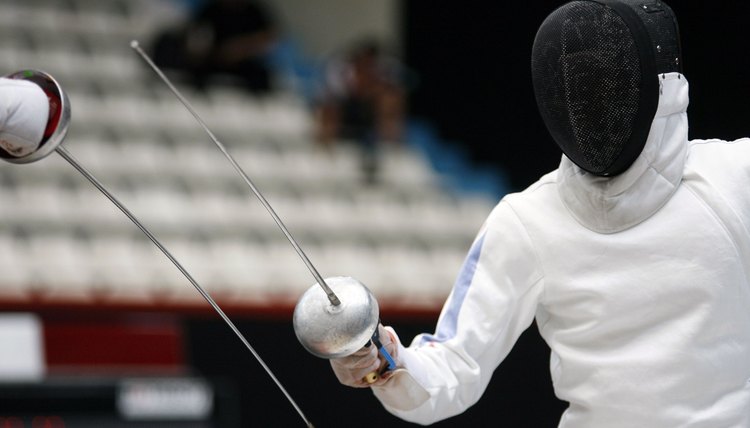
Fencing, a unique combative sport that is part of the Summer Olympics, pits two sword-wielding competitors against one another in a contest of skill and athleticism. Each fencer attempts to touch the other with the tip of his sword to score touches, or points. All fencing competitions must follow a few basic rules to ensure not only competitive balance but also the safety of all participants.
Equipment
Fencing competitors must wear the necessary proper equipment, including a face mask, a fencing jacket, a pair of fencing pants to protect the legs and a fencing glove that covers the sleeve on the sword arm. Officials will check participants before each bout to make certain the equipment reaches all safety standards. Fencers must also wield approved weapons, whether a foil, saber or epee.
Scoring
Fencing utilizes a simple scoring system, awarding one point for each time a fencer touches his opponent with his weapon. Depending on the manner of competition, bouts may last five touches with a time limit of three minutes or 15 touches and a time limit of nine minutes, according to the rules of the U.S. Fencing Association.
Target
A fencer must touch his opponent in an approved target zone of the body to register a point, with the target changing depending on the weapon used. In epee fencing, contacting anywhere on the opponent’s body registers a touch. Sabre fencing limits the target zone to the torso, meaning anywhere above the waist. Foil fencing reduces it even further, restricting the target area to the trunk only and removing the arms and head from consideration.
Playing Area
Fencers compete on a long, narrow strip of material and must remain on the fencing strip at all times. The strip, or piste, must be 46 feet long and measure between 5 and roughly 7 feet wide. The strip contains a center line, two on-guard lines roughly 6 feet from the center line and two lines marking the rear limits of the strip roughly 23 feet from the center line.
Penalties
If a fencer steps beyond the strip’s legal side boundaries, the official will award 1 meter, or approximately 3 feet, of ground to the opponent on the restart. Stepping beyond the strip’s rear limit results in an awarded touch to the opponent. Officials may also award touches to the opponent if a fencer attacks with both hands, if a fencer doesn’t obey instructions or if a fencer displays poor sportsmanship or overly violent behavior.
References
Writer Bio
William Lynch has been a freelance writer for the past fifteen years, working for various web sites and publications. He is currently enrolled in a Master of Arts program in writing popular fiction at Seton Hill University. He hopes to one day become a mystery novelist.