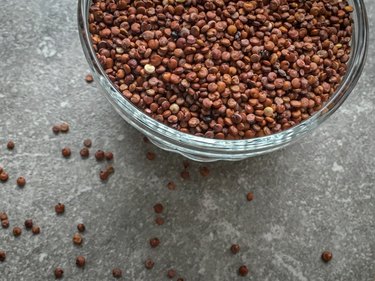
Although many types of quinoa exist in the Andes where it originates, only a few types are available on grocery store shelves, including red, white and black quinoa. White and red quinoa are very similar in nutritional value, but red quinoa may have an edge due to its antioxidant capacity.
What Is Quinoa?
Video of the Day
Quinoa has been eaten for thousands of years by Andean indigenous cultures, but it's only recently become popular in the West. Now, many people interested in eating healthier have their eye on this nutritional powerhouse. In 2013, the United Nations Headquarters declared the "International Year of Quinoa" due to its potential role in ending hunger, malnutrition and poverty.
Video of the Day
Quinoa is categorized as a grain, but it's actually the fruit of a plant in the Amaranthaceae family, and a close cousin to amaranth, beets and tumbleweed. It's often referred to as a pseudo-grain, because it's eaten in the same way as a grain. The quinoa plant also has edible leaves, although they are not widely available to consumers.
According to an article published in Comprehensive Reviews in Food Science and Food Safety in July 2016, red and white quinoa nutrition surpasses that of most cereal grains. In addition to its macronutrients and micronutrients, quinoa is also rich in naturally occurring plant chemicals that offer additional benefits to human health.
Calories and Protein in Quinoa
Red and white (sometimes off-white or yellow in color) have nearly identical macronutrient profiles. Both types of quinoa have the same amount of calories as white and brown rice — around 105 per ounce, dry. However, they both have a higher nutrient density than rice.
Quinoa is known for its protein content, with approximately 4 grams per ounce. It is also unique, because it's one of the few plant foods offering a complete amino acid profile. Amino acids are the basic units of protein. Your body metabolizes protein into its constituent amino acids, and uses them to build proteins in the body that support muscles, bones and teeth and act as chemical messengers, enzymes and antibodies.
There are 20 amino acids in total, nine of which are considered "essential," according to the U.S. National Library of Medicine. You must get these essential amino acids from your diet, while your body can make non-essential amino acids itself.
Typically, plant foods are "incomplete" protein sources because they are either low in or missing one or more of the essential amino acids. Although this does not necessarily make them poor protein sources, it means that you must eat a variety of plant foods, or include animal proteins in your diet, in order to get everything you need. If you regularly include white or red quinoa in your diet, your bases are covered.
Read more: 5 Tips for Eating Protein the Right Way
Carbohydrate and Fat Content
As far as grains go, red and white quinoa are relatively low in carbohydrates, with about 18 grams per ounce, dry. Of those 18 grams, 2 grams come from dietary fiber, or roughage, which is the indigestible parts of plant cell walls that can't be digested by the human body. Although dietary fiber doesn't offer any nutrients, it's important to good health for several reasons:
- Fiber slows digestion and adds bulk to stool, which helps it pass more easily and prevents constipation;
- It helps maintain bowel health, potentially preventing colon cancer and other diseases affecting the colon;
- Fiber lowers cholesterol levels by carrying some of the bad cholesterol out of the body in waste;
- It helps control blood sugar by slowing the absorption of glucose into the bloodstream;
- It leads to greater feelings of satiety, thus aiding weight loss and weight maintenance.
Red and white quinoa also provide small amounts of fat — approximately 1.75 grams per dry ounce. Most of this fat content comes from polyunsaturated and monounsaturated fats. In moderation, these types of fats can have health benefits, helping to lower bad cholesterol and blood pressure and potentially prevent heart disease and stroke.
White and Red Quinoa Micronutrients
Like other grains, white and red quinoa boast a range of vitamins and minerals. Both are particularly good sources of the following:
Folate, a B vitamin necessary for the creation of red blood cells that carry fresh oxygen throughout the body. Folate is an especially important vitamin for pregnant women and those who plan to become pregnant, as adequate amounts can prevent birth defects.
Thiamin, a B vitamin that plays an important role in energy metabolism and healthy cell growth, development and functioning.
Vitamin B6, another B vitamin involved in over 100 enzymatic reactions, primarily those related to protein metabolism. B6 also plays a role in cognitive development, immune function and the creation of red blood cells.
Iron, a mineral required for making red blood cells, muscle metabolism and connective tissue integrity, neurological development, physical growth, cell function and hormone synthesis.
Manganese, a mineral involved in the metabolism of carbohydrate, amino acid, cholesterol and glucose. Manganese also supports the formation of bones, reproduction and immune function, and fights free radicals that contribute to disease development.
Copper, a mineral involved in the production of energy, metabolism of iron and the synthesis of connective tissue and neurotransmitters.
Magnesium, a mineral required for the synthesis of genetic material and protein, the structural development of bone, and the production of energy. Magnesium also helps control blood pressure and blood glucose and transports calcium and potassium across cell membranes, which is crucial for regulating heart rhythm, nerve impulse conduction and muscle contraction.
Read more: 13 Powerful Grains and Seeds
Antioxidant Activity of Quinoa
All plants have naturally occurring compounds called phytonutrients, or phytochemicals. Many of these act as antioxidants, which have been shown to fight oxidative stress and the creation of free radicals that can damage cells and contribute to the development of disease, including cancer.
Quinoa contains a variety of these chemical compounds, including phenols and flavonoids. According to a study in Food Chemistry in January 2015, red, white and black types of quinoa contain more than 23 different phenolic compounds. However, among the three colors, red and black quinoa have more robust phenolic and antioxidant profiles than white quinoa. This is due to their deeper color, a product of a type of plant pigment called betacyanin, a powerful antioxidant that gives many red and purple plants their hues.
A study published in August 2012 in Food and Nutrition Sciences tested the phenolic content of red and yellow quinoa seeds and found that red quinoa had significantly higher levels than yellow quinoa. Because of this, the researchers concluded that red quinoa could be a powerful functional food and contribute significantly to the management and prevention of diseases related to free radical damage.
- Oldways Whole Grains Council: "Types of Quinoa"
- OSU Extension: "Discovering the Ancient Grain Quinoa"
- Quinoa 2013 International Year: "The International Year of Quinoa"
- USDA: "Basic Report: 20450, Rice, White, Medium-Grain, Raw, Unenriched"
- USDA: "Basic Report: 20036, Rice, brown, long-grain, raw (Includes foods for USDA's Food Distribution Program)"
- Harvard T.H. Chan: "Quinoa"
- Genetics Home Reference: "What Are Proteins and What Do They Do?"
- UMass: "Incomplete Proteins"
- MedlinePlus: "Amino Acids"
- Mayo Clinic: "Dietary Fiber: Essential for a Healthy Diet"
- Harvard Health Publishing: "The Truth About Fats: The Good, the Bad, and the In-Between"
- NIH: "Folate"
- NIH: "Thiamin"
- NIH: "Vitamin B6"
- NIH: "Iron"
- NIH: "Manganese"
- NIH: "Copper"
- NIH: "Magnesium"
- NIH: "Antioxidants and Cancer Prevention"
- Food Chemistry: "Characterisation of Phenolics, Betanins and Antioxidant Activities in Seeds of Three Chenopodium Quinoa Willd. Genotypes."
- Food and Nutrition Sciences: "Total Phenolic Content and Antioxidant Activity of Red and Yellow Quinoa (Chenopodium quinoa Willd.) Seeds as Affected by Baking and Cooking Conditions"
- USDA: "Basic Report: 20137, Quinoa, Cooked"
- USDA: "Full Report (All Nutrients): 45344310, Red Quinoa, Upc: 085239349175"
- Comprehensive Reviews in Food Science and Food Safety: "Innovations in Health Value and Functional Food Development of Quinoa (Chenopodium quinoa Willd.)"