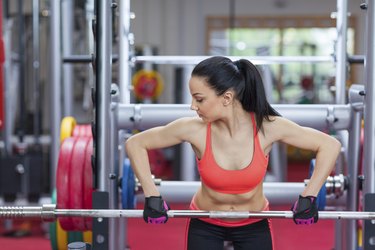
The barbell is easily one of the most popular resistance training devices. The various competitive and commercial uses for the barbell necessitate that barbells be compatible with weights and equipment from different manufacturers. To accommodate the large number of companies that produce equipment, most barbells produced today adhere to standard weights, sizes and shapes.
History
Video of the Day
In the 19th century, before barbells used adjustable plates, weights such as dumbbells, barbells and kettlebells tended to feature hollow orbs which could be loaded with sand or shot. As the fitness movement gained popularity, the more user friendly plate-loaded barbells became the norm. Today, almost all commercially produced barbells are standard, so that any brand of weight may be used with any brand of barbell.
Video of the Day
Olympic Barbell
The Olympic barbell is the standard to which all other barbells try to measure up. At seven feet long, the bar itself is 28 millimeters in diameter and the sleeves that the weights slide onto are 50 millimeters in diameter. The standard weight for an Olympic barbell is 45 pounds. To improve grip, a barbell has knurling over the sections that are to be gripped. Even a cheap Olympic barbell will easily support over 200 pounds of weight, whereas a standard barbell will start to bend.
Other Barbells
Numerous types of barbells are available, each of which are suited for different purposes, while still maintaining the standard dimensions. A weightlifting bar designed for the sport of Olympic weightlifting is made of flexible steel, to provide a whipping effect during explosive lifts. A powerlifting bar used in competitive powerlifting is stiff, providing stability with maximal weights. Designed for international competition, competition barbells are often weighted in kilos rather than pounds. The typical barbells found in most commercial gyms are designed economically, with lower grade steel to lower equipment costs. These non-Olympic standard barbells measure one inch at the end, but can be outfitted with adapters to take the larger-holed Olympic plates.
Benefits
The standard sizing of barbells allows them to be used in multiple settings, without the need for specialized plates. Compatibility is also important for other pieces of gym equipment such as racks, benches and lifting platforms. Standard sizing also allows a single, well cared for barbell to give its owner years of steady use, even while equipment around it is upgraded.
Warning
No matter how well made, the barbell a serious piece of equipment that can be dangerous if used improperly. If you are inexperienced with weight training, do not use a barbell without the supervision of a fitness professional.