We know, we know: Fiber isn't exactly the sexiest topic. But getting the right amount of the gut-friendly roughage in your diet has a ton of health benefits, from improved gastrointestinal (or GI) function to weight loss. Before you dive headfirst into a high-fiber diet, though, it's important to understand what fiber actually is, and how to add it to your plate for optimal results.
"The definition of dietary fiber quite literally is the indigestible component of a plant food," Leah Silberman, RDN, dietitian and founder of the New York City private practice Tovita Nutrition, tells LIVESTRONG.com.
Video of the Day
Video of the Day
Unlike other nutrients such as protein or fat, fiber — which is found in carbohydrates — does not get absorbed by the body. Below, we'll explain why that's actually a good thing, both for losing weight and keeping your system in tip-top shape.
Fill Up on Fiber to Drop Pounds
Fibrous foods in general aid in weight management because they are nutrient-rich and low in calories (think: fruits and vegetables).
In fact, a study published February 2015 in Annals of Internal Medicine found that simply aiming to eat 30 grams of fiber each day can help you lose weight as effectively as a more complicated diet.
You've probably heard that there are two types: soluble and insoluble. Foods like Brussels sprouts, flax seeds, oranges, beans and oats have a higher proportion of soluble fiber, while leafy greens like kale, wheat bran, fruit skins and nuts tend to have more insoluble fiber.
"Soluble fiber dissolves in water and forms a gelatinous-type substance," explains Silberman. Think of chia seeds that expand in water. The same thing happens to this type of fiber in your stomach. As a result, it keeps you feeling full for longer, which can potentially decrease how much you eat.
Insoluble fiber doesn't dissolve in water; instead, it remains intact and adds bulk in the GI tract, speeding up transit time through the body and in turn promoting regularity. Which is important, for sure, but doesn't necessarily help you lose weight.
Indeed, a small study published March 2017 in Nutrition and Healthy Aging found that hunger suppression was greater when postmenopausal women consumed meals with a 3:1 soluble to insoluble fiber ratio compared to a 1:3 ratio.
Don't get bogged down trying to choose the "better" type of dietary fiber, though: Our bodies need both the insoluble and soluble varieties. Instead, focus on eating a variety of plant-based foods, which naturally contain a mix of both.
Read more: 19 High-Fiber Foods — Some May Surprise You!
Eat More Fiber for 4 Big Health Benefits
Dietary fiber delivers advantages beyond just weight loss.
Gut health: "When fiber travels down to the large intestine, it can actually act as a food source, or a prebiotic, for the 'good' bacteria that inhabit that part of our GI tract," says Silberman. "This is beneficial for gut health, immune health and overall digestive health." After all, just like us, our "good bacteria" need to eat in order to thrive.
Bowel health: Not only does dietary fiber bulk up your stool, which decreases your chances of constipation, but a high-fiber diet may also decrease your risk of developing colon cancer, according to the Mayo Clinic.
Metabolic health: Fiber is also critical for metabolic health. The indigestible carb helps regulate how quickly digested materials (like sugar) diffuse through the digestive tract, which can help improve blood sugar levels. A healthy diet rich in insoluble fiber may also reduce the risk of developing type 2 diabetes, per the Mayo Clinic.
Heart health: What's more, fiber has been linked to a number of heart-healthy benefits. A large December 2013 review published in the British Medical Journal, for example, found that total dietary fiber intake was inversely associated with the risk of both coronary heart disease and cardiovascular disease across 22 cohort studies.
In particular, fiber supports heart health by binding with "bad" LDL cholesterol and carrying it out of the body before it enters the bloodstream, according to Harvard Health Publishing. As a refresher: Elevated LDL cholesterol levels are linked to increased risk of conditions like atherosclerosis, heart disease and stroke, per the Centers for Disease Control and Prevention.
Read more: 11 Simple Ways to Keep Your Heart Healthy and Strong
How to Increase Your Fiber Intake

Sadly, if you're like most adults, you don't get enough fiber on the daily. In fact, only about 5 percent of Americans eat an adequate amount of the nutrient, according to a paper published in the January-February 2017 issue of the American Journal of Lifestyle Medicine.
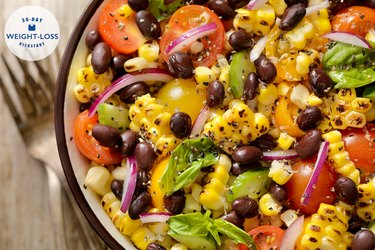
The good news? Increasing your fiber intake is simpler than you may realize, says Silberman. "Add fruit and nuts to your morning oatmeal or yogurt, throw some greens and fruit into your smoothie and add cooked chickpeas, lentils or beans to your salad." Just a half cup of black beans, for example, contains an impressive 7 grams of the rough stuff.
It's recommended that women get 25 grams of fiber per day while men get 38 (that's 21 and 30 for women and men over 50, respectively), per the 2015-2020 Dietary Guidelines — but tracking your daily fiber intake isn't really sustainable or enjoyable, admits Silberman. Instead, simply focus on adding more fruits, vegetables, whole grains, beans, nuts and seeds to your plate.
But if you aren't accustomed to eating tons of fiber, be sure to start slow. "Some people have a harder time digesting large amounts of fiber at once, so I recommend slowly introducing fibrous foods and building up your tolerance, so to speak," says Silberman.
Cruciferous vegetables like Brussels sprouts, broccoli and cauliflower are among the biggest bloat offenders, so be sure to introduce them into the diet gradually. "Another tip is to eat them cooked instead of raw to ease digestion," says Silberman.
Always be sure to drink an adequate amount of water as you increase your fiber intake, as too much fiber and too little hydration can lead to constipation. Eight cups of water per day is the standard recommendation, but fluid needs vary from person to person depending on factors like age and physical activity level.
Start with at least eight cups (or 64 ounces) of water per day and load up on hydrating fruits and vegetables like strawberries, pears, celery and cucumbers, all of which count towards your fluid intake and also happen to be good-for-you sources of dietary fiber. Now that's a double win.
Ready to Lose Weight?
Set yourself up for success with more from our 30-Day Weight-Loss Kickstart.
- Nutrition and Healthy Aging: "Ratios of Soluble and Insoluble Dietary Fibers on Satiety and Energy Intake in Overweight Pre- and Postmenopausal Women"
- British Medical Journal: "Dietary Fibre Intake and Risk of Cardiovascular Disease: Systematic Review and Meta-Analysis"
- Harvard Medical School: "11 Foods That Lower Cholesterol"
- Centers for Disease Control and Prevention: "LDL and HDL Cholesterol: "Bad" and "Good" Cholesterol"
- American Journal of Lifestyle Medicine: "Closing America’s Fiber Intake Gap"
- Food Data Central: "Black Beans"
- Annals of Internal Medicine: "Single-Component Versus Multicomponent Dietary Goals for the Metabolic Syndrome: A Randomized Trial"
- Mayo Clinic: "Dietary fiber: Essential for a healthy diet"
- 2015-2020 Dietary Guidelines: "Appendix 7. Nutritional Goals for Age-Sex Groups Based on Dietary Reference Intakes and Dietary Guidelines Recommendations"
Was this article helpful?
150 Characters Max
0/150
Thank you for sharing!
Thank you for your feedback!