
What does fact checked mean?
At SportsRec, we strive to deliver objective content that is accurate and up-to-date. Our team periodically reviews articles in order to ensure content quality. The sources cited below consist of evidence from peer-reviewed journals, prominent medical organizations, academic associations, and government data.
- Sports Health: Core Stability Training for Injury Prevention
- Sports Health: Core Stability Training for Injury Prevention
The information contained on this site is for informational purposes only, and should not be used as a substitute for the advice of a professional health care provider. Please check with the appropriate physician regarding health questions and concerns. Although we strive to deliver accurate and up-to-date information, no guarantee to that effect is made.
Proper Breathing During Sit-ups
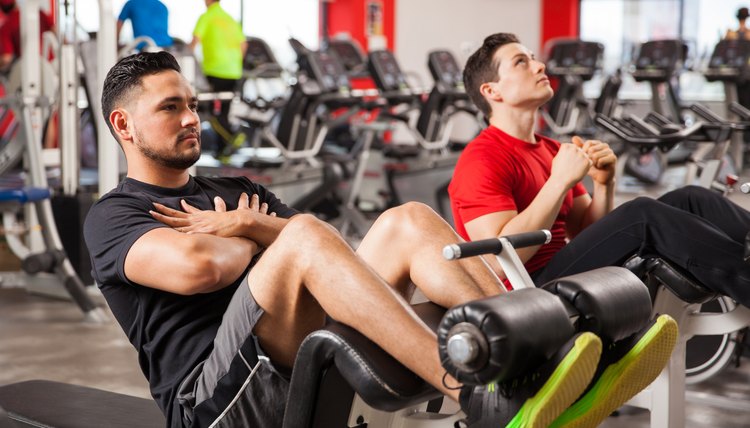
Correct breathing techniques when you’re doing sit-ups — or any resistance exercise — can make a huge difference in the outcome of your workout. Breathing correctly means your workout can leave you feeling energized, while improper breathing can leave you feeling fatigued.
It might even result in injury or other health problems, such as headaches, dizziness and pain in the neck and shoulders. Therefore, it’s important to bring mindfulness into your breathing when you’re doing stomach exercises.
Learn the Pattern
First, the basics: “The golden rule for breathing when you’re working out is to exhale during the hard part and inhale during the easy part,” says Los Angeles-based personal trainer David Knox, author of “Body School: A New Guide to Improved Movement in Daily Life.” “This is especially true when you’re doing abdominal exercises like sit-ups, crunches or planks."
- For sit-ups and crunches, exhale when you’re lifting your torso and inhale when you’re lowering it back to the ground.
- For leg lifts, exhale when you’re lifting your legs and inhale when you’re lowering them.
- For planks, inhale when you’re lowering and exhale when you’re lifting. Maintain a regular breathing rhythm when you're holding the pose.
The chest should fill up laterally rather than from front to back, “Like the sail of a Spanish galleon filling out from the sides,” says Knox. “Your ribcage and core shouldn’t thrust forward, but should expand outward. You should feel a sense of expansion through the rib cage and the middle of the back.”
Tips
As you exhale, squeeze from below the navel. As you inhale, let the air rush upward into your chest and feel your ribcage expand and open. Additionally, don’t hold your breath, as it causes blood pressure to rise and muscle to contract.
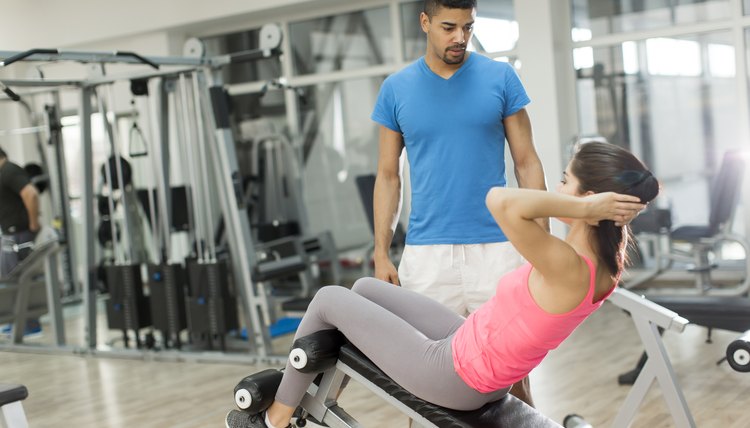
Proper Breathing During Sit-Ups
Breathing Exercises for the Abs
In fact, breathing exercises by themselves can strengthen your abdominal muscles, says Knox, who’s also a yoga instructor. Applying force to the breath when both inhaling and exhaling can strengthen the belly. When exhaling air, the body relies on abdominal muscles to squeeze force air out of the thoracic cavity.
Normally, breath is drawn in and out by the abdominal muscles. During exercise or intentional forced breathing, the secondary breathing muscles in the chest engage. This lifts the ribs, allowing the lungs more room to inflate as more air rushes in.
For a simple ab-strengthening breathing exercise, lie flat on your back and gradually lengthen the duration of your inhalations and exhalations. “The more you control your breathing muscles in your workout, the stronger and more articulate they’re going to become,” says Knox.
References
Writer Bio
Martin Booe is a health, fitness and wellness writer who lives in Los Angeles. He is currently collaborating on a book about digital addiction to be published in the UK this December.