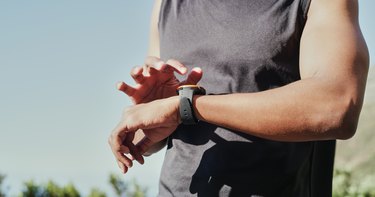
How do you know if you're exercising hard enough or need to push yourself more? Your heart rate can give you valuable information about how hard your heart is working during a particular activity — and you don't have to be an elite athlete to reap the benefits of tracking.
Here's a simple guide to cardio zones to help you make sure you're getting the most out of all your efforts.
Video of the Day
Video of the Day
Measuring Exercise Intensity
Exercise intensity correlates to how hard a given workout feels to you. When your heart is pumping and your muscles are burning, it's a sign you're pushing yourself. But to make sure you're getting the most out of your gym time, you'll want to be mindful of your effort, not going either too hard or not hard enough.
There are two main ways to measure the intensity of your workouts:
- Perceived Exertion: This is a subjective measure of how hard something feels while you're exercising. Depending on your fitness level and other variables (like how you slept the night before and how hydrated you are), working out at a certain intensity may feel harder or easier to you from one day to the next. This measurement will also be different from one person to the next. An "easy" effort for a competitive athlete could be the same as a "hard" effort for a beginner. Perceived exertion is typically measured by what's known as RPE (rate of perceived exertion) scale: 0 being lying down or doing nothing, 10 being the hardest you could possibly push yourself.
- Heart Rate: This is a more objective measure of exercise intensity, or how hard your effort actually is based on how hard your heart is beating. Generally, the higher your heart rate during a workout, the higher the intensity. But like perceived exertion, it's not an exact link to your fitness level. Depending on variables like training status, sleep, stress and nutrition, your heart rate can skew higher in any given workout.
Related Reading
How to Determine Your Cardio Zones
"Heart rate training provides an opportunity for [people] to have a measure of internal work," says Aaron L. Baggish, MD, founder of the Cardiovascular Performance Program at Massachusetts General Hospital. "When used routinely, heart rate training helps you to understand how your body is responding to training. The most fundamental evidence of training progression is a lower absolute heart rate at any given workload compared to prior data."
Heart rate is divided into different zones to help you monitor the intensity of your activity.
To utilize cardio zones during exercise, you first need to figure out your maximum heart rate, which is the absolute fastest your heart can pump. From there, you'll be able to determine your heart rate zones, which are ranges based on a percentage of your maximum heart rate.
Maximum Heart Rate
The highest limit of what your cardiovascular system can handle, aka your max heart rate, varies from person to person. The most accurate way to determine your max heart rate would be by measuring it during all-out exercise, or what's typically known as an exercise stress test.
"This would be considered the gold standard regarding accuracy and is routinely used at the elite level of sport," Dr. Baggish says. (Check with your doctor or personal trainer if you're interested in performing this kind of test.)
To get a loose estimate, you can also use a simple formula: 220 minus your age. So if you are 20 years old, your estimated maximum heart rate is 200 beats per minute (BPM). If you are 45 years old, it's 175 BPM. If you are 70 years old, it's 150 BPM.
Another formula is 207 - 0.7 x your age, which was used in a small 2018 study published in the International Journal of Research in Exercise Physiology. When heart rate training zones were calculated based on a max heart rate calculated with that formula, compared to results from an exercise stress test, people were in the correct zone 86% of the time. When heart rate did not fall within the correct zone, it was never off by more than one zone.
It's important to note that maximum heart rate is only a guide, especially when using equations. You may have a higher or lower maximum heart rate, sometimes by as much as 15 to 20 beats per minute. If you want to know your actual maximum heart rate or personal target heart rate zones, consider talking with an exercise physiologist, personal trainer or your doctor.
Without more scientific measurements, Dr. Baggish recommends the use of external measures (e.g. RPE scale) in conjunction with exercise heart rate to guide individual exercise intensity.
An exercise stress test is the gold standard, but there are two common formulas to find your maximum heart rate (MHR):
- MHR = 220 - your age
- MHR = 207 - (0.7 x your age)
Target Heart Rate
Now you can use your maximum heart rate to calculate your desired target heart rate zone — the level where your heart is being exercised and conditioned but not overworked.
According to the American Heart Association, your target heart rate during moderate intensity activities should be about 50–70% of maximum heart rate, and 70–85% during vigorous physical activity. For a 30-year-old person with a maximum heart rate of 190, the target heart rate range during moderate exercise is 95 to 133 beats per minute (calculated as 220 minus 30, then multiplied by 50% and 70%, respectively). If you're just starting out, aim for the lower end of that range and build gradually over time.
Target heart rate can also be broken down into five zones that are designed to help you achieve more specific exercise goals.
Cardio Zones
Zone 1 (very light) | 50–60% Max Heart Rate |
Zone 2 (light) | 60–70% Max Heart Rate |
Zone 3 (moderate) | 70–80% Max Heart Rate |
Zone 4 (hard) | 80–90% Max Heart Rate |
Zone 5 (max effort) | 90–100% Max Heart Rate |
Zone 1: 50 to 60% Maximum Heart Rate
This is the least intense zone, where effort is considered very light. Think of activities such as leisurely walking, stretching and restorative yoga. You should be able to carry on a full conversation throughout your entire workout. If you're new to exercise you should start your workouts in this zone. You'll burn some calories and build up your cardiovascular system to prepare yourself for harder workouts.
Zone 2: 60 to 70% Maximum Heart Rate
You're still in a relatively low-intensity, or light effort, zone here. You should still be able to talk comfortably while you're exercising. You might be walking at a brisker pace or jogging slowly. If you stay in this zone during your workout you won't be exhausted after your workout. You might even feel refreshed afterward. Most of your workouts should be in zone 2 training.
Zone 3: 70 to 80% Maximum Heart Rate
Welcome to the moderate zone. This level helps improve your lung and heart endurance. (When you run distances or participate in other events such as a triathlon, you'll spend a lot of time in this heart rate zone.) If you're running, you're breathing harder. You should still be able to speak comfortably, but at this point you should only be able to say about one sentence at a time.
Zone 4: 80 to 90% Maximum Heart Rate
This is considered your "hard effort" or vigorous activity zone. This is a heart rate you would hit during a circuit or interval training, where you work for a short 30- to 90-second burst and then rest. It is too intense to sustain for a long time. You should be breathing much harder, and only able to say one or two words at a time. Zone four exercise improves speed and overall exercise performance for short bursts of activity, such as sprinting.
Zone 5 90 to 100% Max Heart Rate
This zone is your "max effort." It's incredibly hard to sustain your workout at this heart rate — you should feel like you're going as close to all-out effort as you possibly can. You're no longer able to speak and your activity will be very short. This heart rate level is seriously high, and is not something you should aim to achieve with any sort of regularity.
A Note About Your Heart Rate Zones
A potential problem with using predicted maximum heart rate for zone training? Because of individual variation in measured maximal heart rate (aka if you went and got a stress test performed), there is no way to know if exercisers are exercising in the correct zone.
"Athletes can utilize predictive equations that have been developed by sports scientists," Dr. Baggish says. "Unfortunately, even the best of these equations introduce a fair bit of estimation error and are not considered particularly accurate."
What does that mean? Well, you could end up exercising at an intensity that is lower than intended and will not get you the training results you're looking for. On the flip side, if your max heart rate is actually lower than what's predicted by the equations, you could end up pushing yourself too hard. This can be particularly dangerous for people with undiagnosed cardiac disease.
"The most important thing that any average person — or elite level athlete for that matter — should know about their heart function is that if they feel symptoms including chest pain, unusually labored breathing or palpitations during exercise that they should see some immediately and discuss with a qualified medical professional," Dr. Baggish says.
Monitoring Your Heart Rate
Heart rate is measured by the number of times your heart beats in one minute. The most basic way to measure your heart rate is by taking your pulse. You can find your pulse at your carotid artery (on the side of the neck) or radial artery (the thumb side of your forearm). Place the tip of your index and middle finger gently over one of those two locations and feel for a beating rhythm.
Once you feel your heartbeat, count the number of beats for 60 seconds. (Alternatively, you can count for 30 seconds and multiply by 2 or for 15 seconds and multiply by 4, but you'll get the most accurate assessment by counting for a full minute.)
Taking your pulse with your fingers works well if you're sitting and resting, but it's not practical if you're exercising. Using a device, such as a smartwatch or other fitness tracker, can help measure your heart rate during your workout.
Tip
You want to avoid relying entirely on your heart rate numbers (whether coming from a device or not), making sure to pay attention to other helpful data — your pace, your rate of perceived exertion and any physical symptoms that indicate you're pushing yourself too hard (or not hard enough).
How Accurate Are Fitness Trackers?
The rise of fitness trackers over the last decade has made it more accessible than ever for the average gym goer to track their heart rate. But are these products accurate?
There are two main types of trackers: wrist-based or a chest strap. The first uses optical sensors that detect light bouncing back from blood flow beneath your skin to measure your pulse. A chest strap has a transmitter in the center of your chest near your heart that picks up your heart rate and sends the data to another device.
"In general, devices that utilize a chest strap with embedded electrodes provide the highest level of accuracy," Dr. Baggish says. "Wrist-based devices utilize a technology called photoplethysmography (PPG). The accuracy of these devices has gotten much better over time, but they are still subject to error, largely introduced when the device has short lapses of connection with the skin surface."
In a May 2017 study in the Journal of Personalized Medicine, Stanford researchers tested the accuracy of seven wristband activity monitors on 60 people and found that six out of seven devices measured heart rate accurately within 5 percent.
Researchers from that study point out that variables such as darker skin tone, larger wrist circumference and higher BMI were linked with increased heart rate errors across multiple devices. Errors were also higher at higher levels of intensity while walking and running.
"Optical wrist-based readings vary based on the watch and the athlete," David Roche, coach at SWAP running, says. "Anecdotally, the newer Garmin models can often be fantastic. We like athletes to do longer intervals around 3 to 5 minutes and see if the heart rate graph aligns with the up-and-down of the effort. If it doesn't, it's better to use a chest strap."
An August 2019 study in Cardiovascular Diagnosis and Therapy on 50 runners included both chest straps and wrist devices, and found chest straps (in this case, the Polar H7) were the closest in accuracy to the electrocardiogram data collected during the experiment.
"Chest strap heart rate monitors can pair with nearly any GPS watch, and we have seen accurate results with our athletes," Roche says. That includes cheaper models, he says, "though the Polar version is used for research purposes, and it may be the best option for athletes that are looking for perfect data."
Because it's hard to guarantee the accuracy of any one device, avoid relying entirely on readings from a device to gauge your exercise intensity. They can serve as a helpful benchmark, but you should also be paying attention to other helpful data points such as your pace, your rate of perceived exertion and any physical symptoms that indicate you're pushing yourself too hard (or not hard enough).
- Heart: Target Heart Rates
- Polar: Running Heart Rate Zone Basics
- Idea Fit: Heart Rate Training
- My Zone: Understanding MYZONE Heart Rate Zones & Energy Metabolism
- Cleveland Clinic: Pulse & Heart Rate: Target Heart Rate
- IJREP: "The Accuracy of Heart Rate-Based Zone Training using Predicted versus Measured Maximal Heart Rate"