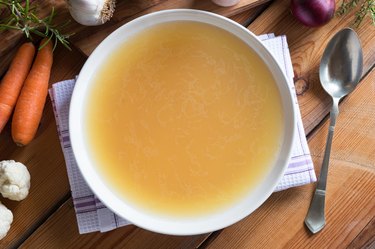
Chicken stock is like broth — a simple food that can be used in various ways. Regardless of whether you've chosen to make stock, broth or consommé, all of these products can be easily modified. The vegetables, herbs and spices you choose to add greatly influence your chicken stock's nutrition.
Read more: 12 Slimming Soups
Video of the Day
Video of the Day
Stock, Broth or Consommé?
Chicken stock, broth and consommé are all very similar foods. Making any one of these typically involves using the same vegetables, herbs and spices. The main differences are how long each one has been cooked for and which parts of the chicken were used.
The lightest and least nutritious out of these three is chicken consommé, which is used to enrich or complement a dish. This type of broth is unique because it is perfectly clear, but still has a rich depth of flavor. Vegetables, herbs and spices are usually added, just like with stock or broth. The main difference is that a consommé isn't cooked for very long; it would become cloudy otherwise.
Chicken broth can be made using meat, bones or a whole chicken. As with consommé, vegetables, herbs and spices are also added to the mix. Broths are usually used as the base for soups, stews and other foods. Most people who make homemade chicken broth allow the meat and vegetables in the broth to cook through, then remove them and use the broth itself to make something else.
You've likely also heard of bone broth — a type of chicken broth. According to a November 2017 study in the Journal of Renal Nutrition, bone broth has been associated with a variety of health benefits. However, bone broths can differ substantially. Light bone broths are similar to standard chicken broths, while heartier, fattier products are more similar to chicken stock.
Chicken stock is typically made by letting the chicken, bones and a variety of vegetables simmer for a long period of time. Stock is different from broth and consommé because it is a heartier, cloudier product.
The chicken and vegetables are allowed to break down in the hot water, releasing their vitamins, minerals and antioxidants. Proteins and fats are also released from the chicken's bones. This is why chicken stock's nutrition is so much richer compared to broths and consommés.
Read more: 10 Easy Clean-Eating Recipes
Chicken Stock Nutrition Facts
Most chicken stocks are made using vegetables like celery, leeks and carrots. However, if you're making chicken stock at home, you can add virtually any vegetable, fruit, herb or spice that you feel might enhance its flavor and nutritional content.
According to the USDA, chicken stock's calories are typically around 86 per cup (240 milliliters). Each cup also contains 6 grams of protein, 2.9 grams of fat and 8.5 grams of carbohydrates. The average chicken stock also contains a variety of nutrients, including:
- 7 percent of the daily value (DV) for thiamin (vitamin B1)
- 16 percent of the DV for riboflavin (vitamin B2)
- 24 percent of the DV for niacin (vitamin B3)
- 9 percent of the DV for vitamin B6
- 5 percent of the DV for potassium
- 5 percent of the DV for phosphorus
- 14 percent of the DV for copper
- 10 percent of the DV for selenium
- 14 percent of the DV for sodium
Chicken stock also contains small amounts (between 1 and 4 percent) of other nutrients, including calcium, iron, magnesium, zinc, vitamin C, folic acid and choline.
Chicken Stock vs. Chicken Broth
Chicken broths are always cooked for shorter periods than chicken stocks. This means any added vegetables have less time to break down in the hot water, which results in far less nutrients in chicken broth compared to chicken stock.
A cup of chicken broth has 11 percent of the daily value for riboflavin (vitamin B2) and small amounts (between 1 and 4 percent) of other vitamins, like B-complex vitamins and vitamin E. There are also small amounts of minerals like calcium, copper, iron, potassium, magnesium, manganese, phosphorus, selenium and zinc in the broth.
According to the USDA, there are just 15 calories in chicken broth per cup (249 milliliters) — far less than the calories in chicken stock. Each cup of broth also contains 1.6 grams of protein and 1.1 grams of carbohydrates. Chicken broth's fat content tends to be lower than chicken stock's, with just 0.5 grams of fat per cup, though this may change if you've made a bone broth.
Homemade chicken broth's nutrition facts aren't too different from the average store-bought product. The main difference is usually the sodium content. A cup of chicken broth you buy at the grocery store might have as much as 924 milligrams of sodium, which is equivalent to 38 percent of the daily value for this nutrient.
Although sodium is an essential nutrient, too much can be bad for your health. The American Heart Association recommends limiting your salt intake to no more than 2,300 milligrams a day. Ideally, sodium consumption should be as low as 1,500 milligrams per day.
This means that about half of your sodium intake could come from just a single cup of chicken broth. If you make your own homemade chicken broth, it can have a fraction of the sodium content of store-bought, resulting in a much healthier food.
Enhancing Chicken Stock Nutrition
Chicken stock nutrition can be easily modified based on the ingredients you've chosen to use. According to an October 2015 study in the Journal of Functional Foods, many plant-based foods are rich in vitamins, minerals and antioxidants. Most of these are common ingredients you might already incorporate in your chicken stocks to enhance their nutrition. These ingredients include:
- Peppers
- Spinach
- Kale
- Onions
- Garlic
- Ginger
- Broccoli
- Cauliflower
- Cabbage
- Potatoes
- Carrots
- Celery
- Cucumbers
- Soybeans
Herbs, spices and oils — which are lower in vitamins and minerals — can still enrich your stock with antioxidants. These antioxidants can improve your cardiovascular health and support your immune system. Antioxidant-rich ingredients like these include:
- Rosemary
- Sage
- Thyme
- Oregano
- Cloves
- Black pepper
- Turmeric
- Fenugreek
- Olive oil
It's also possible to alter the macronutrients in your chicken stock. When chicken bones cook for long periods at low heat, collagen and gelatin are released, increasing the protein content. The fat around the chicken's carcass also releases into the stock during this process.
If you're keen on consuming a lower-calorie product, remove the fat after creating your stock. In contrast, if you're on a low-carb diet and prefer a higher-fat stock, you can use fattier parts of the chicken, like thighs and wings.
- Journal of Renal Nutrition: "A Sip Above the Rest…Is Bone Broth All Its Boiled up to Be?"
- MyFoodData: "Nutrition Comparison of Soup Chicken Broth Ready-to-Serve and Chicken Stock"
- American Heart Association: "How Much Sodium Should I Eat per Day?"
- Journal of Functional Foods: "Phenolics and Polyphenolics in Foods, Beverages and Spices: Antioxidant Activity and Health Effects – A Review"
- MyFoodData: "Nutrition Comparison of Raw Chicken Drumsticks, Raw Chicken Leg, Raw Chicken Thigh, Raw Chicken Wings, and Raw Chicken Breast"