What does fact checked mean?
At Healthfully, we strive to deliver objective content that is accurate and up-to-date. Our team periodically reviews articles in order to ensure content quality. The sources cited below consist of evidence from peer-reviewed journals, prominent medical organizations, academic associations, and government data.
The information contained on this site is for informational purposes only, and should not be used as a substitute for the advice of a professional health care provider. Please check with the appropriate physician regarding health questions and concerns. Although we strive to deliver accurate and up-to-date information, no guarantee to that effect is made.
What is the Vitamin K Content of Carrots?
More than just good for the eyes, carrots come packed with beneficial fiber, vitamin C and potassium. Their sweet, crunchy flavor works well raw and also stands up to cooking, and carrots help you boost your veggie intake. Adding carrots to your diet also increases your intake of vitamin K, a nutrient needed for healthy blood clotting.
K in Carrots
A small carrot about 5 ½ inches in length, weighing around 50 grams, has 6.6 micrograms of vitamin K. A medium carrot -- approximately 61 grams -- contains 8.1 micrograms of vitamin K, while a large carrot 7 ¼ to 8 ½ inches in length ad 72 grams in weight, contains 9.5 micrograms of vitamin K.
Daily Intake
The Average Weight and Height for a 12-Year-Old
Learn More
Recommended dietary intake of vitamin K differs depending on your age, sex, and whether you are pregnant or breastfeeding. Infants from birth to age 6 months need 2 micrograms daily and 2.5 micrograms from ages 7 months to 12 months. Children ages 1 to 3 need 30 micrograms; those ages 4 to 8 need 55 micrograms and from the ages 9 to 13, children should consume 60 micrograms of vitamin K a day. Male and female teens, ages 14 to 18, whether pregnant or breastfeeding, need 75 micrograms daily. Male adults, 19 years of age and older, need 120 micrograms of vitamin K daily. Females of the same age need only 90 micrograms daily, even if they are pregnant or breastfeeding.
- Recommended dietary intake of vitamin K differs depending on your age, sex, and whether you are pregnant or breastfeeding.
- Male and female teens, ages 14 to 18, whether pregnant or breastfeeding, need 75 micrograms daily.
Fulfilling Intake
Vitamin K deficiency is rare, as it is present in many foods and your body produces it. However, if you are looking to boost your vitamin K intake, you may want to focus on eating more leafy greens rather than more carrots. At just 8.1 micrograms of vitamin K in a medium sized carrot, to meet your dietary intake recommendations solely from carrots, men would need to eat almost 15 carrots daily, while women would need to get through 11. Green leafy vegetables, however, are a larger source of vitamin K. For instance, 1 cup of cooked broccoli has 220 micrograms, while 1 cup of raw spinach contains 145 micrograms. 1 cup of raw kale has a whopping 547 micrograms, while 2 cups of raw leaf lettuce will provide you with 125 micrograms.
- Vitamin K deficiency is rare, as it is present in many foods and your body produces it.
- At just 8.1 micrograms of vitamin K in a medium sized carrot, to meet your dietary intake recommendations solely from carrots, men would need to eat almost 15 carrots daily, while women would need to get through 11.
Considerations
Are Carrots Good Snacks?
Learn More
It is important to talk to your doctor before increasing your vitamin K intake, as vitamin K can interact with a variety of prescription medications, reports the University of Maryland Medical Center 2. While carrots contain only a moderate amount of vitamin K, consuming a lot of carrots -- or pairing them with vitamin K-rich foods, like parsley, spinach and kale, might affect your health. Vitamin K can also render warfarin, a common blood thinning medication, ineffective, and you should talk to your doctor before making any changes in your diet if you take warfarin.
Related Articles

The Average Weight and Height for a 12-Year-Old
Learn More
Are Carrots Good Snacks?
Learn More

Nutritional Value of Carrots and Celery
Learn More

Beta-Carotene While Pregnant
Learn More
How Many Calories in Carrot Sticks?
Learn More
Cauliflower Nutrition Guide
Learn More
How Much Beta-Carotene Is in Carrots?
Learn More

Vitamins for a 2-Year-Old
Learn More

How Many Calories & Grams of Fat Should a Female Consume?
Learn More
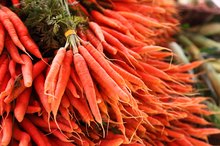
Carrot Nutrition Information
Learn More
References
- Linus Pauling Institute: Vitamin K
- University of Maryland Medical Center: Vitamin K
- MedlinePlus: Vitamin K
- USDA Nutrient Data Laboratory: Carrots, Raw
- Vitamin A Fact Sheet for Health Professionals. NIH Office of Dietary Supplements. Updated February 14, 2020
- Sweet potato, NFS. USDA FoodData Central Updated 4/1/2020
- Spinach, cooked, from fresh, fat not added in cooking. USDA FoodData Central. Updated 4/1/2020
- Carrots, raw. USDA FoodData Central. Updated April 1, 2020
- Melons, cantaloupe, raw. USDA FoodData Central. Updated 4/1/2020
- Pepper, sweet, red, raw. USDA FoodData Central. Updated 4/1/2020
- Apricot, raw. USDA FoodData Central. Updated April 1, 2020
- Broccoli, cooked, from fresh, fat not added in cooking. USDA FoodData Central. Updated April 1, 2020
- Institute of Medicine of the National Academies. "Dietary Reference Intakes: Vitamins." http://iom.nationalacademies.org/Reports/2001/Dietary-Reference-Intakes-for-Vitamin-A-Vitamin-K-Arsenic-Boron-Chromium-Copper-Iodine-Iron-Manganese-Molybdenum-Nickel-Silicon-Vanadium-and-Zinc.aspx.
- National Institutes of Health Office of Dietary Supplements. "Vitamin A Fact Sheet for Health Professionals." https://ods.od.nih.gov/factsheets/VitaminA-HealthProfessional.
- United States Department of Agriculture, Agricultural Research Service National Nutrient Database for Standard Reference Release 28. https://ndb.nal.usda.gov/ndb/search.
Writer Bio
Since 2009 Jessica Benzaquen has published research articles and abstracts in “Pharmacology, Biochemistry & Behavior” and “The Society for Neuroscience Meeting Planner.” After receiving her Bachelor of Arts and Science degree in neuroscience and cognitive neuropsychology at the University of Guelph, she earned her Master of Science degree in neuroscience at the University of Western Ontario while investigating possible environmental triggers for autism.