
How to Use Chinese Medicine Balls for the Hands
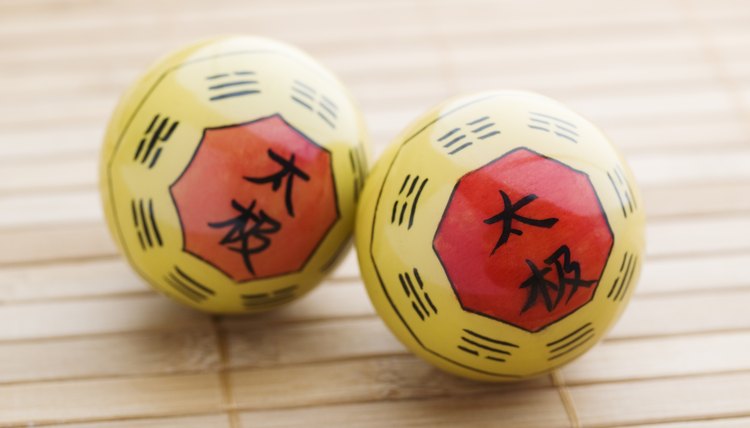
Chinese medicine balls, also known as Chinese Baoding balls, stress balls or exercise balls, are said to date back to the Ming Dynasty of 1368-1644, or earlier. While their origins are mysterious, their uses are pragmatic. The balls help to relieve stress, build muscle tone in the hands and fingers and improve circulation. Chinese medicine balls carved from wood or stone are usually more for decoration than exercise. Hollow metal balls that create a chiming sound when they touch are the most common type of medicine balls for therapeutics.
Place two Chinese medicine balls in the palm of one hand. Close your palm and fingers over the medicine balls, forming a loose grip.
Rotate the Chinese medicine balls clockwise using your fingers and palm. Continue rotating the Chinese medicine balls clockwise, making five complete revolutions.
Rotate your fingers and palm counterclockwise, after five clockwise revolutions, spinning the Chinese medicine balls in the opposite direction for an additional five revolutions.
Switch hands, placing the Chinese medicine balls in the palm of your other hand. Repeat the clockwise and counterclockwise exercises. Continue switching the Chinese medicine balls from palm to palm for approximately 15 minutes. Repeat the exercise several times per day.
Tips
Once you get the hang of rotating two Chinese medicine balls, try adding a third, fourth and finally, a fifth ball to the rotation.
The balls come in small-to-large circumferences for a variety of hand sizes and skill levels.
Rolling a Baoding ball around under your bare foot will help to relieve tension in your foot and trigger more acupuncture points.
Warnings
Start slowly and work your way up to more than two balls. While exercising with Chinese medicine balls can be helpful, overuse can cause cramping and muscle aches. If you begin to develop pain while performing the exercises, give yourself a few days break.
References
Resources
Writer Bio
Jonae Fredericks started writing in 2007. She also has a background as a licensed cosmetologist and certified skin-care specialist. Jonae Fredericks is a certified paraeducator, presently working in the public education system.