
What does fact checked mean?
At SportsRec, we strive to deliver objective content that is accurate and up-to-date. Our team periodically reviews articles in order to ensure content quality. The sources cited below consist of evidence from peer-reviewed journals, prominent medical organizations, academic associations, and government data.
The information contained on this site is for informational purposes only, and should not be used as a substitute for the advice of a professional health care provider. Please check with the appropriate physician regarding health questions and concerns. Although we strive to deliver accurate and up-to-date information, no guarantee to that effect is made.
Blisters From Playing Basketball
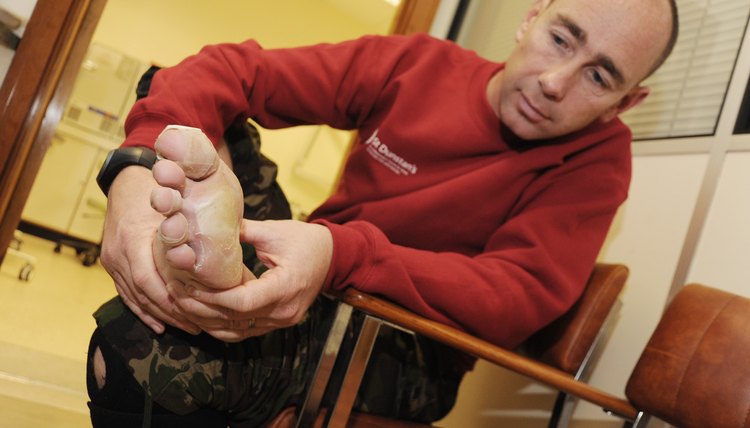
Basketball requires an excessive amount of running and jumping. The constant movement and lower-body trauma can lead to a number of injuries, from twisted ankles to shin splints and sprained knees. While often overlooked among the physical hardships, blisters can be a particularly frustrating aspect of playing basketball.
Identification
A blister is a swollen area of skin that contains watery fluid. The blister will appear as a white patch of thick skin and will be sensitive to the touch. Blisters will often tear open if left unprotected, exposing raw, sensitive skin underneath and increasing the risk of possible infection.
Causes
Burning, infection or irritation can cause blisters to form. Basketball players typically suffer foot blisters because of the unique demands of the sport. Constant running, jumping and quick, cutting movements lead to skin irritation. Improper footwear or ill-fitting socks can create unwanted friction can trigger blister formation.
Treatment
The Mayo Clinic recommends puncturing the blister with a sterile needle, draining the fluid, leaving the overlying skin in place and then covering the entire area with an antibiotic ointment and bandage. After a few days, remove the dead skin and continue to treat the wound with antibiotic ointment. Keep the blister bandaged throughout the day, but leave it open to the air at night. Call your doctor if you notice any signs of infection, such as pus, redness, swelling, increased pain or warm skin.
Prevention
Basketball players need to wear the correct shoes and socks to prevent unnecessary friction, which could lead to skin irritation and blisters. Purchase shoes that have enough room so you can wiggle your toes without rubbing against the front. Be sure the shoes have no interior seams that could irritate the foot. Socks should fit snug with no wrinkles. If you’re prone to sweating a lot, change your socks at halftime during games to keep your feet dry. Wearing bandages or padding in areas of the feet where you tend to blister -- the back of the heel, for example -- can provide extra blister protection.
Considerations
Occasionally, basketball players, especially guards, may develop blisters on their fingers from dribbling the ball too much or taking too many shots in practice. If left untreated, finger blisters can affect a player’s ball handling. Wearing bandages or athletic tape over the blisters can help protect the skin and dull any associated pain, allowing for no decrease in performance. According to the Sports Injury Bulletin, keeping hands lubricated may cause the skin to retain too much moisture, contributing to possible blister formation.
References
- Mayo Clinic: Blisters: First Aid
- Shashikumar B, Reddy RR, Harish M. Oral hemorrhagic blister: an enigma. Indian J Dermatol. 2013;58(5):407. doi:10.4103/0019-5154.117337
- Worthing RM, Percy RL, Joslin JD. Prevention of Friction Blisters in Outdoor Pursuits: A Systematic Review. Wilderness Environ Med. 2017;28(2):139-149. doi:10.1016/j.wem.2017.03.007
- Harvard Health Publishing, Harvard Medical School. Frostbite 404 404.
- Institute For Preventive Foot Health. Causes of Blisters.
- PathologyOutlines.com. Skin - nontumor, Blistering disorders, Blood blister.
- U.S. National Library of Medicine, Medline Plus. Blisters.
Writer Bio
William Lynch has been a freelance writer for the past fifteen years, working for various web sites and publications. He is currently enrolled in a Master of Arts program in writing popular fiction at Seton Hill University. He hopes to one day become a mystery novelist.