What does fact checked mean?
At Healthfully, we strive to deliver objective content that is accurate and up-to-date. Our team periodically reviews articles in order to ensure content quality. The sources cited below consist of evidence from peer-reviewed journals, prominent medical organizations, academic associations, and government data.
- American Dietetic Association; Position of the American Dietetic Association, Dietitians of Canada, and the American College of Sports Medicine: Nutrition and Athletic Performance; March 2009
- U.S. Food and Drug Administration; What You Need to Know About Mercury in Fish and Shellfish; March 2004
The information contained on this site is for informational purposes only, and should not be used as a substitute for the advice of a professional health care provider. Please check with the appropriate physician regarding health questions and concerns. Although we strive to deliver accurate and up-to-date information, no guarantee to that effect is made.
How Much Protein Is in a Filet of Flounder?
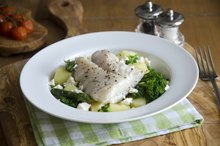
Flounder is type of flatfish found in the ocean and commonly eaten in the United States. A filet of flounder is an excellent source of protein and other nutrients. However, certain groups of people should limit flounder and other fish consumption due to possible toxins found in fish from waters that may be contaminated.
Background
The amount of protein you require on a daily basis depends on your age, gender and activity level. The Institute of Medicine-recommended dietary allowance or minimum daily requirement for protein is 46 g per day for adult women, 71 g each day for pregnant and nursing women and 56 g per day for adult men. These recommendations are based on an IOM requirement of 0.8 g of protein per kilogram of body weight per day. However, according to the American Dietetic Association, athletes require slightly more protein than this, or about 1.2 to 1.7 g of protein per kilogram of body weight per day.
- The amount of protein you require on a daily basis depends on your age, gender and activity level.
- These recommendations are based on an IOM requirement of 0.8 g of protein per kilogram of body weight per day.
Protein in Flounder
Is There Limit to How Much Tuna Fish and Sardines You Can Eat?
Learn More
The amount of protein present in flounder depends on the portion size. One fillet of flounder is typically about 3 to 4 oz., slightly larger than the size of a deck of cards. According to the U.S. Department of Agriculture Nutrient Data Laboratory, one 4-oz 12. fillet of flounder, or about 127 g of flounder, contains about 19 g of protein, and one 3-oz. fillet or 85 g of flounder provides about 13 g of protein.
- The amount of protein present in flounder depends on the portion size.
- fillet or 85 g of flounder provides about 13 g of protein.
Considerations
Fish, including flounder, are a source of high-quality complete protein. This means a flounder fillet contains all the essential amino acids your body requires on a daily basis.
Concerns
Protein Content of Canned Salmon
Learn More
Mercury and other contaminants are a concern if you’re eating lots of flounder to meet your protein needs. The U.S. Food and Drug Administration encourages women of childbearing age, pregnant and nursing women and children to limit fish and shellfish consumption to 12 oz. per week of low-mercury-containing fish varieties. According to the U.S. Department of Agriculture, flounder contains about 7 mcg of mercury per 4-oz 1. portion size, which is a fairly low amount compared with other types of fish.
- Mercury and other contaminants are a concern if you’re eating lots of flounder to meet your protein needs.
- The U.S. Food and Drug Administration encourages women of childbearing age, pregnant and nursing women and children to limit fish and shellfish consumption to 12 oz.
Related Articles
Is There Limit to How Much Tuna Fish and Sardines You Can Eat?
Learn More
Protein Content of Canned Salmon
Learn More

Nutritional Values of Meat & Fish
Learn More
Sardine Allergies
Learn More

Nutrition of Mahi Mahi Vs. White Fish
Learn More

How to Mix Tuna With Egg Whites
Learn More
The Nutritional Value of Plaice
Learn More
Baked Haddock Nutritional Values
Learn More

Salmon Oil Vs. Cod Liver Oil
Learn More

Gyro Meat Nutritional Information
Learn More
References
Writer Bio
Erin Coleman is a registered and licensed dietitian. She also holds a Bachelor of Science in dietetics and has extensive experience working as a health writer and health educator. Her articles are published on various health, nutrition and fitness websites.