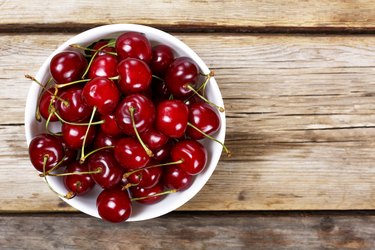
Cherries, when they're baked in a pie or freshly picked off the tree, are cherished for their distinctive taste.
But flavor is not the only benefit these fleshy stone fruits bring to the table: Cherries are loaded with valuable nutrients that can protect your skin, heart and digestive system.
Video of the Day
Video of the Day
You may not think to add cherries to your grocery haul until you see them fresh at a farmers' market, but they're worth incorporating into your everyday meals.
"Cherries are a great addition to any diet, so be sure to add them to your shopping list when they are in season," says Mia Syn, RDN. "I encourage eating a rainbow of produce to vary your intake of vitamins, minerals and phytonutrients. Eating with the seasons is one easy way to do that."
Here are the delicious perks you can expect when you dig into a bowl of cherries.
Related Reading
Sweet Red Cherries: Nutrition and Calories
Sweet cherries, as the name suggests, have a sweet taste and are high in natural sugars. When they're ripe, sweet cherries are juicy with firm flesh. The color of sweet cherries can range from dark purple to light red. Darker varieties tend to have a stronger taste.
Most of the calories in cherries come from carbohydrates. Carbs are the body's main source of energy and provide the fuel needed for many metabolic functions.
One cup, or about 20 cherries with pits, is equal to a single serving. The nutritional value of one cup of sweet cherries is:
- Calories: 87
- Total fat: 0.3 g
- Cholesterol: 0 mg
- Sodium: 0 mg
- Total carbs: 22.1 g
- Dietary fiber: 2.9 g
- Sugar: 17.7 g
- Added sugar: 0 g
- Protein: 1.5 g
How Many Calories Are in a Handful of Cherries?
A typical serving size is about 20 cherries, which equals 1 cup, according to the Produce for Better Health Foundation.
The number of cherries in a handful depends on the size of your hand, but it would likely amount to about 10 cherries, or half a cup. There are roughly 44 calories in 10 cherries.
Snacking on a handful gives you all the beneficial cherry nutrition without as many calories or carbs, or as much sugar, as an entire 1-cup serving.
Minerals and Vitamins in Cherries
Sweet cherries are full of vitamins and minerals that can benefit your health. In a 1-cup serving, or 20 cherries, you'll get:
- Vitamin C: 11% of your Daily Value (DV)
- Copper: 9% DV
- Potassium: 7% DV
- Vitamin B5: 5% DV
- Magnesium: 4% DV
- Manganese: 4% DV
- Riboflavin (B2): 4% DV
- Thiamin (B1): 3% DV
- Vitamin A (IU): 3% DV
- Iron: 3% DV
Black Cherries: Nutrition and Calories
With a deep red to almost black skin, black cherries or dark cherries are another sweet, juicy and nutritious snack option. Black cherries have a similar nutrition profile to sweet cherries.
According to the USDA, here are the black cherry nutrition facts for a serving of 20 cherries (about 1 cup):
- Calories: 90
- Total fat: 0 g
- Cholesterol: 0 mg
- Sodium: 0 mg
- Total carbs: 22 g
- Dietary fiber: 3 g
- Sugar: 18 g
- Added sugar: 0 g
- Protein: 1 g
Per serving, there are about 90 calories in black cherries. Much like their sweet, red counterparts, most of the black cherry calories come from carbs. Dark cherries are also high in vitamin C (11% DV), and they contain some iron (3% DV) and calcium (1% DV).
Acerola Cherries: Nutrition and Calories
Acerola cherries — also called Barbados cherries or West Indian Cherries — are less likely to be found fresh at the grocery store than other cherry varieties. You might see them as an ingredient in juices and supplements.
Grown from the acerola tree native to South America, Central America and some parts of California, Texas and Florida, acerola cherries start to ferment right after they're harvested and spoil quickly. When frozen, they tend to fall apart as they thaw, so they're best used in jams, syrups and juices.
Taste-wise, acerola cherries are juicy, sweet and a little tart. The skin can range from a deep red to orange color.
According to the USDA, 1 cup of fresh acerola cherries has:
- Calories: 31
- Total fat: 0.3 g
- Cholesterol: 0 mg
- Sodium: 6.9 mg
- Total carbs: 7.5 g
- Dietary fiber: 1.1 g
- Sugar: unreported
- Added sugar: 0 g
- Protein: 0.4 g
The USDA does not report the amount of sugar in acerola cherries. Acerola cherries are lower in calories and carbs than sweet cherries. Most notably, they're extremely high in vitamin C. A 1-cup serving has 1,644 milligrams of vitamin C — that's 1,827% of your DV!
Warning
Acerola cherries are one of the highest food sources of vitamin C, and they provide much more than you need in a day, according to the USDA.
Acerola juice is such a rich source that the USDA warns against drinking it if you also take vitamin C supplements.
Taking large amounts of vitamin C may increase your risk of developing kidney stones. To avoid potential health problems, adults should not take in more than 2,000 milligrams daily, per the Office of Dietary Supplements (ODS).
Bing Cherries: Nutrition Facts and Benefits
Bing cherries are among the most popular variety of sweet cherries. You'll likely find them at the farmer's market and in the produce aisle during cherry season, with their recognizable heart shape and deep red to reddish-purple color.
Bing cherries are ripe when they're large and firm, and they offer an intense sweetness that's tasty straight off the stem, in pies and baked goods and beyond.
The calories in bing cherries are in line with that of all sweet cherries, and the rest of their nutritional value and its health benefits are similar, too.
Vitamin C in Cherries
Cherries are particularly rich in vitamin C. Acerola cherries have the most vitamin C of all the cherry varieties. A 1-cup serving gives you more than 10 times the amount you need in a day.
Vitamin C plays a role in healing wounds and controlling infections, and acts as an antioxidant that can neutralize harmful free radicals, per the Harvard T.H. Chan School of Public Health.
Free radicals are highly unstable molecules that are created when you digest food, exercise or are exposed to environmental factors like air pollution, sunlight and cigarette smoke, per the National Institutes of Health (NIH).
These free radicals cause oxidative stress, which can trigger cell damage and is believed to play a role in several diseases, including heart disease, cancer, Alzheimer's disease, Parkinson's disease and eye diseases, per the NIH.
Vitamin C is also required to form collagen. Low levels of collagen can lead to wrinkles, crepey skin, less flexible tendons, joint pain, osteoarthritis, weakening muscles or even gastrointestinal problems due to the thinning of the digestive tract lining, per the Cleveland Clinic. Collagen declines naturally with age, but another main reason people don't get enough is a poor diet.
Copper in Cherries
Like vitamin C, copper is required for collagen production, per the Cleveland Clinic. Your body also needs copper to carry out essential functions like creating energy, connective tissues and blood vessels, and this mineral also helps maintain your nervous and immune system, per the NIH.
Although copper deficiency is rare in the United States, it can cause extreme fatigue, lightened patches of skin, high cholesterol levels and connective tissue disorders.
Potassium in Cherries
One cup of cherries provides 7 percent of your DV for potassium, an electrolyte that keeps your heartbeat regular and helps to offset some of sodium's negative effects on your blood pressure, per the U.S. National Library of Medicine (NLM).
Potassium is found in fruit like cherries, plus leafy greens and root vegetables.
B Vitamins in Cherries
These vitamins help you make energy from the food you eat and create red blood cells, per the NLM. Even though B vitamins are largely found in animal products, you'll find B1, B2, B3 and B5 in certain plant foods like cherries. In particular, this sweet fruit provides 5 percent of the DV for vitamin B5.
Pantothenic acid, or vitamin B5, is critical for the creation of sex- and stress-related hormones in the adrenal glands, per Mount Sinai. It also helps the body use other vitamins, especially vitamin B2.
Iron in Cherries
Although a cup of cherries only contains 3 percent of the DV for iron, it's worth highlighting because your body needs this mineral for many functions.
Iron makes up hemoglobin, a protein that carries oxygen throughout our bodies — and helps your muscles store and use oxygen, per the NLM. With too little iron, you may develop iron deficiency anemia.
Fiber in Cherries
One of the main benefits of this delicious fruit is its fiber content: One cup has 2.9 grams, which can help you reach the daily recommended amount of 25 to 38 grams per day (or 14 grams for every 1,000 calories you eat), per the Academy of Nutrition and Dietetics.
Most Americans fall short on fiber, even though it's an essential nutrient that has impressive benefits. Fiber helps you feel full, lowers your cholesterol, prevents constipation and keeps blood sugar within a healthy range.
Research shows that getting enough fiber is linked to a lower risk of heart disease, which is the top cause of death in the U.S. Every 10 grams of fiber per day is linked to a 15 percent lower risk of death from ischaemic heart disease, found a large May 2012 study in the European Journal of Clinical Nutrition.
Sterols in Cherries
Cherries contain 12 milligrams of phytosterols per 100 grams, according to a November 2013 review in the Journal of Environmental Science. In comparison, pears contain 8 milligrams per 100 grams and bananas contain 16 milligrams per 100 grams.
Plant sterols are known for their ability to lower LDL "bad" cholesterol and may also have anti-cancer properties, note the authors of the review.
Antioxidants in Cherries
Cherries get their red-to-purple pigment from plant nutrients called anthocyanins, which act as antioxidants in the body. These anthocyanins help the body fight cell damage from harmful free radicals.
Anthocyanin-rich fruits such as cherries have been shown to have higher antioxidant activity compared to other fruit and vegetables, according to a June 2020 review in Current Research in Food Science.
Research suggests sweet cherries — like Bing cherries and black cherries — contain more anthocyanins than tart cherries, Syn says. In fact, the darker the color of the fruit, the more anthocyanins it may have.
Anthocyanins are linked to a number of health benefits, including a lower risk of heart disease and reductions in cancer cell growth, per an October 2015 report in the Journal of Food Processing & Technology.
Related Reading
Cherries' Glycemic Index
The glycemic index is a numerical scale that measures the potential effect that a food or beverage may have on your blood sugar, according to Harvard Health Publishing.
Foods that rank high on the list — 70 or greater —are considered to be high-glycemic foods that will rapidly and significantly raise your blood sugar levels. Foods that rank lower on the list — 55 or lower — are considered to be low-glycemic foods that will not rapidly or significantly affect your blood sugar levels. There are several factors that determine a food or beverage's glycemic index, including how much a food is refined or processed, amount of fiber, how long the food is cooked and what kind of sugars a food or drink contains.
Cherries have a glycemic index of 22 and are considered to be a very low-glycemic food, per the University of California San Diego. The glycemic index ranking of 22 pertains to fresh cherries, with no added sweeteners or sugar preservatives. This ranking does not include cherries such as Maraschino cherries that are soaked and preserved in a jar full of sugary syrup. Fruits that are preserved in a can or jar often have a much higher glycemic index ranking because processed and refined sugars have a much more dramatic effect on your blood than naturally occurring sugar.
Cherries have a lower glycemic index ranking than apples, bananas, grapes, oranges, fresh peaches, pears and watermelon.
- MyFoodData: "Cherries (Sweet)"
- Cleveland Clinic: "The Best Way You Can Get More Collagen"
- Harvard T.H. Chan School of Public Health: "Vitamin C"
- National Institutes of Health: "Antioxidants: In Depth"
- National Institutes of Health: "Copper"
- U.S. National Library of Medicine: "Potassium"
- U.S. National Library of Medicine: "B Vitamins"
- Mount Sinai: "Vitamin B5 (Pantothenic acid)"
- U.S. National Library of Medicine: "Iron"
- Academy of Nutrition and Dietetics: "Easy Ways to Boost Fiber in Your Daily Diet"
- The University of Sydney: "Glycemic Index Research and GI News"
- European Journal of Clinical Nutrition: "Dietary fibre intake and ischaemic heart disease mortality: the European Prospective Investigation into Cancer and Nutrition-Heart study"
- Journal of Environmental Science: "The Role of Phytosterols Enriched Foods-A Review"
- Journal of Food Processing & Technology: "Health benefits of anthocyanins"
- Produce for Better Health Foundation: How many cherries, strawberries, and raspberries are in a serving ?
- Current Research in Food Science: Relationship between color and antioxidant capacity of fruits and vegetables
- USDA MyFoodData: Sweet Dark Cherries
- USDA MyFoodData: Acerola Cherries
- Office of Dietary Supplements: Vitamin C