
What does fact checked mean?
At SportsRec, we strive to deliver objective content that is accurate and up-to-date. Our team periodically reviews articles in order to ensure content quality. The sources cited below consist of evidence from peer-reviewed journals, prominent medical organizations, academic associations, and government data.
- Science Direct: Lumbosacral Radiculopathy
- Cleveland Clinic: Spondylolisthesis
- Current Sports Medicine Report: Spondylolisthesis: Clinical Suspicion, Diagnosis, and Sports
- Current Sports Medicine Report: Spondylolisthesis: Clinical Suspicion, Diagnosis, and Sports
The information contained on this site is for informational purposes only, and should not be used as a substitute for the advice of a professional health care provider. Please check with the appropriate physician regarding health questions and concerns. Although we strive to deliver accurate and up-to-date information, no guarantee to that effect is made.
Exercises for Radiculopathy in the Lower Back & Legs

A searing pain running from your lower back down into your legs is the trademark symptom of a lumbar radiculopathy. While the word "radiculopathy" may sound intimidating, the condition isn't as bad as it sounds. A radiculopathy means that there is damage to a nerve at the root, which is a common side effect of lower back injuries like herniated discs and fractures. If you're feeling pain from your back to your legs, some stretches can make you feel better.
Radiculopathy Anatomy
The vertebrae of the spine have two spaces near the back, one on each side, where nerves jut out into the body. These are called peripheral nerves, because they reach out to different parts of the body and away from the center. The part of the nerve near the spine is the root of the nerve, which is where the nerve begins. Any damage or even pressure to this part of the nerve will trigger pain signals.
Causes of Radiculopathy
One of the most common causes of a radiculopathy is a disc or bulge. Between every vertebrae of your spine is a gel-like disc that provides a buffer between the vertebrae above and below so that they don't rub each other. If there is too much pressure on one area of the disc it creates a bump that juts out of the disc. If that bump hits one of the nerves that comes out of the vertebra you will feel pain.
Spondylolisthesis is another very common cause of radiculopathy. In a spondylolisthesis one of the vertebra of your back slips out of place. This can be caused by a fracture or from degeneration. Over your lifetime the discs between your vertebrae will shrink, which makes a spondylolisthesis more likely. Once a disc slips out .of place it can hit one of the nerves in the back, causing a radiculopathy.
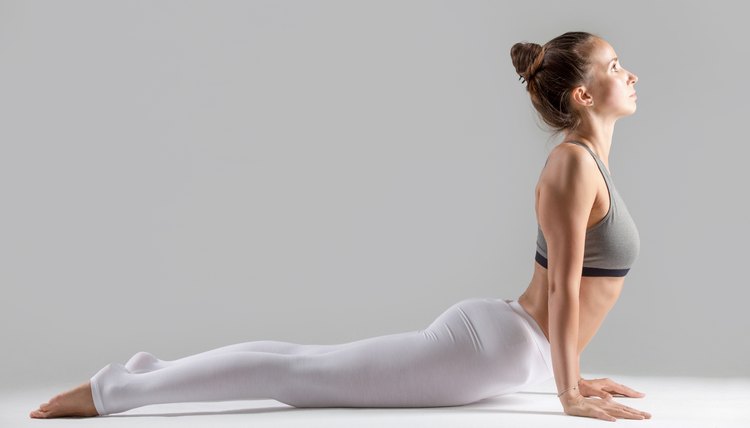
Pain going from the lower back to the legs is also known as sciatica.
Lumbar Radiculopathy
A radiculopathy can happen in any place in your spine -- the cervical, thoracic or lumbar portions. However, if you have pain from your lower back down into your legs, it's a lumbar radiculopathy. The nerves that run down into your legs are located in your lower back, known as the lumbar region. Sciatica is another term for the same problem -- pain running from the lower back down into the legs.
Treatment
If you have a lumbar radiculopathy the pain can be uncomfortable and even debilitating. Treatment might involve pain medicine and even surgery, but exercise can help. While you might want to simply lie in bed, it's important to keep moving around to reduce your pain. The best exercises for radiculopathy are gentle stretches.
Single Hamstring Stretch
This exercise, from the National Health Service, is a hamstring and lower back stretch.
How To: Lie on your back with a pillow under your head. Your feet should be flat on the ground and knees bent. Grab behind one thigh and pull that leg in a few inches. Extend the leg that you're holding and try to straighten your knee. Hold for 20 to 30 seconds, then switch sides.
Piriformis Stretch
The piriformis, a muscle underneath your glute, can become very tight if you have sciatica.
How To: Lie on your back with your feet on the ground. Cross your right ankle over the left knee. Grab your left knee right above the shin with both hands and lean back. Hold for 20 to 30 seconds, then switch sides.
Double Knee to Chest
This is a gentle lower back stretch that can help with a spondylolisthesis.
How To: Lie on your back and hold the front of each knee with one hand. Pull your knees in towards your chest and let your back stretch.
Back Extension
This exercise will help you strengthen your multifidus, which is a muscle that runs along the entire length of your spine. If you have a radiculopathy this muscle can start to weaken, according to a 2007 study in Spine, so it's important to strengthen it.
How To: Lie on your stomach with your arms by your sides and legs straight on the ground. Pull your head, shoulders, and chest up off of the mat with your lower back muscles. Then slowly lower back down to the mat.
References
- Mindbodygreen: 4 Exercises for Sciatic Pain Relief
- Science Direct: Lumbosacral Radiculopathy
- Cleveland Clinic: Spondylolisthesis
- American Academy of Physical Medicine and Rehabilitation. Cervical radiculopathy. 2019.
- Alexander CE, Varacallo M. Lumbosacral radiculopathy. [Updated 2019 Mar 23]. In: StatPearls [Internet]. Treasure Island (FL): StatPearls Publishing; 2019 Jan-.
- Caridi JM, Pumberger M, Hughes AP. Cervical radiculopathy: a review. HSS J. 2011;7(3):265–272. doi:10.1007/s11420-011-9218-z
- Zhang X, Zhang Z, Wen J, Lu J, Sun Y, Sang D. The effectiveness of therapeutic strategies for patients with radiculopathy: A network meta-analysis. Mol Pain. 2018;14:1744806918768972. doi:10.1177/1744806918768972
- AAOS. Cervical Radiculopathy: Surgical Treatment Options. AAOS website.
- AAOS. Cervical Radiculopathy (Pinched Nerve). AAOS website.
- Canale, S., Beaty, J. Cervical Disc Disease. Canale and Beaty: Campbell's Operative Orthopaedics. 11th ed.
- Neuroscience Resource Pages. Radiculopathies.
Writer Bio
Henry is a freelance writer and personal trainer living in New York City. You can find out more about him by visiting his website: henryhalse.com.