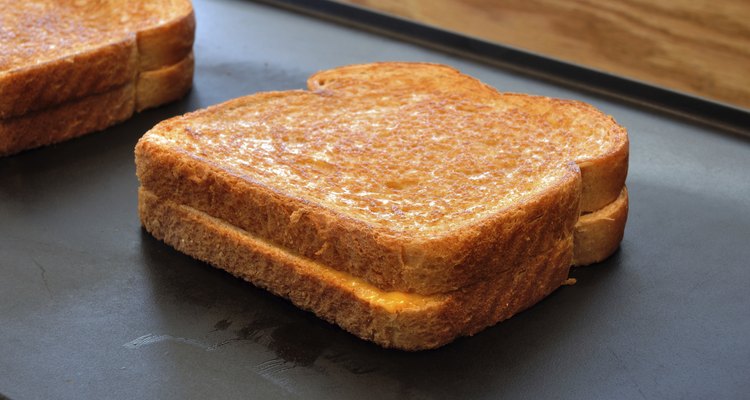
Mark Herreid/iStock/Getty Images
Few children can resist the sight of a crisp, warm and gooey grilled cheese sandwich. Adults also enjoy a grilled sandwich bubbling with cheddar. With obesity in adults, and alarmingly even in American children, on the rise it's legitimate to question whether grilled cheese sandwiches are healthy.
History
The grilled cheese sandwich is believed to have originated in the 1920s with the creation of mass produced sliced bread. Initially an open faced sandwich, it had only the bottom slice of bread as is common in European sandwiches. Deliciously cheesy, the grilled cheese sandwich is still a favorite among Americans of all ages. Recipes vary from kitchen to kitchen but are nearly always made with an orange colored cheese, namely American cheese or aged cheddar.
Comparisons
Compared with similarly sized food fare, grilled cheese made with high-quality bread and one of the most popular brands of orange colored melting cheese is still higher in both calories and fat. For example, a Wendy's Junior burger has 230 calories while four slices of Kraft American cheese have 84 calories and two slices of La Brea Whole Grain have 320 calories for a total of 420 calories. The burger has less fat, with 3 g saturated fat with a total of 8 g of fat. In comparison the four slices total 12 g saturated fat and an overall 32 g of fat and two slices of whole grain have 30 calories from fat with a grand total of 62 fat calories. Similarly, a slice of Pizza Hut cheese pizza has 240 calories, 4.5 g saturated fat and a total of 11 g fat and 12 g for a pepperoni slice.
Cheese
The heart of the grilled cheese sandwich, both literally and figuratively, is its cheese. Cheese selection directly adjusts the health of this sandwich. The two most common cheeses for this much loved sandwich are cheddar and American. While American cheese is often considered bland, it is noticeably lower in fat. Kraft brand American cheese has 8 g of fat per slice, of which 3 g are saturated. Total calories per 21 g Kraft slice are 70, from which 45 are from fat, with 20 mg cholesterol and 270 mg sodium. Kraft cheese has no dietary fiber, 1 g sugar, 4 g protein and no vitamin C or iron. In subtle contrast, Kraft mild cheddar is described in 28 g calories per slice and has 10 g fat, of which 6 g are saturated, with 30 mg cholesterol and 180 mg sodium. Kraft cheddar also has no dietary fiber, vitamin C or iron. While free of sugar Kraft's mild cheddar has 6 g protein. However, both cheeses are high in calcium. As the NIH National Heart Lung and Blood Institute reminds us, "fat matters but calories count." Nutritionally similar the healthiest sandwiches are achieved by using the most personally satisfying melting cheese because satiation decreases overeating.
Bread
At its least, healthy grilled cheese is made with highly processed bread devoid of the primary components of the grain kernel. This "white bread" and other similar "enriched wheat" breads lack dense nutritional value critical in the three primary meals of the day. So white bread and false wheat bread is filling yet leaves vitamins and minerals for healthy cell function unmet. A half of a sandwich as a between meal snack may be a satisfying compromise to fans of white bread. Alternatively, the healthiest grilled cheese sandwiches are made from one hundred percent whole grain breads. The higher fiber content of whole grain bread provides more nutrients, a greater sense of fullness and cleanses the intestines. One slice of La Brea whole grain for example has 3 g dietary fiber, or 11 percent of daily value based on a 2,000 calorie diet. In comparison Wonder Bread's Classic White has zero dietary fiber while it's Smart White has 3 g. Consequently, the American Diabetes Association recommends whole wheat breads because they contain all three parts the grain kernel, resulting in more vitamins, minerals and essential fatty acids.
The Grill
Preparing the grill also influences the fat content of grilled cheese. The classic American grilled cheese sandwich recipe is made by buttering the bread to enhance flavor and grilling effect. However, grilling with a dab of olive provides a better "good" cholesterol content. A mere teaspoon of extra virgin olive oil swirled in a warm frying pan to coat evenly serves to toast one side of a grilled cheese sandwich. Lightly salting the oiled pan, or healthier yet, placing a spring of fresh thyme or oregano adds subtle flavor.
Related Articles

How Many Calories Are in One Slice of ...

Whole Eggs Vs. Egg Yolks for Sweet Bread
Russian Rye Bread vs. Pumpernickel
Which Cheeses Are Lower in Fat?
Types of Cheese Used in Pizza

Canned Tuna Vs. Fresh Tuna
Zwieback Toast vs. Melba Toast
Nutritional Information for Cheesecake ...

What Is the Best Way to Toast ...

How to Serve Sauerkraut

Things to Make With Ciabatta Bread & ...
How to Cook Hot Ham & Cheese in the Oven

Buttered Toast & Bodybuilding
What Is the Difference Between Scones & ...
How to Toast a Baguette

How to Make a Vegemite Sandwich
Calories in Banana Bread With Chocolate ...
The Dangers of Roquefort Cheese
How Long Does Banana Bread Stay Fresh?

Strontium Titanate Vs. Diamond
References
Resources
Writer Bio
Based in Western Washington's wine-tasting country, Laurel Lake has enjoyed working in research and writing since 2001. She also enjoys backpacking, cooking, teaching abroad, teaching fitness classes and is a former registered yoga instructor. Lake holds a Master of Public Health from George Washington University.
Photo Credits
Mark Herreid/iStock/Getty Images