
What does fact checked mean?
At SportsRec, we strive to deliver objective content that is accurate and up-to-date. Our team periodically reviews articles in order to ensure content quality. The sources cited below consist of evidence from peer-reviewed journals, prominent medical organizations, academic associations, and government data.
The information contained on this site is for informational purposes only, and should not be used as a substitute for the advice of a professional health care provider. Please check with the appropriate physician regarding health questions and concerns. Although we strive to deliver accurate and up-to-date information, no guarantee to that effect is made.
What Type of Push-Ups Will Work My Rear Deltoids?
Comprised of three separate sets of fibers, the deltoid muscles -- more commonly called the "delts" -- wrap around the contour of the shoulders. The largest of these is the anterior deltoid, which is the most visible on the shoulder and the muscle most people exercise the most -- too often to the exclusion of the other parts of the muscle. That's too bad because neglecting the middle and rear deltoids can not only cause you to have an unbalanced look, it can also result in serious shoulder problems.
Normal push-ups don't do much for the rear deltoids because the demands are mostly put on the front and middle delts. If you really want to work them, you might actually benefit more from doing the dumbbell rear lateral raise or lever seated reverse flies.
Alas, the options are quite limited for working those rear delts with pure body weight exercises. However, if you're taking a break from the gym or want to stick to a steady diet of body weight exercises, there is one push-up variation that will give them the tough love they deserve: the one-armed push-up.
About the Rear Delts
The rear delts are the smallest of the delt muscles and they're tucked away behind the shoulders. They cross the back of the shoulders and provide the opposing action to the anterior delts, allowing you to raise your arm backwards above your waist. ACE recommends targeting the rear delts at the beginning of your workout because it's usually the weakest of the shoulder muscles, then following up with the stronger front delt.
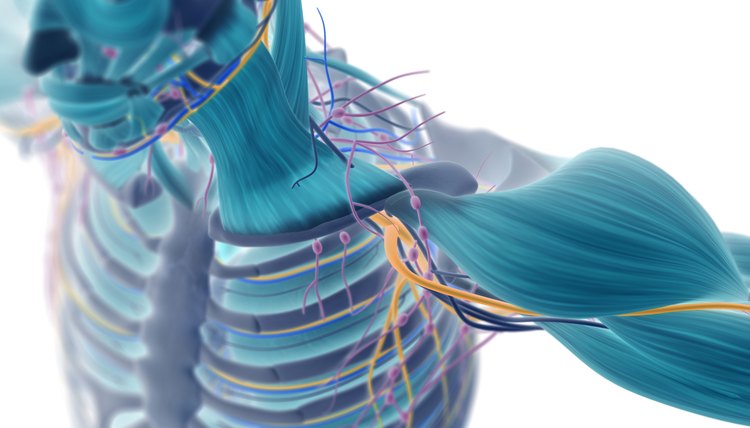
The rear delts are the smallest of the shoulder muscles, and usually the weakest.
One-Armed Push-Up
Two-handed push-ups don't cut it for the rear delts, but switch to one-hand and their fibers will light up the EMG. At first, you may find it easier to do the push-up at an incline, using a bench or step.
Assume the push-up position with one hand placed on the floor or elevated surface. Your feet should be wider than a normal push-up, well past hip-width.
Holding your free hand close against your lower back, tense the muscles throughout your entire body.
Slowly bend your elbow to lower your body until your chest almost touches the floor. Extend the elbow to return to the starting position.
One-Armed Plyometric Push-Up with Medicine Ball
Now turbo-charge those one-handed push-ups with a medicine ball and your rear delts will definitely let you know they exist.
Kneel before a medicine ball, put one hand atop the ball and the other on the floor. The hands should be spaced at a slightly wider than the shoulders.
Position your upper body with one arm straight on the ground and your other arm bent with your hand on the ball. Straighten your body with your feet at shoulder width.
Bend your elbows to lower your body until you feel a stretch is your shoulders or chest and immediately thrust your body upward rapidly. Keep pushing down on the medicine ball, lifting your other hand off the floor as your body rises upward. Use the floor hand to catch yourself as you come back to the ground. Repeat.
Explore In Depth
References
- ACE Fitness: Dynamite Delts: ACE Research Identifies Top Shoulder Exercises
- Science, Theory and Clinical Application in Orthopaedic Manual Physical Therapy, by Ola Grimsby, Jim Rivard
- Dance Anatomy and Kinesiology, by Karen S. Clippinger
- Schory A, Bidinger E, Wolf J, Murray L. A systematic review of the exercises that produce optimal muscle ratios of the scapular stabilizers in normal shoulders. Int J Sports Phys Ther. 2016;11(3):321-336.
- Sakoma Y, Sano H, Shinozaki N, et al. Anatomical and functional segments of the deltoid muscle. J Anat. 2011;218(2):185-190. doi:10.1111/j.1469-7580.2010.01325.x
- Kim MK, Lee JC, Yoo KT. The effects of shoulder stabilization exercises and pectoralis minor stretching on balance and maximal shoulder muscle strength of healthy young adults with round shoulder posture. J Phys Ther Sci. 2018;30(3):373-380. doi:10.1589/jpts.30.373
- Snarr RL, Hallmark AV, Casey JC, Esco MR. Electromyographical comparison of a traditional, suspension device, and towel pull-up. J Hum Kinet. 2017;58:5-13. doi:10.1515/hukin-2017-0068
- Schoenfeld BJ, Contreras B, Krieger J, et al. Resistance training volume enhances muscle hypertrophy but not strength in trained men. Med Sci Sports Exerc. 2019;51(1):94-103. doi:10.1249/MSS.0000000000001764
Writer Bio
Martin Booe is a health, fitness and wellness writer who lives in Los Angeles. He is currently collaborating on a book about digital addiction to be published in the UK this December.