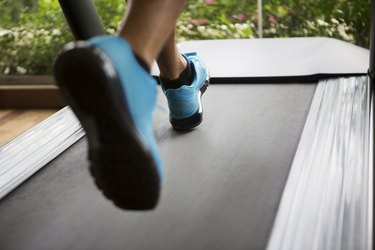
No, endless crunches and legs lifts aren't the secret to a flat belly. Ab exercises may strengthen the muscles that lie underneath excess fat, but they don't burn it off. In other words, you can't spot reduce: The best weight-loss plan includes both a comprehensive workout routine — complete with cardio and strength training — and a healthy diet.
But even though cardio is important, you shouldn't just hop on the treadmill, plod along for 30 minutes and expect to lose a lot of weight, either. Picking the right kind of cardio is also crucial, and that means high-intensity cardio and high-intensity interval training (HIIT) workouts. If you want cardio to burn fat and lose weight, choose a form of exercise that raises your heart rate for an extended period of time.
You also need to be diligent about the amount of time you spend doing cardio exercise to lose weight. A January 2014 paper published in Progress in Cardiovascular Diseases notes that exercise exceeding 200 minutes per week, or 40 to 45 minutes per day five days per week, yields far greater weight loss than the minimum recommendation from the Centers for Disease Control and Prevention of 150 minutes per week. This minimum amount is to support good health, not necessarily weight loss.
Tip
You can't target a specific part of your body, such as your belly, for weight loss. But boosting the intensity of your cardio workouts will help you lose more weight overall.
Read more: The Truth About Running for Weight Loss
Ready to break a serious sweat? Here are the best cardio exercises for weight loss.
1. High-Intensity Cardio
There is no one best cardio exercise for weight loss. The type of cardio exercise you choose is less important than the intensity at which you perform it. While any activity is better than no activity when it comes to weight loss, moving at a high intensity or performing high-intensity cardio is most effective.
In an August 2017 study published in Health and Quality of Life Outcomes, researchers measured different exercise intensities' effect on weight loss. After 12 weeks, people who exercised at a high intensity, defined as 70 to 80 percent of maximum heart rate, three days a week lost significant weight, reduced their waist circumference and reduced overall body fat. Although people exercising at lower intensities still lost weight, their results weren't as notable as the high-intensity exercisers.
To make things a bit easier, here's a ranking of the cardio workouts that burn the most calories, based on the Harvard Health Publishing's average caloric burn for a 155-pound person for 30 minutes of high-intensity work:
- Stationary cycling: 391 calories
- Running (6 mph): 372 calories
- Swimming: 372 calories
- Jumping rope: 372 calories
- Step aerobics: 372 calories
- Elliptical: 335 calories
- Rowing machine: 316 calories
- Circuit training: 298 calories
- Outdoor bicycling (12 to 14 mph): 298 calories
- Stair stepper: 223 calories
Remember to choose an exercise that you enjoy for your high-intensity routines. If you don't like it, you're far less likely to make it a regular part of your life, which is essential to losing weight and keeping it off. Even after you've achieved your goal weight, you'll need to continue to exercise 200 minutes or more per week to stay there.
How to do it: Warm up for five to 10 minutes at an easy pace with your exercise of choice — this could be on a stationary bicycle, treadmill or outdoor track. Then work at an intensity that's 70 to 85 percent of your maximum heart rate for 20 to 25 minutes or longer, per the Centers for Disease Control and Prevention. Be sure to cool down for several minutes. Do this routine three to four times per week.
Read more: How to Lose Belly Fat With These 7 Cardio Workouts
2. High-Intensity Interval Training
HIIT, or high-intensity interval training, which involves alternating short bouts of all-out effort with short periods of rest or lower-intensity effort, blasts fat: A January 2017 in the Journal of Diabetes Research found that this type of exercise burns more fat than steady-state cardio performed at a constant moderate pace.
A February 2018 study published in the Journal of Exercise Rehabilitation also found that high-intensity interval training three times a week for 12 weeks resulted in a decrease in fat mass percent, lower body mass indexes and improved health markers such as lower cholesterol.
How to do it: Warm up for five to 10 minutes, and then structure your workout so you go hard (near or at maximum effort) for anywhere from 30 seconds to four minutes at a time. Recover for an equal or slightly longer period of time. Continue for 20 to 30 minutes. Example: Sprint on a treadmill or track for one minute, then walk for one minute 10 times, for a total of 20 minutes. Cool down at an easy pace for three to five minutes.
Use any type of cardio to complete this workout, including a stationary bike, treadmill, calisthenics (think burpees and squat jumps) or an elliptical trainer.
Perform a HIIT workout three to four times a week and avoid consecutive days of HIIT training.
Read more: How to Use the Elliptical for Fat Loss
Tip
An easy way to figure your maximum heart rate is to subtract your age from 220. For example, if you're 35 years old, your maximum heart rate is 185.
3. Circuit Strength Training
Even though you're after the calorie-burning and fat-loss effects of cardio, strength training is also critical to weight loss. A comprehensive strength-training routine that builds muscle in all the major muscle groups makes your body more efficient at burning calories. Perform your strength-training exercises quickly and back-to-back to elevate your heart rate, build muscle and lose weight.
How to do it: Plan a circuit routine that targets all the major muscle groups: back, chest, arms, shoulders, legs, hips and abs. The circuit may be based on time (30 to 60 seconds per exercise) or on the number of repetitions (eight to 12 executions of each move.)
Do two to three rounds of the entire group of exercises, taking one to two minutes rest between each round. Use weights that fatigue each muscle group by the last couple of repetitions. This means it's difficult for you to complete that last two or three repetitions with good form and through the full range of motion. Circuit train three times a week on non-consecutive days (say, Monday, Wednesday and Friday).
Here's an example of a repetition-based circuit strength routine for weight loss to get you started.
Move 1: Bent-Over Row
- Stand feet hip-width apart, holding a barbell with an overhand grip.
- Hinge forward from the hips so your back makes a 45-degree angle with the floor.
- Bend your elbows to pull the bar toward your lower ribs as you squeeze your middle back muscles together.
- Straighten your elbows to complete one rep.
Move 2: Chest Press
- Lie on your back on a workout bench, holding a dumbbell in each hand, palms facing your feet.
- Bend elbows out to the sides as you lower the weights down to your chest; elbows form a 45-degree angle with the body and upper arms are parallel to the floor.
- Push the weights back up to straighten the elbows to complete one repetition.
Move 3: Biceps Curl
- Stand with your feet hip-width apart. Hold a dumbbell in each hand, arms extended in front of your thighs and palms facing forward.
- Keep your upper arms close to your torso and bend your elbows to curl the weight to the fronts of your shoulders.
- Lower the weights back down to complete one repetition.
Move 4: Triceps Kickback
- Stand with feet hip-distance apart and knees bent.
- Tilt your torso 45 degrees forward, keeping your spine long.
- Hold a weight in each hand bend at the elbows to bring your hands toward the shoulders in front of you.
- Straighten your arms back behind you, keeping your shoulders elbows locked in place.
- Lower back to the start with control.
Move 5: Squat
- Stand with the feet a little wider than your hips. Hold a dumbbell in each hand, arms hanging alongside your thighs.
- Bend your knees and hips to lower your thighs so that they’re parallel to the floor. Keep your knees behind your toes, maintain full foot contact with the ground and push your buttocks back.
- Straighten the legs and hips to complete one repetition.
Move 6: Lunge
- Hold a dumbbell in each hand, feet hip-distance apart.
- Take a big step forward and bend the front knee to a 90-degree angle. You’ll be balanced on the front foot and the ball of the back foot; keep your torso perpendicular to the floor.
- Push off the front foot to return the feet together.
- Repeat on the other side.
Move 7: Bicycle Crunch
- Lie on your back on a mat. Place your hands alongside your head, elbows pointed to the sides. Lift your legs up so the knees and hips create a 90-degree angle.
- Crunch your right elbow toward your left knee as you extend the right leg parallel to the ground.
- Repeat in the opposite direction.
Do 45 seconds of the following machine-based strength exercises for a time-based circuit:
- Lat pulldown
- Chest press
- Triceps extension
- Biceps curl
- Leg press
- Hamstring curl
- Seated crunch
Do all the exercises in quick succession, rest one to two minutes, then repeat one or two more times. The entire workout should take about 20 to 25 minutes.
Read more: Want to Lose Weight at the Gym? Follow This Plan