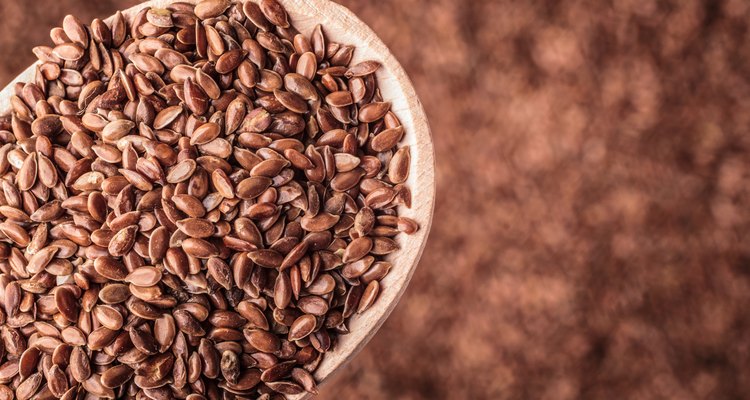
Anetlanda/iStock/Getty Images
If you're looking to add nutritional value to your diet, the University of Massachusetts Medical School recommends trying flax or wheat germ, the oil-rich, inner layer of the wheat grain. Both foods offer essential nutrients that support your health and a moderate number of calories -- a 2-tablespoon serving of ground flax and wheat germ contains 75 and 52 calories, respectively. Flax and wheat germ differ slightly in their nutrient content, and both are worthwhile additions to your diet.
Healthy Fats
Both wheat germ and flax come loaded with healthy fats, though they differ in fatty acid composition. Flax contains the omega-3 fatty acid alpha-linolenic acid, a fat that might lower cardiovascular disease risk, explains the Linus Pauling Institute. Each 2-tablespoon serving contains 3.2 grams of ALA, which covers your intake requirements for the day. Wheat germ, while not a source of omega-3s, still contains beneficial unsaturated fats, which improve your blood cholesterol levels. A 2-tablespoon portion of wheat germ contains 1.4 grams of fat, with 1.2 grams coming from unsaturated fat.
Dietary Fiber
Flaxseed has a leg up on wheat germ when it comes to beneficial fiber. Each serving of ground flax packs 3.8 grams of fiber into your meal -- twice as much fiber as a serving of wheat germ -- and provides 15 percent of the daily fiber needs for women and 10 percent for men. Fiber fends off constipation by helping food pass through your digestive system, and high-fiber diets might support healthy weight control, notes Colorado State University Extension.
Essential Minerals
Flax offers more manganese, but less copper, than wheat germ. Both manganese and copper support your cellular metabolism and contribute to healthy bone and connective tissue. You also use copper to synthesize neurotransmitters -- a group of chemicals needed for nerve communication. A serving of flax contains 171 micrograms of copper, which makes up 19 percent of your daily needs, while an equivalent serving of wheat germ contains 115 micrograms. On the other hand, a serving of wheat germ boasts 1.91 milligrams of manganese -- 83 percent of the daily recommended intake for men and the entire daily requirement for women -- while flaxseed contains just 0.35 milligram.
Serving Tips and Suggestions
Blend flaxseed or wheat germ into your juices and smoothies -- they'll add more texture to your beverage while boosting its nutritional value. Flaxseeds and wheat germ also work well in baked goods -- just stir a few tablespoons into the batter. Try making homemade whole-grain blueberry muffins with flax or wheat germ for a nutritious and satisfying breakfast. Alternatively, sprinkle a few tablespoons of either food over your hot or cold cereal or use them as a healthful topping for salads. Store wheat germ and flax in the fridge to prevent spoilage, recommends the University of Massachusetts Medical School.
Related Articles

Kamut Vs. Wheat

The Nutritional Value of Edamame Beans

Benefits of Cottage Cheese

Flaxseed Meal Nutrition

Is Flaxseed Good for Men?

The Nutrition of Stone Ground Corn

Calories in Candied Walnuts

How to Substitute Wheat Germ for Flour
Peanuts Vs. Pistachios

Nutrition in Calabaza Squash

How Much Whole Grain Should You Eat a ...

Nutrition Information on Blueberries

Oat Bran Vs. Wheat Germ

How to Get Rid of Scars With Wheat Germ ...

Benefiber as an Appetite Suppressant

Nutritional Value of String Beans

The Nutrition in Coconut Powder

Cracked Wheat Nutrition

Bulgur Vs. Farro

Can I Exercise on the Master Cleanse ...
References
Writer Bio
Sylvie Tremblay holds a Master of Science in molecular and cellular biology and has years of experience as a cancer researcher and neuroscientist.
Photo Credits
Anetlanda/iStock/Getty Images