
Weider Home Gym Workout Plan
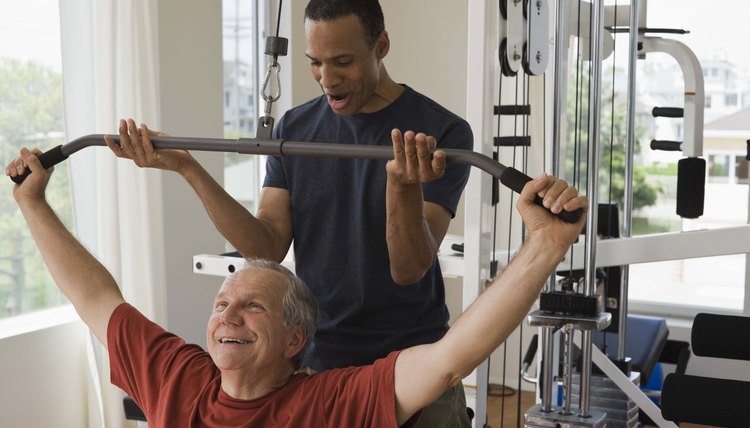
The Weider fitness company offers two home gyms that allow you to create resistance training, muscular endurance or aerobic workout routines. The X-Factor home gym is a progressive resistance machine that uses pulleys providing up to 210 lbs. of resistance, while the Club 8980 W machine uses pulleys and weight stacks to provide up to 175 lbs. of resistance. You can create workouts tailored to your needs based on how much weight or resistance you use.
Considerations
Before planning a workout for a Weider home gym, consider your health and fitness goals. Health goals would include aerobic exercise to improve blood cholesterol and cardio capacity. Fitness goals would include improving muscular endurance and cardiovascular stamina. Weight loss goals would most likely require aerobic exercise. Bodybuilding would focus on heavy weight or high resistance exercises. You may want to achieve more than one goal, so rank your objectives in order of importance.
Muscle Building Workout Plan
Use more weight or higher resistance to build muscle with a Weider home gym. Your workout plan should include performing one or two sets of lifts using 60 to 80 percent of your maximum weight or resistance, then performing two to three sets using your maximum. Perform three to five reps of an exercise, and take two to three minutes between sets. Perform three to five sets of one exercise before moving on to the next. Muscles grow larger as they repair the damage you do during weightlifting, so take 24 to 48 hours between workouts. Consider alternating upper- and lower-body workouts.
Muscular Endurance Workout Plan
If you participate in sports, you'll want to train muscular endurance, which allows you to use your muscles for longer periods of time, rather than just one or several lifts. Do this by decreasing the resistance on the Weider gym to 40 to 70 percent of your max and increasing the number of repetitions per set to eight to 12, depending on your starting strength level. Create a circuit-training workout plan by performing multiple exercise sets during the course of your workout, taking only one-minute breaks between sets. A Weider home gym lets you perform many familiar exercises such as biceps curls, chest presses, triceps extensions, lat pulls and flyes.
Aerobic Workout Plan
You can create an aerobic workout using a Weider home gym by using little resistance or weight and working at a faster pace. In addition to burning calories and improving your cardiovascular capacity, you'll tone muscle. Perform an aerobic workout using resistance settings that allow you to continue working non-stop for 30 minutes or longer. You can take short breaks as you change exercises or machine settings or your position on the machine. Elevate your heart rate until you are breathing hard but are still able to talk.
Warming Up and Cooling Down
Regardless of what type of workout you do on a Weider home gym, start with a warm up that use little or no resistance to gradually elevate your heart rate, stretch your muscles and bring more blood and oxygen to your cardiorespiratory system. This will help create better workouts, according to fitness author and performance coach Brian Mac. Finish every workout with a cool down consisting of gradually decreasing muscle movements. This will help prevent blood from pooling in your muscles and help reduce stiffness and soreness later. After your heart rate has gone below 100 beats per minute or you have stopped breathing hard, stretch the muscles you used to help reduce later stiffness and improve flexibility.
References
Resources
Writer Bio
Sam Ashe-Edmunds has been writing and lecturing for decades. He has worked in the corporate and nonprofit arenas as a C-Suite executive, serving on several nonprofit boards. He is an internationally traveled sport science writer and lecturer. He has been published in print publications such as Entrepreneur, Tennis, SI for Kids, Chicago Tribune, Sacramento Bee, and on websites such Smart-Healthy-Living.net, SmartyCents and Youthletic. Edmunds has a bachelor's degree in journalism.