
What does fact checked mean?
At SportsRec, we strive to deliver objective content that is accurate and up-to-date. Our team periodically reviews articles in order to ensure content quality. The sources cited below consist of evidence from peer-reviewed journals, prominent medical organizations, academic associations, and government data.
The information contained on this site is for informational purposes only, and should not be used as a substitute for the advice of a professional health care provider. Please check with the appropriate physician regarding health questions and concerns. Although we strive to deliver accurate and up-to-date information, no guarantee to that effect is made.
The Difference Between Hang Cleans, Power Cleans and Clean Pulls
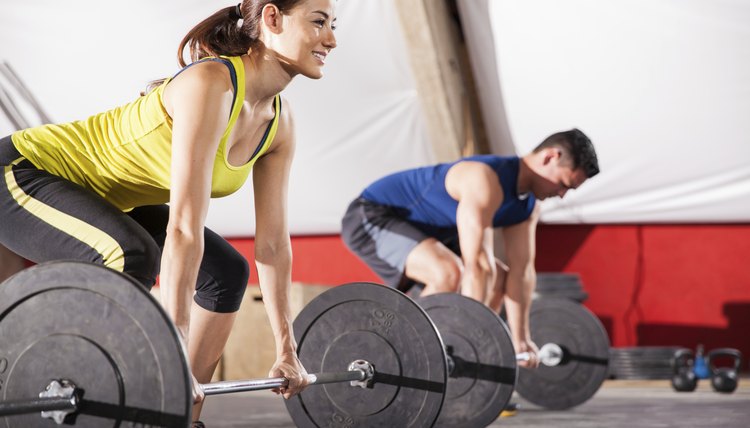
Hang cleans, power cleans and clean pulls are explosive, Olympic weightlifting exercises that build power in your hips, glutes, quads and lats. Athletes and advanced lifters often incorporate all three into their training programs. The exercises vary slightly in technique and offer different training benefits, which makes them very popular crossfit exercises for strength training.
What is a Hang Clean?
The hang clean is a combination of a deadlift and a front squat and is utilized to strengthen your hamstrings. It requires you to begin with the barbell at the front of your thighs. To get into starting position, stand with feet shoulder-width apart and hold the barbell with your hands set to just outside the width of your shoulders. Bend your hips and knees so that the barbell rests at your mid-thigh, your arms are straight and your shoulders are over the top of the bar.
Explosively extend your hips, knees and ankles to jump, using that force to propel the barbell upward. Shrug your shoulders and continue to pull the bar upward with your arms. The bar should remain close to your torso. Pull your body under the bar and rotate your elbows around the bar to catch it at your shoulders as you drop into a squat position. Drop to the lowest point of your full squat and then quickly stand up.
What is a Power Clean?
The power clean, or hang power clean, is very similar to the hang clean, with the main difference being that the bar begins on the floor rather than at the front of your thighs. This workout requires greater range of motion and explosiveness at your hips and knees at the starting hang position, which makes it a popular olympic lifting exercise. Stand with your feet positioned under the barbell. Grip the bar with your hands just wider than your shoulders, with your arms straight and your shoulders over the top of the bar. Extend your hips and knees to pull the bar off the floor and propel it upward. When it reaches your knee, explode into a jump and shrug your shoulders. Pull your body under the bar and rotate your elbows under the bar to catch it at your shoulders. Drop into a squat and stand up.
What is a Clean Pull?
The clean pull is often used as a training exercise for both hang cleans and power cleans. It’s designed to help you learn to propel the barbell upward through force produced in your hips and legs. You can perform it either from the hang or power position, with the bar at your thighs or floor. Grip the bar with your hands slightly wider than your shoulders. Drive upward, forcefully extending your hips, knees and ankles. Simultaneously shrug to continue to propel the bar upward. Rather than propelling your body under the bar to catch it at your shoulders, land softly in a standing position and allow the barbell to fall back in front of your thighs.
Benefits of Each Exercise
The clean pull is beneficial for beginners as well as those athletes and exercisers who want to limit the stress on their shoulders, elbows and wrists. For example, in-season football players may opt for clean pulls if their upper-body joints and upper back are sore from competition. If you’re primarily interested in building muscle and lower-body power, the hang clean may be the best option, as it produces the greatest amount of force and power in your hips, knees and ankles. The power clean is the only of the three exercises to engage the stretch-shorten cycle, which means your muscles are actively stretched immediately before they’re forced to contract. This is similar to how the muscles must work when jumping, so power cleans may be best for basketball, volleyball and other jumping athletes.
Lifting Tips
Whichever exercise you perform, complete three reps for three to five sets. Start by using a broomstick and move to an unloaded barbell as you master the technique. When you're comfortable, select a heavier weight that requires you to produce the force in your hips and legs rather than being able to pull the bar upward with your arms. The weight you use should make completing three reps challenging. Don’t be afraid to use dumbbells in order to learn proper technique.
References
Resources
Writer Bio
Kim Nunley has been screenwriting and working as an online health and fitness writer since 2005. She’s had multiple short screenplays produced and her feature scripts have placed at the Austin Film Festival. Prior to writing full-time, she worked as a strength coach, athletic coach and college instructor. She holds a master's degree in kinesiology from California State University, Fullerton.