
What does fact checked mean?
At SportsRec, we strive to deliver objective content that is accurate and up-to-date. Our team periodically reviews articles in order to ensure content quality. The sources cited below consist of evidence from peer-reviewed journals, prominent medical organizations, academic associations, and government data.
The information contained on this site is for informational purposes only, and should not be used as a substitute for the advice of a professional health care provider. Please check with the appropriate physician regarding health questions and concerns. Although we strive to deliver accurate and up-to-date information, no guarantee to that effect is made.
Muscles Used During a Supine Dumbbell Press
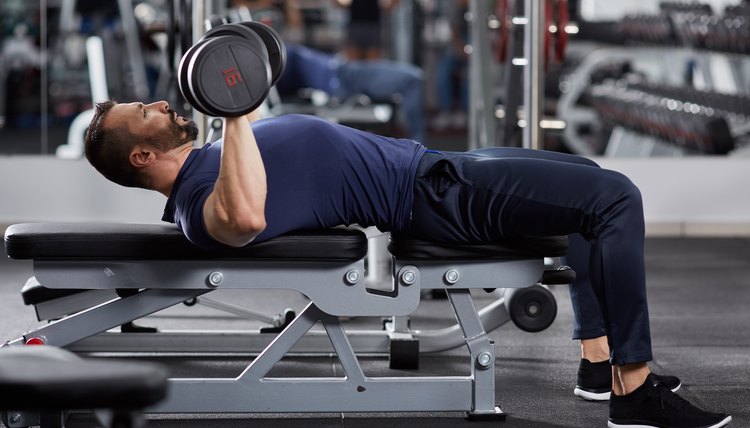
To figure out what the supine dumbbell press is all about, let's take a closer look at its name. Because it's supine, you know that you'll be lying down on your back. And since it's a press, it's a safe bet that you'll lifting weights over your head.
Now don't be shy — imagine that you're lying down and give those imaginary dumbbells a press. Feel that engagement in your pecs? That's because the supine dumbbell press mainly targets the chest — but its benefits don't end there.
Targeting the Pecs
Call it the supine dumbbell chest press or the dumbbell bench press, this classic lift starts with your back flat on a bench, arms bent at 90 degrees, and a dumbbell in each hand with your palms facing out.
As you extend your arms upward — stopping just before your elbows lock — and return to the starting position, you should feel a little stretch in your chest. That means you're engaging the lift's key target: The sternal head of the pectoralis major.
Since "sternal head of the pectoralis major" doesn't exactly roll off the tongue, you'll usually hear these muscles referred to as the lower pecs or just pecs. These fan-shaped muscles make up most of your chest, and they don't just look good in a slim-cut tee; they're absolutely essential to helping along the movement of your shoulder joints.
Assistance From the Shoulders and Arms
The supine dumbbell press has earned its place in the pantheon of essential chest workouts, but let's not forget about its synergists. These are the muscles that help an exercise's target muscles perform a full movement, which means that — while they might not be the target — they get worked, too.
As you perfect your lower pecs, you're also working your clavicular part of your pectoralis major and the anterior deltoids, a smaller muscle group that connect your upper chest to your shoulders. At the top of the movement, it's up to your arms to keep the weight safely above your head. That's when you'll feel your triceps (triceps brachii) and biceps (biceps brachii) — two key upper arm muscles — kick in as stabilizers.

The supine dumbbell press goes beyond the pecs.
A Few More Perks
As a compound exercise, the supine dumbbell press gets two or more of your joints moving, which is one reason it excels at building that chest muscle. And while barbells are synonymous with chest presses and bench presses, the simple act of using dumbbells comes with a host of benefits: They offer a greater range of motion, and put less strain on shoulders, elbows and wrists.
Sometimes, a funny thing happens when you press a barbell; the stronger side of your body might help your weaker side bear a heavy load, making for uneven muscle engagement. That's not the case for a dumbbell exercise like this supine press, which also engages stabilizers more actively than your average barbell press.
Pressing On
There's no question that the dumbbell bench press is an effective option for working the chest and upper arms, but it's a big world out there in the gym. Is this supine press one of your go-tos on chest day, or do you have a different secret weapon? What about dumbbell press variations? Let us know in the comments — your pecs might just thank you.
References
- Oregon State University MediaSpace: Exercise of the Week: Supine Dumbbell Chest Press
- ExRx.net: Dumbbell Bench Press
- The Crossfit Journal, Issue 45, May 2006: The Press
- ExRx.net: Pectoralis Major (Sternal Head)
- Lauver JD, Cayot TE, Scheuermann BW. Influence of bench angle on upper extremity muscular activation during bench press exercise. Eur J Sport Sci. 2016;16(3):309-16. doi:10.1080/17461391.2015.1022605
- Trebs A, Brandenburg J, Pitney W. An electromyography analysis of 3 muscles surrounding the shoulder joint during the performance of a chest press exercise at several angles. J Strength Cond Res. 2010;24(7):1925-1930. doi:10.1519/jsc.0b013e3181ddfae7
- Trebs A, Brandenburg J, Pitney W. An electromyography analysis of 3 muscles surrounding the shoulder joint during the performance of a chest press exercise at several angles. J Strength Cond Res. 2010;24(7):1925-1930. doi:10.1519/jsc.0b013e3181ddfae7
Writer Bio
In addition to fitness experience including USFCA fencing discipline, stage combat, track and equestrian training, Dan has contributed health and fitness-oriented content to AZCentral, SportsRec, JillianMichaels.com, ModernMom, The Nest and more.