
You want to be or stay fit and healthy, but where do you start? It may seem overwhelming, but it's the small things you do each day that add up to a fit and healthy lifestyle.
Accept that you're always a work in progress, and use these 14 tips as a guide for your journey on the path to good health.
Video of the Day
Video of the Day
1. Kick Unhealthy Habits
Habits are a part of life, and they can be helpful in a lot of ways. But those that are pleasure-based are so much harder to quit, according to the National Institutes of Health — and oftentimes bad for your health.
Because there's no way to do any of these in a healthy way, the "to-quit" category includes:
- Smoking
- Excessive drinking
- Drugs
- Unsafe sex
Unhealthy eating and being sedentary can also develop into bad habits if they're not done in moderation, according to the University of Phoenix.
"Habits become habits because they are easy and provide reward," says Shanna Levine, MD, board-certified internal medicine doctor and owner of Goals Healthcare. "In order to kick bad habits, surround yourself with people that maintain healthy habits, and make healthy habits easy and rewarding. For example, if you use a nicotine vape and your boyfriend does too, you should both quit together."
A good way to break unhealthy habits is to change your routine, replacing bad habits with good ones.
"If you want to exercise, make it fun. Find a workout buddy or invest in home tools that make it effortless," Dr. Levine says. "I like to watch my favorite shows on the iPad while using my indoor bike, and the hours fly by."
Of course, it'll take some time to kick your unhealthy habits, but it's worth it if you want to lead a healthier lifestyle.



2. Get Your Checkups

Get to your doctor for an annual physical just to make sure everything is as it should be. Routine health exams can help find problems before they really start and help catch health issues early, when chances for treatment and cure are higher, according to the National Library of Medicine.
"As a primary care physician, I cannot stress enough the importance of checkups," says Dr. Levine. "Many of my patients are able to identify and treat many conditions before they become chronic and/or irreversible."
Most routine checkups are covered by insurance, so take full advantage of those benefits. That being said, pay attention to your body and any symptoms you're having, and see your doctor if anything seems awry, even if it's not time for a checkup.
Tip
If you put off doctor's appointments because your physician doesn't seem to really listen to your concerns or shames you about your health in some way, those may be signs it's time to find a new doctor.
3. Make Sleep a Priority
Sleep affects our physical and mental health tremendously, and many people don't get enough, according to Centers for Disease Control and Prevention (CDC).
Lack of sleep adversely affects mood and mental health, concentration, memory, weight, the immune system and cardiovascular health. Sleep allows the body to heal, repair and rejuvenate itself in a way it simply cannot when a person is awake.
The CDC recommends the following amounts of quality sleep each night for adults:
- Ages 18 to 60: 7 or more hours
- Ages 61 to 64: 7 to 9 hours
- Ages 65 and older: 7 to 8 hours



4. Exercise Regularly

When it comes to staying fit, the benefits of consistent exercise should come as no shock. Working out helps manage weight and build muscle, combats health conditions, improves mood, boosts energy, promotes better sleep (see above!) and can even put a spark back into your sex life, according to the Mayo Clinic.
Adults should aim for 150 to 300 minutes of moderate-intensity cardio (think: walking, jogging, biking) or 75 to 150 minutes of vigorous-intensity cardio (running, swimming) throughout the week, according to the Physical Activity Guidelines for Americans. And strength training that works all the major muscle groups should be done at least two days per week.
5. Eat a Nutritious Diet
A nutritious diet is one of the most important ways to stay healthy and fit. The benefits of choosing healthy foods include:
- Improved heart health
- Better gut health
- Healthier skin
- Weight loss
- Improved mood
- Less brain fog
- Balanced blood sugar
Get as many fiber-rich fresh fruits, vegetables and whole grains into your diet as possible and make them the main part of your overall diet, recommends the CDC. Include lean sources of protein such as poultry, fish, tofu and beans. Eat balanced meals and learn portion control in order to stay within your calorie needs.
Limit the sugar, refined carbs (think: desserts and white bread, rice and pasta) and processed foods (packaged fare with long ingredient lists) in your diet, as these tend to serve up lots of calories with little nutritional value.
6. Enjoy Breakfast Every Day
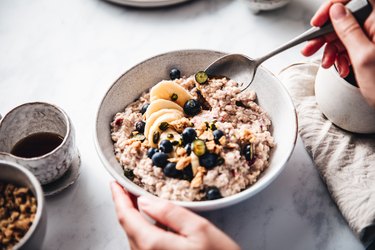
A nutritious breakfast starts your day off right. It not only sets you up so you have energy and fuel for optimal mental and physical performance, but also to maintain stable blood sugar levels and a healthy weight because you are less likely to overindulge later in the day, according to the Cleveland Clinic.
"This is essential. Your breakfast should be nutritional and satisfying," says Dr. Levine.
If you're short on time, pre-plan your morning meal the night before or pick one day a week to make several nutritious grab-and-go breakfasts.
"Smoothies are perfect as you can customize them, they're easy to digest and you can pack a lot of healthy calories in," Dr. Levine says.



7. Hydrate With Water
Staying hydrated is a daily necessity to keep your body functioning properly. All fluids support hydration, but plain water is still the best choice for maintaining a healthy body, according to Harvard Health Publishing.
The benefits of drinking water include:
- Helps carry nutrients and oxygen to your cells
- Flushes the bladder's bacteria
- Aids in digestion and prevents constipation
- Normalizes blood pressure
- Stabilizes the heart
- Cushions joints and protects organs
- Regulates body temperature
- Maintains the sodium level in your body
Convinced yet?
So, how much water should you drink a day? A good general guidelines is to aim for half your body weight in ounces. So, if you weigh 180 pounds, aim for about 90 ounces, or about 11 cups.
8. Reduce Your Stress

Stress is a normal survival response to everyday life pressures, but it can become pretty unhealthy when it starts to disrupt day-to-day functioning, according to the American Psychological Association (APA).
Indeed, chronic stress can affect almost every part of the body — musculoskeletal, respiratory, cardiovascular, endocrine, gastrointestinal, nervous and reproductive systems, the APA notes.
So, how can you handle it?
The APA suggests the following to reduce the harmful effects of stress on the body:
- Regular exercise
- Doing what you love (think: hobbies you enjoy)
- Setting appropriate boundaries
- Spirituality
- Being in nature
- Surrounding yourself with people who support you
- Seeking help from a medical professional
Dr. Levine also believes that meditation, journaling, aromatherapy and reducing or eliminating social media are all quick and easy ways to reduce stress.
"Start with a one-minute guided meditation," she says. "Take 10 minutes in the morning to journal about everything you are grateful for. Grab a small bottle of lavender oil and smell it when you feel stressed. Every little act builds up to a less stressed day."




9. Don't Bottle It Up
Like stress, emotions like fear, anger and grief are a normal part of life. Keeping those emotions bottled up inside can cause mental and emotional stress as well as physical symptoms, according to a February 2019 review in the International Journal of Psychotherapy Practice and Research. Unexpressed feelings can lead to cardiac abnormalities and depression.
Plus, an October 2013 study in the Journal of Psychosomatic Research found that people who bottled up their emotions increased their risk of premature death from all causes by more than 30 percent, with their risk of being diagnosed with cancer increasing by 70 percent. Although it's important to note that more research is needed in this area.
Start by acknowledging your feelings, then talk about them — you can even start a journal or express yourself through some sort of art. And if you think you need to take a bigger step, therapy is always a fantastic option, according to Mental Health America.
Tip
Not all mental health services are covered by insurance, so checking your plan's coverage is a good place to start when searching for a therapist.
10. Find Your Zen

Yoga and meditation don't just help with relaxation and stress reduction — there are tons of physical and mental benefits that these two practices offer.
The benefits of yoga, according to John Hopkins Medicine, include the following:
- Improves balance, strength and mobility
- Helps with back pain
- Eases arthritis symptoms
- Is good for your heart
- Promotes good sleep
- Increases your energy and elevates your mood
- Helps manage stress
- Connects you with a supportive community if you choose to do it in a studio
Some studies also suggest that yoga can help with osteopenia (bone loss), cancer, women's health issues and chronic pain.
Meditation's benefits are equally impressive . The National Institutes of Health states that meditation techniques can help reduce:
- High blood pressure
- Symptoms of irritable bowel syndrome
- Anxiety and depression
- Pain
- Insomnia
Data from the 2017 National Health Interview Survey (NHIS) found that meditation use by American adults tripled between 2012 and 2017.
So why not find a local yoga class in your neighborhood or download a meditation app? Set aside some quiet time for yourself and get your zen on.
11. Get Vaccinated
Being vaccinated and staying up to date with your shots is one very important way to stay healthy.
Vaccines have greatly reduced or eliminated diseases that once harmed or killed people of all ages. These diseases are still around, though, so if you're not up to date with vaccinations, you're putting yourself at risk.
"It is so important to have a primary care physician. They're your gatekeepers for reviewing appropriate vaccinations as well as screening for age-appropriate illnesses." Dr. Levine says.
Each year in the U.S., thousands of people become seriously ill from diseases that vaccines could've prevented, according the CDC. And even if they were vaccinated as a child, some vaccines' protection can wear off.
So, keep up with vaccines and boosters, and protect yourself as well as your family, friends and coworkers. (P.S.: Vaccines are way cheaper than hospitalizations!)
Tip
Follow this vaccine schedule to protect yourself (and your kids) at every age.
12. Wash Those Hands

Did you know that the number one way to prevent the spread of germs is by maintaining good hand hygiene? It's that easy!
According to the CDC, hand-washing with soap and water can prevent approximately 30 percent of diarrhea-related sicknesses and about 20 percent of respiratory infections like colds. And lessening the number of these infections helps prevent the overuse of antibiotics, which is another health hazard.
If you're out and about where hand-washing isn't an option, you can sanitize your mitts by using disinfecting hand wipes or a liquid hand sanitizer.
13. Manage Your Conditions
If you have a chronic illness or condition, it's so important to manage it. More and more conditions are emerging, so the rate of self-management continues to grow as a crucial method to managing these conditions, preventing illness and promoting wellness, according to an August 2014 review by the American Public Health Association.
It's not only important to be on top of checkups and medications, but it's also a necessity to work with your health care provider in order to be supported and educated on self-management skills. This will help build the confidence you need to lead a healthier life, according to The Agency for Healthcare Research and Quality.
14. Grow a Support System

A support system benefits your mental health as well as your physical health. Having some people that you trust and can talk to can help you cope with everyday challenges, make difficult decisions or even aid in a crisis situation.
Family members, friends, teachers, neighbors and/or colleagues can help combat loneliness, social isolations, anxiety — whatever it is you need, according to the National Council for Mental Wellbeing's Mental Health First Aid.
And having a support network while working on nutrition and exercise is a must! Having friends or family members who are encouraging of your healthy eating and exercise goals is vital for long-term success, according to the Mayo Clinic. It could be someone to lean on when you're discouraged, someone to work out with or even someone to watch your kids while you cook or work out.
So, make sure to reach out to family and friends, join clubs, take classes or volunteer at your favorite organization, find a peer support group and find local events to attend.
Related Reading
- National Institutes of Health: "Breaking Bad Habits"
- University of Phoenix: "How to Form Health Habits (and Break Bad Ones)"
- National Library of Medicine: "Health Checkup"
- Centers for Disease Control and Prevention: "The Basics About Sleep"
- Centers for Disease Control and Prevention: "How Much Sleep Do I Need?"
- Mayo Clinic: "7 Benefits of Regular Physical Activity"
- Physical Activity Guidelines for Americans, 2nd Edition: "Active Adults"
- Centers for Disease Control and Prevention: "Healthy Eating for a Healthy Weight"
- Cleveland Clinic: Is Breakfast Important?"
- Harvard Health Publishing: "How Much Water Should You Drink?"
- American Psychological Association: "Stress Relief is Within Reach"
- American Psychological Association: "Stress Effects on the Body"
- International Journal of Psychotherapy Practice and Research: "Consequences of Repression of Emotion: Physical Health, Mental Health and General Well Being"
- Journal of Psychosomatic Research: "Emotion Suppression and Mortality Risk Over a 12-Year. Follow-Up"
- Mental Health America: "Helpful Vs Harmful: Ways To Manage Emotions"
- John Hopkins Medicine: "9 Benefits of Yoga"
- National Institutes of Health: "Meditation: In Depth"
- 2017 National Health Interview Survey (NHIS)
- Centers for Disease Control and Prevention: "Why Vaccines are Important for You"
- Centers for Disease Control and Prevention: "Show Me the Science - Why Wash Your Hands?"
- American Public Health Association: "Self-Management: A Comprehensive Approach to Management of Chronic Conditions"
- The Agency for Healthcare Research and Quality: "Why is Self-Management Support Important?"
- Mental Health First Aid: "The Importance of Having a Support System"
- Mayo Clinic: "Social Support: A Necessity for Weight Loss"
Is this an emergency? If you are experiencing serious medical symptoms, please see the National Library of Medicine’s list of signs you need emergency medical attention or call 911.