
What does fact checked mean?
At SportsRec, we strive to deliver objective content that is accurate and up-to-date. Our team periodically reviews articles in order to ensure content quality. The sources cited below consist of evidence from peer-reviewed journals, prominent medical organizations, academic associations, and government data.
- American Council on Exercise: What Exercises Should I Perform if I'm Trying to Gain Weight?
- ExRx.net: Rectus Abdominis
- ExRx.net: Obliques
- American Council on Exercise: American Council on Exercise (ACE)-sponsored Study Reveals Best and Worst Abdominal Exercises
The information contained on this site is for informational purposes only, and should not be used as a substitute for the advice of a professional health care provider. Please check with the appropriate physician regarding health questions and concerns. Although we strive to deliver accurate and up-to-date information, no guarantee to that effect is made.
Can You Increase Waist Size?
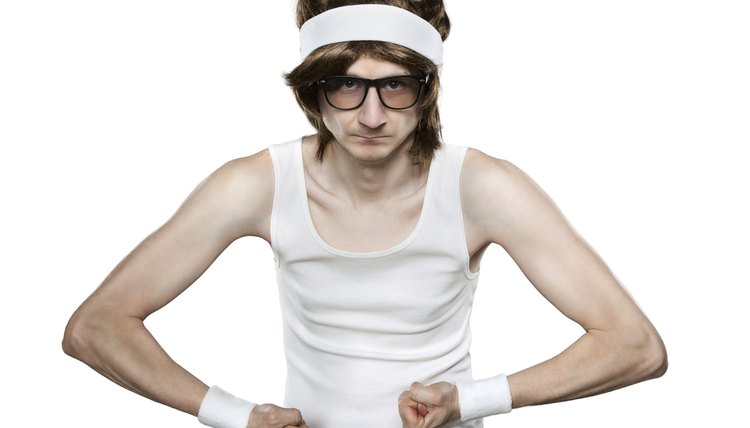
If you want to increase your waist size, the simplest way would be to eat unhealthy foods and gain fat. In terms of health and fitness though, that's not ideal. Whether you're a thin person looking to beef up or you're a frequent exerciser looking for more bulk around your waist, increase waist size by gaining muscle not fat.
Workouts Focused on Muscle
Your waist muscles include the rectus abdominis or "six pack" muscles in front and the obliques on the sides. According to the American Council on Exercise (ACE), the most effective exercises for the rectus abdominis are the bicycle crunch, the captain's chair and exercise ball crunches. For the obliques area, perform the captain's chair, the bicycle crunch and the reverse crunch. ACE recommends three to five sets of eight to 12 repetitions of each exercise, with short recovery times in between. Give yourself at least 48 hours' rest between workouts to allow your muscles to generate new tissue.
Foods for Gaining Muscle
According to Joe Stoppani, PhD and Joe Wuebben of "Muscle & Fitness," nutrition is 50 percent of the equation for gaining muscle. Eat 2 to 3 grams of carbohydrates per pound of bodyweight and 1 gram of protein per pound of bodyweight every day. ACE and "Muscle & Fitness" also recommend eating carbohydrate and protein shakes before and shortly after weight training for even more success.
References
- American Council on Exercise: What Exercises Should I Perform if I'm Trying to Gain Weight?
- ExRx.net: Rectus Abdominis
- ExRx.net: Obliques
- American Council on Exercise: American Council on Exercise (ACE)-sponsored Study Reveals Best and Worst Abdominal Exercises
- Critical Bench: Q: What Is the Best Exercise for Building Abdominal Muscles?
- Muscle and Fitness: Muscle Food: 10 Nutrition Rules to Build Muscle
- American Council on Exercise. American Council on Exercise (ACE) - sponsored study reveals best and worst abdominal exercises. Updated 2001.
- Sternlicht E, Rugg S, Fujii LL, Tomomitsu KF, Seki MM. Electromyographic comparison of a stability ball crunch with a traditional crunch. J Strength Cond Res. 2007;21(2):506-9. doi:10.1519/R-20436.1
Writer Bio
Nicole Vulcan has been a journalist since 1997, covering parenting and fitness for The Oregonian, careers for CareerAddict, and travel, gardening and fitness for Black Hills Woman and other publications. Vulcan holds a Bachelor of Arts in English and journalism from the University of Minnesota. She's also a lifelong athlete and is pursuing certification as a personal trainer.