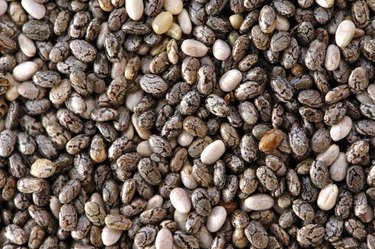
Chia is a flowering member of the mint family. Once an important agricultural crop to the ancient Aztecs of central Mexico, it is still grown commercially today in Argentina, Ecuador, Guatemala and Australia. The plant is prized for its seed, which is a traditional food in the southwestern U.S. that many natural health advocates consider a "superfood." The mottled seeds vary in primary color from brown to black and white. In terms of nutrition, however, there is no significant difference between them.
Historical Significance
Chia, or Salvia hispanica, was widely cultivated by the Aztec of the pre-Columbia era, who not only used the seed for food but also for currency. In fact, the seed was carried during long hunting and trade expeditions. Columbus introduced the seed to the New World in the 15th century, but the popularity of this crop eventually faded in much of North America. Chia seed became part of a cultural icon in the 1980s, however, with the advent of animal-shaped terracotta figurines known as Chia Pets. Although chia seed continues to supply the "hair" for these "pets" today, the majority grown is harvested as food.
Nutritional Value
According to agronomist Ricardo Ayerza, Jr., and agricultural engineer Wayne Coates, authors of "Chia: Rediscovering a Forgotten Crop of the Aztecs," the oil produced from chia seed contains more omega-3 fatty acids than any other plant-based oil. In fact, the seed contains a higher concentration of alpha-linolenic and linoleic fatty acid than any other crop. In addition, the authors say that chia seed has more fiber and protein than wheat, barley, oats, corn or rice but contains no gluten. The seed is also an abundant source of calcium, iron, magnesium, phosphorus, zinc, potassium and copper.
White vs. Black
Some marketers promote white chia seed as superior in nutritional quality to black chia seed. In fact, some have even applied for a patent based on a claim of developing a unique variety of seed. However, Ayerza and Coates maintain that any nutritional difference between white and black chia seed is more likely due to the conditions in which the seed was grown than the color of the seed itself. The authors add that since nearly all chia seed cultivated today originates from Mexican chia seed, there is no reason to suspect any genetic difference between them that might affect nutrition.
Chia Seed Uses
Chia seed is eaten raw, ground into flour for baking, soaked in water or juice to yield "chia fresca" to thicken puddings and sauces, and is used to produce sprouts for salads, sandwiches and omelets, much like alfalfa sprouts. Although chia seed is not generally well known as a food source in Europe, the European Union approved its use in 2009 as a "novel food" that can be added to baked goods at a maximum concentration of 5 percent.
References
- "Chia: Rediscovering a Forgotten Crop of the Aztecs"; Richard Ayerza, Jr., Wayne Coates; 2005
- "Official Journal of the European Union"; Commission Decision of 13 October 2009; Published Nov. 11, 2009


Member Comments