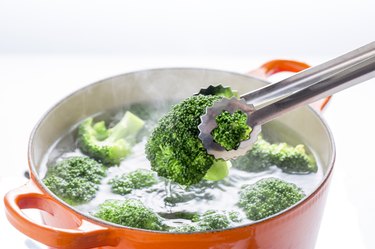
Broccoli does lose some nutritional value when it's cooked, but the exact amount can't be precisely measured because several variables are at play. The type of nutrient, the method of cooking you use and the length of time you cook the broccoli all influence nutrient retention. On the positive side, broccoli is packed with such a large amount of vitamins and minerals that even cooked broccoli remains a rich source of nutrients.
Water-Soluble Vitamins Lost
Video of the Day
The B vitamins and vitamin C are water-soluble, meaning they leach out into the water when you wash them and during cooking. The exact amount of vitamins you'll lose depends on the amount of water used during cooking, as well as how long you cook the broccoli, because water-soluble vitamins are also vulnerable to heat. Using a large quantity of water and overcooking results in the largest loss. The U.S. Department of Agriculture reports that you'll lose 15 percent to 25 percent of the broccoli's vitamin C and 5 percent to 15 percent of most B vitamins, except folate. The loss of folate is 15 percent to 35 percent.
Video of the Day
Minimal Impact on Minerals
Most of the minerals in broccoli are retained during cooking because they stand up to heat and water better than vitamins. If you steam, stir-fry or roast your broccoli, you'll get 100 percent of its minerals, according to the USDA. When broccoli is boiled, it loses 5 percent to 10 percent of the total minerals. The difference in mineral retention between cooking methods also illustrates the best ways to retain the most minerals. Microwaving, steaming, stir-frying and roasting ensure you'll get the most nutrients because they cook the broccoli quickly and with little to no water.
Better Bioavailability From Cooking
Bioavailability refers to the amount of nutrients your body actually absorbs and uses after the broccoli is digested. The vitamin A in broccoli, which is in the form of carotenoids, exists inside the structural part of cell walls, called the cellular matrix. Cooking helps release them from this matrix. Carotenoids are also better absorbed when eaten together with a little fat. You only need about 3 to 5 grams of fat, which is less than 1 teaspoon of olive oil, to ensure the absorption of vitamin A carotenoids, according to the Linus Pauling Institute. Even though some of the vitamin A is lost during cooking, the improved bioavailability helps offset the loss.
Bottom Line: Nutrients You'll Get
Extreme overcooking may deplete nutrients beyond the percentages reported by the USDA, but if it's boiled just until cooked, you'll still get plenty of vitamins and minerals from broccoli. Fiber isn't affected by cooking, so you'll get 5 grams from 1 cup of cooked broccoli. Even after it's boiled, a 1-cup serving of chopped broccoli provides more than 100 percent of your recommended dietary allowance for vitamins C and K, 80 percent of vitamin A, 42 percent of folate and 23 percent of vitamin B-6. The same serving is also a good source of iron and potassium.
- Colorado State University Extension: Water-Soluble Vitamins: B-Complex and Vitamin C
- Baylor College of Medicine: Cooking Suggestions Can Help Preserve Vitamins, Minerals
- USDA Agricultural Research Service: USDA Table of Nutrient Retention Factors
- European Food Information Council: Nutrient Bioavailability: Getting the Most out of Food
- Linus Pauling Institute: Carotenoids
- University of California, Davis: Maximizing the Nutritional Value of Fruits and Vegetables
- USDA National Nutrient Database: Broccoli, Cooked, Boiled, Drained, Without Salt
- Institute of Medicine: Dietary Reference Intakes
- USDA National Nutrient Database: Oil, Olive, Salad or Cooking
- Linus Pauling Institute: Vitamin A