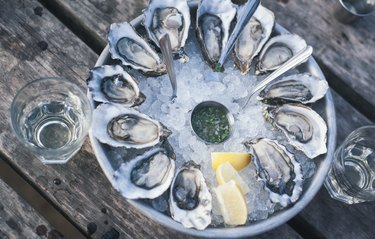
Oysters belong to the shellfish family, falling within the subcategory of bivalve mollusks. Their benefits include ample protein in a small, low-calorie serving, and a variety of minerals and B vitamins. The individual nutrient amounts vary according to the type of oysters you buy and whether you eat them raw or cooked. These mollusks are less contaminated by heavy metals than other varieties of seafood, so it's safe to eat them several times a week.
Tip
With their rich protein, mineral and vitamin content, oysters are good for you – but be careful how you serve them.
Video of the Day
Oyster Types
Oysters take their names from their places of origin. The waters in which they're found give the four types of oyster their distinctive flavors.
Video of the Day
Eastern oysters, also called Blue Points, are the most common oyster available in the United States, hailing from the waters off the Canadian and U.S. Eastern Seaboards, as well as from the Gulf of Mexico. Oysters from northeastern and mid-Atlantic waters taste salty, while Gulf oysters have an earthier flavor. In contrast, Pacific oysters tend to be larger, meatier and sweeter than their Eastern cousins.
Two less common types of oyster include the European flat oyster, which tastes metallic, and the Olympia oyster, a sweet mollusk that measures no bigger than a half-dollar.
Oyster Calories
A serving of oysters equals 3 ounces. Eastern oysters are smaller than Pacific, so you'll get roughly six oysters in a serving. If you choose Pacific oysters, three will make a serving.
Eating oysters au naturel offers your lowest-calorie option. A serving of raw Eastern oysters contains only 50 calories, while the same serving of Pacific oysters provides 69 calories. That's just 3 percent of the daily value on a 2,000-calorie diet. When you buy canned oysters, the calorie difference remains negligible.
When baked or steamed, Eastern oysters supply 67 calories, and the count in Pacific oysters shoots up to 139 calories. Breading and frying your oysters brings the calories up to 169 for a serving. This method of preparation will also boost the oysters' unhealthy saturated fat and dietary cholesterol content.
Read more: Raw Oysters Nutritional Facts
Protein in Oysters
All oysters supply protein, but raw Pacific oysters enjoy an edge over Eastern in this macronutrient. You'll get 8 grams of protein in a 3-ounce serving of Pacific oysters, or 16 percent of the daily value, while the Eastern variety offers about half that amount. Baking or steaming roughly doubles the protein in oysters.
While these protein amounts may look small compared to red meat, consider that both raw and cooked oysters supply very little fat – between 1 and 4 grams of total fat, of which the saturated fat content is less than a gram.
Oysters are also low-carb, containing just 1 to 3 percent of the DV for carbohydrate in a 3-ounce serving, depending on type and preparation.
Oysters and Cholesterol
Shellfish contain dietary cholesterol, which makes some consumers shy away from this type of seafood. Among shellfish, however, oysters offer relatively low amounts of cholesterol. A serving of raw Eastern oysters gives you 21 grams of cholesterol, but that amount doubles in Pacific oysters. Cooking oysters increases their cholesterol counts to 53 and 85 grams, respectively.
It's worth noting that the Dietary Guidelines for Americans no longer sets an intake of 300 milligrams of dietary cholesterol per day. Saturated fat appears to be a bigger culprit in spiking blood cholesterol levels, and the amount in oysters is negligible. Still, the guidelines do recommend including as little dietary cholesterol as possible in your daily regimen.
Read more: Oysters and Cholesterol
Minerals in Oysters
Oysters provide a mix of minerals, including copious amounts of several microminerals. You'll get between 5 and 9 milligrams of iron in oysters, which depends on the type and how you eat them; that's 27 to 43 percent of the daily value for this nutrient, which helps transport oxygen through your bloodstream.
The amounts of zinc, selenium and copper in oysters are even more impressive. A serving of raw Eastern oysters, for example, supplies almost 300 percent of your daily need for zinc and nearly 100 percent of the DV for selenium. You need zinc for wound healing and to support your sense of taste, among other functions, while selenium works as an antioxidant in the body.
Copper helps you metabolize iron and is part of many enzymes. Baked oysters supply the greatest amount of copper, with 419 percent of the DV in Eastern oysters and 253 percent in the Pacific variety.
B Vitamins in Oysters
B vitamins are water soluble, which means your body can't store them and you need to get them regularly through food. Oysters, both raw and cooked, supply a variety of B vitamins, most notably vitamin B12. In a serving of raw oysters, you'll get about 14 micrograms of B12, or more than five times the daily value for this vitamin.
Working in tandem with folate and vitamin B6, vitamin B12 helps regulate levels of homocysteine in the blood, a compound that may elevate risk for heart disease. This nutrient also plays a vital role in brain health and preventing cognitive decline as you grow older. Getting more than the DV for B12 is especially important when you're over 50, because absorption of B12 decreases with age.
Oysters and Food Safety
Mercury, a heavy metal, is an environmental contaminant often present in seafood. Eating too much contaminated seafood can prove toxic to the nervous system and is especially dangerous for pregnant women and young children.
You don't have to worry about mercury contamination when you eat oysters. According to a joint report by the FDA and the EPA, oysters rank among the "best choices" for seafood and are safe to eat two or three times a week.
Eating raw oysters does, however, carry other risks, especially for certain individuals. These mollusks live close to shore and may ingest bacteria or pick up viruses from sewage runoff. Consuming raw oysters is especially risky for young children, pregnant women, older people and individuals with compromised immune systems, such as those undergoing chemotherapy.
To cut risk of food poisoning, steam or bake your oysters. Seafood Health Facts recommends steaming them for four to nine minutes after you see steam rising. When boiling oysters, continue to cook for three to five minutes after the shells open. Bake shucked oysters for a minimum of three minutes at very high heat.
Read more: The 9 Safest Seafood Options
- Berkeley Wellness: Oysters: Nutrient-Packed Delicacies
- MyFoodData.com: Cooked Pacific Oysters, Cooked Eastern Oysters (Wild), Raw Pacific Oysters, Raw Eastern Oysters
- Seafood Health Facts: Seafood Preparation and Nutrition
- Health.gov: Dietary Guidelines for Americans, 2015-2020
- University of Michigan Medicine: Minerals
- Berkeley Wellness: Vitamin B12
- FDA: Advice About Eating Fish
- Seafood Health Facts: Is Raw Seafood, Like Oysters and Sushi Safe to Eat?