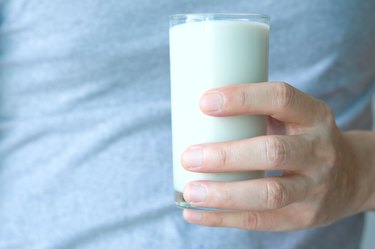
Soy and soy products get a bad reputation as bad for men, or people assigned male at birth (AMAB). Soy milk has long been perceived as something men and boys should only have sparingly.
The thought was that the phytoestrogen in soy — plant compounds that act like estrogen in the body — would throw hormones out of balance for people AMAB. But emerging research has shown that soy and soy milk shouldn't be feared.
Video of the Day
Video of the Day
It turns out the health benefits of soy milk and other soy products make it an excellent option for everyone. Soy milk is one of the most popular soy products, but tofu and soybeans are also great choices.
Tip
No, soy milk is not bad for men, or people assigned male at birth (AMAB). It doesn’t change their hormones or give them so-called "feminine" qualities, per a March 2021 review in Reproductive Toxicology.
What Is Soy Milk?
Soy milk comes from soybeans, which are legumes high in protein and low in fat. Soybeans contain phytoestrogens, or plant compounds that mimic estrogen in the body, according to the Harvard T.H. Chan School of Public Health.
Estrogen, often referred to as the "female hormone," is the main sex hormone produced by bodies of people assigned female at birth (AFAB), and it's responsible for things like menstruation and reproduction. People AMAB also produce estrogen, but in lower amounts, which is why many wonder if soy milk is bad for people AMAB, per the Mayo Clinic.
Soy milk is a very popular non-dairy milk replacement, according to a September 2016 study in the Journal of Food Science and Technology. It has monounsaturated fats and polyunsaturated fats, which have been linked to a lower risk of heart disease.
Soy milk also has phytosterol, a plant compound that has been linked to improvements in cholesterol, per a November 2017 review in ABC Cardiology.
Is Soy Milk Bad for Men?
In people AMAB, testosterone is said to be the hormone that is responsible for "masculine" characteristics such as a deep voice, defined jaw shape and muscle strength, according to the Mayo Clinic.
When testosterone levels aren't balanced in people AMAB, they may lose some of these characteristics. The idea that phytoestrogens will increase estrogen levels and decrease testosterone levels in people AMAB has led many to fear drinking soy milk or eating other soy products.
But according to a December 2014 review in German Medical Science, soy isoflavone — a type of phytoestrogen — does not appear to act like estrogen. The researchers also found that neither isoflavone supplements nor soy products affected testosterone.
It should be noted that a small number of the study participants experienced symptoms from soy, such as breast tenderness, but these people were not found to have abnormal hormone levels. The scientists concluded that drinking soy milk may cause a temporary estrogenic reaction during digestion.
Tip
If you do notice that you’re experiencing side effects typically associated with estrogen, such as breast tenderness, pay attention to how long they last and how much soy you've had.
If they only last for a short period, it could be a temporary effect of soy phytoestrogen. But talk to your doctor if the effects are long-lasting; they may signal a hormonal imbalance unrelated to soy.
Soy and Children
Other research also suggests that soy may affect children differently than adults.
Babies fed soy formula experienced reproductive changes, such as uterus and breast bud size, when compared with cow's milk formula in a March 2018 study in the Journal of Clinical Endocrinology and Metabolism. Interestingly, these changes were observed in babies AFAB and not babies AMAB.
Because this was an observational study rather than a randomized clinical trial, additional research is needed to further evaluate the effects of soy milk on babies.
Children who took in high amounts of soy isoflavones had higher chances of developing a condition called Kawasaki disease when compared with those who didn't, per a large-scale August 2016 study in Nutrition Research. The risk was even higher in children of Asian descent.
Kawasaki disease causes inflammation in the artery walls throughout the body, generally affecting the coronary arteries that supply blood to the heart, according to the Mayo Clinic. While it's treatable, its symptoms can be frightening. These include:
- A rash on the main part of the body or in the genital area
- An enlarged lymph node in the neck
- Extremely red eyes without a thick discharge
- Red, dry, cracked lips and an extremely red, swollen tongue
- Swollen, red skin on the palms of the hands and the soles of the feet, with later peeling of skin on fingers and toes
All this being said, drinking a moderate amount of one or two glasses of soy milk per day is considered safe for most children, per Harvard Health Publishing.
Warning
Soy is one of the most common food allergies, so be careful when introducing your little one to soy milk and other soy products. Adults and children who are allergic to soy should not drink soy milk. According to the Mayo Clinic, symptoms of a soy allergy include:
- Tingling in the mouth
- Hives, itching or scaly skin (eczema)
- Swelling of the lips, face, tongue and throat, or other body parts
- Wheezing, a runny nose or breathing difficulty
- Abdominal pain, diarrhea, nausea or vomiting
- Skin redness (flushing)
The Bottom Line
The most recent research shows that soy and soy milk are safe for everyone, except those with an allergy to soy. Soy doesn't seem to have much of an effect on hormones in moderate doses. If you have an existing thyroid problem, talk to your doctor before drinking soy milk every day.
Soy and soy milk have many important vitamins and nutrients including isoflavones, which have been associated with a reduced risk of conditions like heart disease, breast cancer and prostate cancer.
- Journal of Food Science and Technology: “Plant-Based Milk Alternatives an Emerging Segment of Functional Beverages: A Review”
- Phytotherapy Research: “Comprehensive Evaluation of the Role of Soy and Isoflavone Supplementation in Humans and Animals Over the Past Two Decades”
- McGill University: “Nutritionally Speaking, Soy Milk Is Best Plant-Based Milk”
- German Medical Science: “Soy and Phytoestrogens: Possible Side Effects”
- Nutrients: “Isoflavones: Anti-Inflammatory Benefit and Possible Caveats”
- Mayo Clinic: “Mayo Clinic Minute: Men and Testosterone”
- Mayo Clinic: Estrogen (Oral Route, Parenteral Route, Topical Application Route, Transdermal Route