What does fact checked mean?
At Healthfully, we strive to deliver objective content that is accurate and up-to-date. Our team periodically reviews articles in order to ensure content quality. The sources cited below consist of evidence from peer-reviewed journals, prominent medical organizations, academic associations, and government data.
- Office of Dietary Supplements; Vitamin C; April 2010
- Harvard School of Public Health: Three of the B Vitamins: Folate, Vitamin B6, and Vitamin B12
The information contained on this site is for informational purposes only, and should not be used as a substitute for the advice of a professional health care provider. Please check with the appropriate physician regarding health questions and concerns. Although we strive to deliver accurate and up-to-date information, no guarantee to that effect is made.
Do Onions Have Vitamin K?
Onions make a tasty addition to salads, burgers, soups and casseroles. Because you can buy them year-round, they fit in dishes for all seasons. High in fiber, protein and minerals, onions offer a great deal of nutritional value. When it comes to vitamins, onions contain low levels of vitamin K, but they make up for it with fair amounts of other vitamins.
Vitamin K
Vitamin K is responsible for your blood's ability to clot properly. However, if you have a medical condition that requires you to be on blood thinners, vitamin K may interfere with your medication's ability to work properly. If you like onions, there is good news -- onions contain only a trace amount of vitamin K, so keeping them in your diet should not have adverse effects on your medication. A 1 cup serving of raw, chopped onion contains 0.6 mcg of vitamin K, which is 1 percent of the recommended daily intake. Spring onions, or scallions, contain 206 mcg of vitamin K in 1 cup, which could be significant if you are restricting vitamin K. If you are on blood thinners, ask your doctor about the safe amount of vitamin K foods you can consume.
- Vitamin K is responsible for your blood's ability to clot properly.
- Spring onions, or scallions, contain 206 mcg of vitamin K in 1 cup, which could be significant if you are restricting vitamin K. If you are on blood thinners, ask your doctor about the safe amount of vitamin K foods you can consume.
Vitamin C
Peeled Cucumbers & Vitamin K
Learn More
Onions are also rich in vitamin C, with 11.8 mg in a 1 cup serving, which is 11 percent of the recommended daily intake. Vitamin C is an antioxidant vitamin that helps protect the body from chronic disease, including cancer and heart disease. Other roles of vitamin C in the body include the synthesis of collagen and production of connective tissues and mucous membranes, strengthening of the immune system and absorption of iron. Those with higher intakes of vitamin C have a lower risk of developing eye trouble, such as age-related macular degeneration, notes the Office of Dietary Supplements 2. Vitamin C is water-soluble, which means it is not stored in the body and needs to be replaced daily. Adding raw onion to your salads or sandwiches will help you reach 100 percent of your recommended vitamin C intake each day.
- Onions are also rich in vitamin C, with 11.8 mg in a 1 cup serving, which is 11 percent of the recommended daily intake.
- Vitamin C is water-soluble, which means it is not stored in the body and needs to be replaced daily.
B Vitamins
Onions contain all members of the B vitamin family, with the exception of B-12, which is found only in animal products. Vitamin B-6 and folate have the highest concentration, with a 1 cup serving delivering 0.2 mg of B-6, which is 10 percent of the RDI, and 30.4 mcg of folate, which is 8 percent of the RDI. A report from the Harvard School of Public Health explains that vitamin B-6 and folate work together to fight heart disease, cancer and birth defects. The report also states that vitamin B-12 works alongside B-6 and folate to maximize these benefits, so adding raw onion to a burger is a good way to get the three vitamins together. Other B vitamins in onion include thiamin, riboflavin, pantothenic acid and niacin. All B vitamins work to produce red blood cells and promote energy metabolism.
- Onions contain all members of the B vitamin family, with the exception of B-12, which is found only in animal products.
- A report from the Harvard School of Public Health explains that vitamin B-6 and folate work together to fight heart disease, cancer and birth defects.
Vitamin A
Jalapeno Peppers for High Blood Pressure
Learn More
Onions contain only a trace amount of vitamin A -- 3.2 IU in a 1 cup serving which is not even 1 percent of your RDI. Though it may not seem substantial, every bit helps you reach your intake goal for the day. Vitamin A is an antioxidant vitamin that plays a major role in eye health.
Related Articles
Peeled Cucumbers & Vitamin K
Learn More
Jalapeno Peppers for High Blood Pressure
Learn More
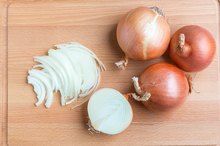
The Vitamin C in Onions
Learn More
Sodium Content of Fresh Tomatoes
Learn More

What Vitamins & Minerals Are in Onions?
Learn More
Do Cranberries Have Citric Acid?
Learn More
Cauliflower Nutrition Guide
Learn More
How to Boil Onions for Soup
Learn More
What Should You Eat With a Cold & Sore Throat?
Learn More
The Onion Soup Diet
Learn More
References
- USDA National Nutrient Database: Onions, Raw
- Office of Dietary Supplements; Vitamin C; April 2010
- Holick MF, Gordon CM. Patient Guide to Vitamin D Deficiency. The Journal of Clinical Endocrinology & Metabolism. 2011;96(7):1-2. doi:10.1210/jcem.96.7.zeg33a
- Sunyecz JA. The use of calcium and vitamin D in the management of osteoporosis. Ther Clin Risk Manag. 2008;4(4):827-836. doi:10.2147/tcrm.s3552
- Giovannucci E, Liu Y, Hollis BW, Rimm EB. 25-hydroxyvitamin D and risk of myocardial infarction in men: a prospective study. Arch Intern Med. 2008;168(11):1174-1180. doi:10.1001/archinte.168.11.1174
- Gorham ED, Garland CF, Garland FC, et al. Optimal vitamin D status for colorectal cancer prevention: a quantitative meta analysis. Am J Prev Med. 2007;32(3):210-216. doi:10.1016/j.amepre.2006.11.004
- Lappe JM, Travers-Gustafson D, Davies KM, Recker RR, Heaney RP. Vitamin D and calcium supplementation reduces cancer risk: results of a randomized trial. The American Journal of Clinical Nutrition. 2007;85(6):1586-1591. doi:10.1093/ajcn/85.6.1586
- Prentice RL, Pettinger MB, Jackson RD, et al. Health risks and benefits from calcium and vitamin D supplementation: Women’s Health Initiative clinical trial and cohort study. Osteoporos Int. 2013;24(2):567-580. doi:10.1007/s00198-012-2224-2
- Urashima M, Segawa T, Okazaki M, Kurihara M, Wada Y, Ida H. Randomized trial of vitamin D supplementation to prevent seasonal influenza A in schoolchildren. Am J Clin Nutr. 2010;91(5):1255-1260. doi:10.3945/ajcn.2009.29094
- Salehpour A, Hosseinpanah F, Shidfar F, et al. A 12-week double-blind randomized clinical trial of vitamin D₃ supplementation on body fat mass in healthy overweight and obese women. Nutr J. 2012;11:78. doi:10.1186/1475-2891-11-78
- Carrillo AE, Flynn MG, Pinkston C, et al. Impact of vitamin D supplementation during a resistance training intervention on body composition, muscle function, and glucose tolerance in overweight and obese adults. Clin Nutr. 2013;32(3):375-381. doi:10.1016/j.clnu.2012.08.014
- Marcinowska-Suchowierska E, Kupisz-Urbańska M, Łukaszkiewicz J, Płudowski P, Jones G. Vitamin D Toxicity-A Clinical Perspective. Front Endocrinol. 2018;9:550. doi:10.3389/fendo.2018.00550
- Ross AC, Manson JE, Abrams SA, et al. The 2011 report on dietary reference intakes for calcium and vitamin D from the Institute of Medicine: what clinicians need to know. J Clin Endocrinol Metab. 2011;96(1):53-58. doi:10.1210/jc.2010-2704
- Bouillon R, Van Schoor NM, Gielen E, et al. Optimal vitamin D status: a critical analysis on the basis of evidence-based medicine. J Clin Endocrinol Metab. 2013;98(8):E1283-E1304. doi:10.1210/jc.2013-1195
- American Academy of Dermatology. Position Statement of Vitamin D. 2010.
- Taksler GB, Cutler DM, Giovannucci E, Keating NL. Vitamin D deficiency in minority populations. Public Health Nutr. 2015;18(3):379-391. doi:10.1017/S1368980014000457
- Holick MF, Binkley NC, Bischoff-Ferrari HA, et al. Evaluation, treatment, and prevention of vitamin D deficiency: an Endocrine Society clinical practice guideline. J Clin Endocrinol Metab. 2011;96(7):1911-1930. doi:10.1210/jc.2011-0385
- Cannell JJ, Vieth R, Umhau JC, et al. Epidemic Influenza and Vitamin D. Epidemiol Infect. 2006; 134:1129-40.
- Carrillo AE1, Flynn MG, Pinkston C, Markofski MM, Jiang Y, Donkin SS, Teegarden D. Impact of Vitamin D Supplementation During a Resistance Training Intervention on Body Composition, Muscle Function, and Glucose Tolerance in Overweight and Obese Adults. Clin Nutr. 2013 Jun;32(3):375-81. doi: 10.1016/j.clnu.2012.08.014. Epub 2012 Aug 31.
- Ginde AA, Mansbach JM, Camargo CA, Jr. Association Between Serum 25-Hydroxyvitamin D Level and Upper Respiratory Tract Infection in the Third National Health and Nutrition Examination Survey. Arch Intern Med. 2009; 169:384-90.
- Giovannucci E, Liu Y, Hollis BW, Rimm EB. 25-hydroxyvitamin D and Risk of Myocardial Infarction in Men: a Prospective Study. Arch Intern Med. 2008; 168:1174-80.
- Gorham ED, Garland CF, Garland FC, Grant WB, Mohr SB, Lipkin M, Newmark HL, Giovannucci E, Wei M, Holick MF. Optimal Vitamin D Status for Colorectal Cancer Prevention: a Quantitative Meta-analysis. Am J Prev Med. 2007 Mar;32(3):210-6.
- Heaney, Robert P. “The Vitamin D Requirement in Health and Disease.” The Journal of Steroid Biochemistry & Molecular Biology 97 (2005):13-9.
- Holick MF. Vitamin D. In: Shils M, Olson J, Shike M, Ross AC, ed. Modern Nutrition in Health and Disease, 9th ed. Baltimore: Williams and Wilkins, 1999.
- National Institutes of Health Office of Dietary Supplements. Vitamin D: Dietary Supplement Fact Sheet. University of Ottawa Evidence-based Practice Center. Effectiveness and Safety of Vitamin D in Relation to Bone Health. Agency for Healthcare Research and Quality. Aug 2007: 07-E013.
- Salehpour A1, Hosseinpanah F, Shidfar F, Vafa M, Razaghi M, Dehghani S, Hoshiarrad A, Gohari M. A 12-week Double-blind Randomized Clinical Trial of Vitamin D₃ Supplementation on Body Fat Mass in Healthy Overweight and Obese Women. Nutr J. 2012 Sep 22;11:78. doi: 10.1186/1475-2891-11-78.
- Urashima M, Segawa T, Okazaki M, Kurihara M, Wada Y, Ida H. Randomized Trial of Vitamin D Supplementation to Prevent Seasonal Influenza A in Schoolchildren. Am J Clin Nutr. 2010 91:1255-60. Epub 2010 Mar 10.
- Wilkins, Consuelo H. and Yvette I. Sheline, et al. “Vitamin D Deficiency Is Associated with Low Mood and Worse Cognitive Performance in Older Adults.” American Journal of Geriatric Psychiatry 14 (2006): 1032-40.
Resources
Writer Bio
A certified nutritionist who majored in health, fitness and nutrition, Traci Vandermark has been writing articles in her specialty fields since 1998. Her articles have appeared both online and in print for publications such as Simple Abundance, "Catskill Country Magazine," "Birds and Blooms," "Cappers" and "Country Discoveries."