
NBA Legends: Steve Kerr. Plus, Shooting The Basketball, What does BEEF stand for in basketball?
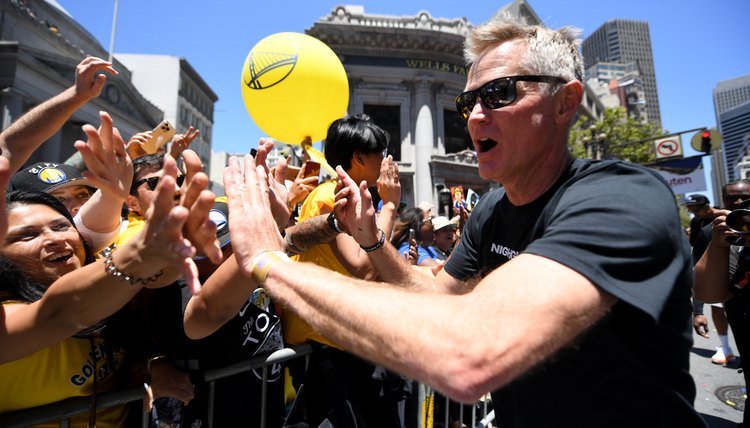
Steve Kerr is not only one of the greatest shooters in NBA history but one of the most successful head coaches of all time as well. His success with the Golden State Warriors has been revolutionary, in addition to his success as an NBA player. Most of that comes from his revolutionary stance on shooting called BEEF. The B.E.E.F. principle is commonly practiced during shooting drills because the coach can observe each player’s technique and offer an appropriate critique.
Where is Steve Kerr from?
Steve Kerr was born in Beirut, Lebanon to American Malcolm Kerr and his wife Ann. Kerr would spend most of his young life in the Middle East and even attended school in Cairo. He would go to high school in Los Angeles, California. After his graduation, his father would sadly be killed by a Lebanese militia.
What college did Steve Kerr attend?
After a low level of recruitment, Kerr decided to attend the University of Arizona. He would play college basketball there for five years and would make the Final Four with the Wildcats in 1988. In that season he would shoot an NCAA record 57% from three making him a prospect for the upcoming NBA draft.
Who drafted Steve Kerr?
Steve Kerr was drafted by the Phoenix Suns in the 2nd round of the 1988 NBA draft. He would later be traded to the Cleveland Cavaliers. Then he would be traded to the Orlando Magic and would play crucial minutes on the bench as a three point specialist.
When did Steve Kerr play with the Chicago Bulls?
Kerr signed with the Bulls in 1993 to play with Scottie Pippen, the same year Michael Jordan retired to play baseball. The Bulls would make the playoffs with Kerr coming off the bench but it wasn’t until Jordan returned as his teammate that Kerr and the Bulls would win an NBA championship. With Phil Jackson at the coaching helm, the Bulls would win three straight NBA finals. In the 1997 Finals versus Utah, Kerr would hit the series winning shot with seconds left on the clock. In 1998, he would make the series winning pass to Jordan in another NBA Finals against Utah.
What other teams did Kerr play for?
Kerr would be traded to San Antonio in 1999, where Gregg Popovich utilized him as the sixth man. The San Antonio Spurs would go on to win the 1999 NBA Finals giving Kerr his fourth title. He would be traded to the Portland Trailblazers and then would be traded back in 2002 and win yet another Finals. He would end his NBA career in 2003 as the NBA leader in career three point percentage and single season three point percentage. The way he played basketball would become a blueprint for the three point specialists that would emerge in future years.
What did Steve Kerr do before coaching?
Kerr would move into a career as an executive after his playing career was over. He would buy 1% of the Phoenix Suns and in 2007, would become the team’s general manager. He would also be a contributor for the Turner Network Television channel as part of their NBA on TNT coverage and even was a contributor for ESPN’s Grantland.
When did Steve Kerr start coaching?
In 2014, Kerr took over the head coaching for the Golden State Warriors and had one of the most successful first year’s ever. The Warriors would finish with a regular season record of 67-15, thanks to the MVP efforts of Steph Curry and All-stars Draymond Green and Klay Thompson. He would lead them in the NBA playoffs over the New Orleans Pelicans, Memphis Grizzlies, and Houston Rockets. After winning the Western Conference, they would face LeBron James and the Cavs. They would go on to win the series 4-2, making Kerr one of five first time coaches to win an NBA Finals. Kerr would have to take a leave of absence the following season with Luke Walton, son of UCLA star Bill Walton, taking over. The absence, spurned by back problems, would catapult Walton to become head coach of the Los Angeles Lakers and Sacramento Kings.
How many championships have the Warriors won with Steve Kerr?
Kerr would go onto win two championships, in the years ensuing the 2016 NBA Finals. He would lose to the Toronto Raptors in 2019 and his teams would miss the playoffs in the next two years due to various injuries. Kerr would lead the newly rebuilt Warriors to another championship in 2022, beating the Dallas Mavericks, Denver Nuggets, and Memphis Grizzlies along the way. The series, which was against the Boston Celtics, finished in six games and gave Curry a Finals MVP.
What is BEEF?
Balance
Balance is an essential aspect of scoring for any type of shot, providing you with a foundation as you extend your legs in preparation for throwing the ball. Players should keep the feet squared and positioned approximately a shoulder-width apart, says former basketball coach Jill Prudden in “Coaching Girls’ Basketball Successfully.” A similarly comfortable distance is acceptable as long as the feet are far enough apart to support the player’s weight and prevent her from losing balance. Bending the knees and positioning the dominant foot slightly ahead of the other also prepares your body for the forward motion. Try to establish balance before you receive the ball so that you are ready to make a shot as quickly as possible.
Eyes on the Target
Basketball players have to maintain focus. Although it is important to be aware of other players on the court, you must redirect your attention to the target to make a successful shot. Professional scouts Jerry Krause and Jerry Meyer and former college coach Don Meyer advise in “Basketball Skills & Drills” that you narrow your focus to a specific area of the basketball goal, such as the backboard or back rim of the net. They recommend dedicating your focus to the target for at least 1 second before shooting.
Elbows Aligned
The position of your arms provides a foundation for the entire shot, affecting the strength of the wrists and hands right before the ball is released. Proper elbow alignment and stable positioning of the hands ensures that your shot will follow the intended path toward the net. Keep your lower arm vertical, forming a 90-degree angle and keeping the elbows positioned directly under the ball. Raise your elbows slightly and avoid angling them too far inward or outward.
Follow Through
A player’s hands guide the shot and influence the trajectory of the basketball. This aspect of the B.E.E.F. shooting principle is known as the “follow through” because the player completes the full range of arm movement necessary to perform the shot. With hands firmly planted on the ball, your wrists should flick forward and propel the ball toward the net. The goal is to launch the ball upward rather than outward, so extend the arms and wrists fully to create the ideal arch. Meyer, Krause and Meyer recommend aiming for an arm angle of approximately 55 to 60 degrees after the release.
References
Writer Bio
Ess Loumarr is a freelance writer from New England and has worked as a copywriter since 2008. Her short fiction has appeared in the "Spectrum Anthology" at the University of California, Santa Barbara. She received a Bachelor of Arts in English literature and composition at Columbia University, as well as prizes for playwriting and fiction.