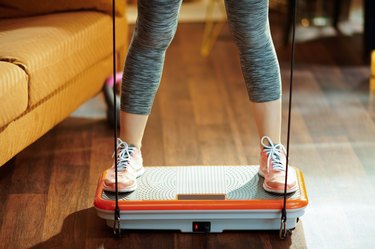
Vibration plate exercises utilize a machine offering whole-body vibration, a training methodology that helps increase bone density and build strength. The plate vibrates according to specific frequencies and amplitudes, set by the user.
Why Vibration Plate Exercises?
Video of the Day
Standing on the moving plate causes you to tense and relax your muscles to maintain your balance. In fact, a research review published in 2017 by BMJ Open reports that whole-body vibration exercises are effective for preventing falls.
Video of the Day
Doing so results in greater muscle activation than you achieve when standing or exercising on solid ground. An exercise session on a vibration plate takes much less time than traditional weight-based exercises. According to the Mayo Clinic, effective workouts can be completed in just 15 minutes, three times per week.
Mayo Clinic also points out that benefits of using a vibration plate regularly might also include improved bone density, reduced back pain and possibly weight loss, although more research is needed in these areas.
However, exercising with a vibration plate might not be safe for everyone. Consult your doctor before attempting vibration platform exercises if you have medical conditions, difficulty maintaining your balance or are pregnant.
Read more: Fitness Vibration Plate Dangers
Include Traditional Strength Moves
To achieve results training with a vibration plate, you have to do more than simply stand still. Perform the same types of unweighted body exercises you do on the floor, such as push-ups and triceps dips for the upper body.
Include lower extremity strengthening exercises such as standing with a very slight bend in the knee, regular squats, wide stance squats, single-legged squats and lunges to improve muscle strength and power.
According to a March 2017 article published by Functional Morphology and Kinesiology, vibration training has been shown to increase recruitment of muscle fibers and is an effective training method for increasing power.
Improve Your Flexibility
According to a research review published in 2013 by The Journal of Musculoskeletal and Neuronal Interactions, adding vibration to traditional flexibility training methods, such as stretching, improved overall results.
Stretch your hamstrings with a simple forward bend in which you stand on the plate and hang forward from the hips. Or open up your upper body and arms by kneeling on the ground and reaching your arms onto the plate.
To open up your hip flexors, get into a lunge position with your front foot on the floor and your back toes on the plate.
Read more: Calories Burned in a Vibration Workout
Challenge Your Core
The hips, abdomen and back make up the muscles of the core. These muscles produce much of your athletic power and daily functionality. The vibration plate can help you train these muscles by creating instability that forces your core to compensate and help you balance.
To train your internal abdominal muscles in a plank position, put your forearms on the plate and your toes on the floor, forming a straight line. Or to address the internal obliques, balance on just one forearm with the sides of your feet on the floor.
Also try standing on the plate with your hands behind your head and rotating side-to-side from your waist to improve spinal mobility.
- The Mayo Clinic: "Whole Body Vibration Training — An Effective Workout?"
- BMJ Open: "Effect of Whole-Body Vibration Exercise in Preventing Falls and Fractures: A Systematic Review and Meta-Analysis"
- Functional Morphology and Kinesiology: "The Use of Vibration as Physical Exercise and Therapy"
- The Journal of Musculoskeletal and Neuronal Interactions: "Effects of Vibration on Flexibility: A Meta-Analysis"