
What does fact checked mean?
At SportsRec, we strive to deliver objective content that is accurate and up-to-date. Our team periodically reviews articles in order to ensure content quality. The sources cited below consist of evidence from peer-reviewed journals, prominent medical organizations, academic associations, and government data.
- American Council on Exercise: Standing Dorsi-Flexion (Calf Stretch)
- Medline Plus: Shin Splints - Self-Care
The information contained on this site is for informational purposes only, and should not be used as a substitute for the advice of a professional health care provider. Please check with the appropriate physician regarding health questions and concerns. Although we strive to deliver accurate and up-to-date information, no guarantee to that effect is made.
Stretches for Shin Splints
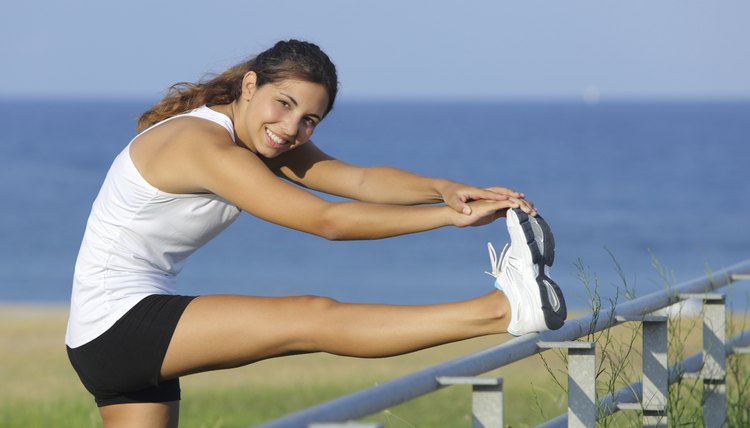
Shin splints, otherwise known as medial tibial stress syndrome (MTSS), are a common running injury. If you have pain on either the inside or the front and outside of the lower leg, it may be a shin splint. Shin splints mainly occur in beginner runners who start out too intensely by running too long and too quickly. They may occur in advanced runners who drastically switch their workout routine, for example, running mostly on flat surfaces and then running on hills. You may take measures to prevent shin splints or alleviate the pain if you've already developed them.
Toe Lift
This stretch strengthens the front of the lower leg or the anterior tibialis. Stand with your back towards a wall, your heels about a foot from the wall. Lean back so that your butt and shoulders catch the wall. Slowly lift the toes up toward the ceiling, hold this position for five seconds and then release them back to the floor. Repeat this exercise for three sets of 10 to 15 repetitions.
Upper Calf Stretch
This stretch elongates the gastrocnemius and soleus muscles, the ones located in both the upper and the lower, outer sections of the rear lower leg. Stand with your face to a wall, your right foot forward and your left foot back. With relaxed shoulders and outstretched arms, push gently and firmly into the wall as you bend your right knee, stretching the left leg. Hold for a minimum of 30 seconds and breath deeply into the stretch. Switch legs and repeat.
Lower Calf Stretch
Perform this stretch to target the soleus muscles, located at the lower edges of the calves. Stand facing a wall. Split your legs with your right foot forward and your left leg back. Reach your arms forward to the wall and press your hands into it, relaxing your shoulders. Lift and lengthen your upper body as you bend both knees slightly, ideally keeping both heels on the floor. Hold for a minimum of 30 seconds and then repeat with the left leg forward.
Additional Care
Having shin splits does not necessarily mean that you have to stop exercising all together. Instead of running, consider low-impact activities such as yoga, Pilates, swimming, cycling and working out on an elliptical trainer. Icing your shins can also help to minimize the pain: Drape a cloth over the affected area and then place an ice pack on it for fifteen minutes at a time. Try to ice your shins four times a day.
Explore In Depth
References
- American Council on Exercise: Standing Dorsi-Flexion (Calf Stretch)
- Medline Plus: Shin Splints - Self-Care
- Alaia MJ. Diseases & Conditions: Shin Splints. OrthoInfo. American Academy of Orthopaedic Surgeons. Reviewed August 2019.
- Shin Splints. Merck Manual Professional Version.
- Callahan LR. Overview of running injuries of the lower extremity. Updated May 28, 2020.
- Shin splints - self care. MedlinePlus NIH.
Resources
Writer Bio
Ashlee Green is a writer based in Pittsburgh, Pa. Her articles and interviews have appeared in "YES! Magazine," "Lalitamba Literary Journal" and "The Hamakua Times." She has a Bachelor of Arts in creative nonfiction from the University of Pittsburgh.