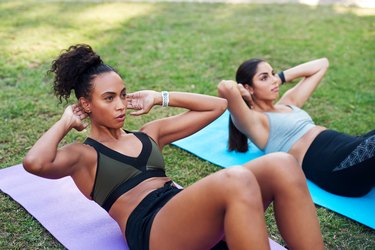
The pelvic floor is a group of muscles under the pelvis that separate the perineal region from the pelvic cavity above it. The pelvic floor supports the bladder, the uterus in women and the intestines, and holds a major role in urinary and fecal continence.
Although abdominal exercises are beneficial, there are some instances in which they may cause harm to the pelvic floor.
Video of the Day
Video of the Day
Read more: How to Know When You Are Overdoing Kegel Exercises
Avoid Muscle Imbalance
Many people focus on gaining that "six-pack" ab look and as a result, concentrate their ab work on rectus abdominis exercises and perhaps the obliques. This concentration on only one or two of the abdominal muscles ignores inner obliques as well as the transversus abdominis, which results in abdominal imbalance.
The transversus abdominis in particular is important for supporting the abdominal wall, according to the Loyola University Medical Education Network. When the rectus abdominis is always held tightly or contracted constantly, an increased pressure is placed on the pelvic floor muscles, which may cause injury or dysfunction.
Pelvic Pain After Ab Workout
If you have pelvic pain after an ab workout, you might need to re-think you workout program. Traditional sit-ups and crunches cause pressure to build in the abdominal cavity and push on the pelvic floor. This may result in prolapsed bladder or uterus and urinary urgency.
Men and women with weak pelvic floor muscles, women who have had recent pelvic surgery, people who are pregnant or have recently given birth, menopausal people, and those who are overweight are more at risk of pelvic floor injuries during abdominal exercise.
Injuries to the Pelvic Floor
Damage to the pelvic floor may result in pain with ejaculation, pain with vaginal penetration, urinary and fecal incontinence, lower back pain, pelvic pain, prolapsed bladder or prolapsed uterus in females. Pelvic floor dysfunction may also cause constipation, poor urine stream, an frequent urination, according to the Mayo Clinic.
Read more: Pelvis Circulation Exercises
Sit-Ups and Pelvic Floor
If you are at risk for pelvic floor injury or suffer from weak pelvic floor muscles, avoid all exercises that place extreme stress on the upper abs.
Avoid traditional sit-ups and crunches, bicycle crunches where both legs are raised at the same time, the twisting crunch, yoga or Pilates moves that involve raising the head off the floor at the same time as the legs, and gym machines that focus on the abdominals as an isolated movement.
Exercises which are best for the pelvic floor muscles are those that keep your legs and head on the floor, or only one leg raised at one time, and lower abdominal exercises.
Strengthen Your Pelvic Floor
In addition to picking out abdominal exercises to avoid with a weak pelvic floor, you can strengthen these muscles. According to the Ohio State University Wexner Medical Center, you can do Kegel exercises without even leaving your desk:
- Tighten the muscles that you use to stop the flow of urine. Do not tighten your buttocks.
- Hold for a slow count of four, then relax for the same amount of time.
- Gradually increase the amount of time you hold this contraction.
- Perform these exercises for five minutes, two times per day.