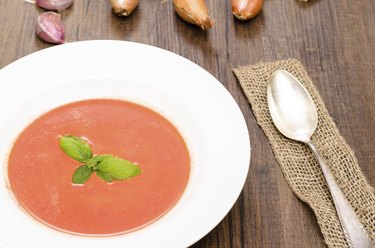
Tomatoes are a fan-favorite of, well, basically everyone. Tomatoes alone account for almost 20 percent of all vegetable consumption, according to a 2016 Nutrition Today report. Maybe it's not that surprising when you think about the many ways we eat our tomatoes from pasta sauce to salads to soup.
Indeed, tomato soup has so much to offer nutritionally thanks in part to its many vitamins, minerals and phytonutrients. However, if you're buying the store-bought stuff, choosing the wrong one can have its downsides.
Video of the Day
Video of the Day
1. Tomato Soup Gives You a Lycopene Boost
Tomato soup comes packed with beneficial lycopene — a red-hued nutrient that gives the soup its bright color. Lycopene offers powerful antioxidant protection, which means that it seeks out and neutralizes reactive oxygen species, a type of molecule linked to the aging process. The carotenoid may also reduce the risk of some types of cancer like prostate, breast, lung and colorectal cancer.
In fact, tomatoes account for 80 percent of all of the lycopene that we eat, according to a March 2014 study published in Mediators of Inflammation.
There is no established recommended daily intake for lycopene, but getting 10 milligrams daily from food might offer health benefits, notes Harvard Health Publishing. One cup of tomato soup contains an impressive 16 milligrams of lycopene. What's more, cooking tomatoes, like in tomato soup, makes lycopene more bioavailable to the body according to the American Institute of Cancer Research.
2. You'll Get a Healthy Dose of Minerals
Slurp some tomato soup and you'll also boost your potassium, selenium and copper intake. A serving of tomato soup has 550 milligrams potassium, a mineral considered a "nutrient of public health concern" by the 2015-2020 Dietary Guidelines for Americans because many of us don't meet the daily requirements and low intakes are associated with health concerns.
Selenium is nutritionally essential and plays many roles in our bodies from protecting against oxidative damage and infection to reproduction and thyroid hormone metabolism, as outlined by the National Institutes of Health (NIH). A serving of tomato soup contains 3.7 micrograms of selenium or 6 percent of the recommended daily intake.
Our go-to soup also contains copper, which is important for neurotransmitter and connective tissue synthesis. A cup of tomato soup has 620 micrograms of copper or 69 percent of your recommended daily intake.
3. It Packs in Vitamins A and C
Tomato soup is also a source of vitamins A and C, two important nutrients. Like potassium, these two vitamins are called out in the 2015-2020 Dietary Guidelines for Americans as a public health concern. Other nutrients that fall into this category include dietary fiber, choline, magnesium, calcium, and vitamins D and E.
Vitamin A is important for reproduction, the immune system and healthy vision, according to the NIH. A serving of tomato soup has 400 IUs of vitamin A or 8 percent of the Daily Value. Vitamin C is an antioxidant, boosts iron absorption and supports a healthy immune system according to the NIH. A serving of tomato soup has 6 milligrams of vitamin C or 8 percent of the recommended amount for women and 6 percent for men.
4. It May Help You Lose Weight
A study published in the British Journal of Nutrition in April 2014 found an association between those who regularly eat soup and a lower risk of obesity. After reviewing dietary recall data from National Health and Nutrition Examination Surveys, researchers found that people who regularly enjoyed soup weigh less, have smaller waists and better overall diets compared to those who did not.
Soups, especially broth or vegetable-based ones, are a great way to get in more nutritious vegetables, beans and lean meats. In the study, those who ate soup, however, had higher sodium intakes — which leads us to our drawback.
Sodium: The One Drawback
Tomato soup, like most other store-bought and canned soups, has one major nutritional disadvantage — its sodium content. A serving of regular tomato soup contains 467 milligrams of sodium, which is roughly 20 percent of the recommended daily limit. A diet high in sodium leads to sustained high blood pressure, which, in turn, can damage your heart and blood vessels, according to the American Heart Association.
When possible, select low-sodium tomato soup — which contains 5 percent or less of the daily limit per serving. Another option is to make it at home so that you can limit the amount of salt added.
- Nutrition Today: "Tomato Consumption in the United States and Its Relationship to the US Department of Agriculture Food Pattern"
- Mediators of Inflammation: "Enhancing the Health-Promoting Effects of Tomato Fruit for Biofortified Food"
- Harvard Health Publishing: "Lycopene-Rich Tomatoes Linked to Lower Stroke Risk"
- Tomato Wellness: "What Is Lycopene?"
- American Institute of Cancer Research: "Heat, Shape and Type: Increasing Lycopene Absorption"
- British Journal of Nutrition: "Soup Consumption is Associated with a Lower Dietary Energy Density and a Better Diet Quality in US Adults."
- 2015-2020 Dietary Guidelines for Americans: "Underconsumed Nutrients & Nutrients of Public Health Concern"
- National Institutes of Health: "Selenium"
- FoodData Central: "Campbell's Tomato Soup, Condensed"
- National Institute of Health: "Vitamin A"
- National Institute of Health: "Vitamin C"
- American Heart Association: "Shaking the Salt Habit to Lower High Blood Pressure"