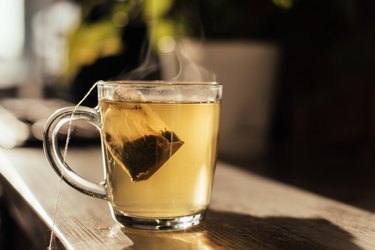
While water is the most commonly consumed beverage in the world, tea comes next, according to the Harvard T.H. Chan School of Public Health. And that's a smart move for many: Tea is full of polyphenols that act as antioxidants, which may help reduce the risk of some diseases.
Along with potential health benefits, some forms of tea serve as a wake-me-up beverage in the morning or during an afternoon energy dip, while herbal and caffeine-free options can be soothing throughout the day.
Video of the Day
Video of the Day
Keep scrolling to learn about the number of calories, nutrition info and amount of caffeine in popular teas.
Warning
Keep in mind the caffeine in tea can result in unpleasant side effects, including anxiety, problems sleeping and a fast heart rate, according to the U.S. National Library of Medicine. But quitting a daily tea habit — especially cold turkey — might cause headaches, irritability and other withdrawal symptoms.
Calories in Tea and Nutrition Information
Brewing tea is simple: Hot water is poured over the leaves of the Camellia sinensis plant or over dried flowers, roots and leaves (in the case of herbal teas), per the Harvard T.H. Chan School of Public Health.
And when it's steeped on its own without any sweetener or milk, tea is virtually calorie-free. Take a look at the calories and nutritional information for your average 8-ounce cup of regular tea, without anything added to the cup, per the USDA:
- Calories: 2
- Total Fat: 0 g, 0% DV
- Cholesterol: 0 mg, 0% DV
- Sodium: 0 mg, 0% DV
- Total Carbohydrates: 0 g, 0% DV
- Dietary fiber: 0 g, 0% DV
- Sugar: 0 g
- Added sugar: 0 g, 0% DV
- Protein: 0 g, 0% DV
- Potassium: 87.7 mg, 2% DV
Keep scrolling to review the calorie counts and nutrition facts for several common tea brands and varieties.
Green, Black, Oolong and White Teas
That single plant — the Camellia sinensis — can be used to make several different types of tea, such as black tea, green tea, oolong tea and white tea.
These teas are all caffeinated and can be prepared from tea bags or loose leaves.
Take a look at the caffeine levels, calories and nutrition facts for all of these types of tea:
- Black tea: The nutrition facts and calories for black tea are listed above. This virtually calorie-free beverage contains about 48 mg of caffeine in 8 oz., per the American Academy of Nutrition and Dietetics.
- Green tea: An 8-oz. cup of green tea has 0 calories, a tiny amount of sodium (1% DV) and small amounts of potassium (1% DV) and phosphorus (5% DV), according to the USDA. Green tea is lower in caffeine than black tea, with 29 mg. in an 8-oz. cup, per the American Academy of Nutrition and Dietetics.
- White tea: Compared to other types of tea derived from the Camellia sinensis plant, white tea is low in caffeine, per Penn Medicine. This tea is also calorie-free, according to the USDA.
- Oolong tea: This tea is made from leaves that are dried and partially fermented, per the Harvard T.H. Chan School of Public Health. Like white tea, oolong tea does not have any calories, according to the USDA. It has 29 mg. of caffeine per 8-oz. cup, according to the American Academy of Nutrition and Dietetics.
Black tea accounts for 78 percent of the tea consumed worldwide, per a 2017 report in the Journal of Oral and Maxillofacial Pathology. About 20 percent of the tea consumed globally is green, and less than 2 percent is oolong tea.
Chai Tea
Chai tea is a type of black tea with spicy, aromatic flavors. Like most brewed teas, plain chai is a calorie-free drink — there are 0 calories in a chai tea bag, per the USDA. However, chai is often served as a latte, with added sweeteners as well as your milk of choice, like dairy or soy milk. These ingredients can up the calorie count significantly.
The calories in soy chai lattes vary according to which mixins you add, whether at home or at a coffee shop, and the size of your beverage. There are 120 to 310 calories in a chai tea latte with soy milk from Starbucks.
Here's a breakdown of Starbucks soy chai latte calories per order size:
- Tall soy chai tea latte calories: 190
- Grande soy chai latte calories: 240
- Venti soy chai tea latte calories: 310
There are more calories in a venti chai tea latte because it's the biggest size offering.
Tip
To keep calories low, you can make a soy chai tea latte at home using 8 ounces of unsweetened soymilk, which has only 80 calories. Heat your soymilk in the microwave or on the stovetop and steep a chai tea bag in the warm milk for a few minutes.
If you use dairy milk, adding a half cup of non-fat milk and half a tablespoon of honey to your tea will result in a drink of just 75 calories.
Matcha Tea
Matcha is a highly concentrated source of catechins, which are the antioxidants responsible for most of the health benefits associated with green tea. If you're looking to get more antioxidants without taking in more calories, you're probably better off sticking with homemade matcha as there's a very minimal number of calories in matcha powder.
There are 7 calories in 1 tsp matcha powder, according to the USDA.
Many of the matcha-based beverages available in coffee shops are high in calories and sugar. The grande Matcha Green Tea Latte at Starbucks has 190 calories; some of the Starbucks matcha powder calories come from sugar, as the powder contains a bit of added sugar for sweetness.
Adding Milk and/or Sugar
There are zero calories in one cup of tea, but that changes once you add sugar and/or milk.
There are 11 calories in tea with sugar, if you add a one-serving packet (3 g) of sugar to your cup; you'll also get 2.8 g (1% DV) of carbohydrates and 2.8 g of sugar (6% DV), per the USDA.
There are about 48 calories in tea with milk and sugar if you use 2 oz. of whole milk and one packet of sugar.
Tip
While it's true that tea supports your health, sugar and other extras can offset its benefits. If you're not a fan of plain tea, consider adding lemon, cinnamon, vanilla essence or stevia. Better yet, check out our Pomegranate Iced Tea recipe for inspiration.
Herbal Teas
Unlike black, oolong, white and green teas, herbal teas do not come from the Camellia sinensis plant. Instead, they're made from brewing roots, flowers and leaves of other plants (think: peppermint, chamomile and more), according to the Academy of Nutrition and Dietetics.
Nearly all herbal teas do not contain caffeine, and yerba mate is an exception.
Yerba Mate
Yerba mate tea is an herbal tea made from the Ilex paraguariensis plant. Yerba mate tea has no calories, per the USDA, but note that because it has a bitter taste, sugar is often added.
Yerba mate tea has nearly as much caffeine in a cup as coffee, per a frequently cited October 2007 review in the Journal of Food Science.
Chamomile Tea
In ancient times, chamomile tea, which is brewed using the plant's flowers, was used medicinally, according to the National Center for Complementary and Integrative Health (NCCIH). There are two types of this plant: German chamomile and Roman chamomile, per the NCCIH.
More research is needed into the health effects of chamomile, per the NCCIH. It's often thought to help with stress and improve sleep, according to Penn Medicine. While there are rarely side effects associated with this tea, an allergic reaction is more common if you have allergies to plants such as ragweed, chrysanthemums, marigolds or daisies, per the NCCIH. As with many herbal teas, there's a lack of data regarding if chamomile tea is safe to drink during pregnancy or while breastfeeding, per the American Pregnancy Association.
Chamomile can potentially be helpful for people with asthma, per the Ohio State University College of Medicine, but it can also be harmful, per Mount Sinai. Consult your doctor if you have questions or concerns.
Take a look at the calories and nutrition facts for an 8-ounce cup of chamomile tea, according to the USDA:
- Calories: 2
- Total Fat: 0 g, 0% DV
- Cholesterol: 0 mg, 0% DV
- Sodium: 0 mg, 0% DV
- Total Carbohydrates: 0 g, 0% DV
- Dietary fiber: 0 g, 0% DV
- Sugar: 0 g
- Protein: 0 g, 0% DV
- Iron: 0.2 mg, 1% DV
- Calcium 4.7 mg, 0% DV
- Potassium: 21.3 mg, 0% DV
Chamomile tea does not have caffeine.
Tea Type | Calories (per 8 oz. cup) | Caffeine (per 8 oz. cup) |
|---|---|---|
Green Tea | 2 | 29 mg |
Black Tea | 2 | 48 mg |
Oolong Tea | 2 | 29 mg |
White Tea | 2 | 30-55 mg |
Chai Tea | 0 | 26 mg |
Matcha Tea | 7 | 70 mg |
Yerba Mate Tea | 0 | 78 mg |
Chamomile Tea | 2 | 0 mg |
Tea Brands
There are many brands of tea available, and tea drinkers often display great loyalty to their brand of choice. Take a look at some of the most popular tea brands out there, including hot and iced tea.
Tetley Tea
Tetley offers many types of tea — black, green and herbal — with the typical nutrition information as detailed above. Tetley Tea has caffeine, although decaffeinated varieties are also available. They also sell tea bags designed for making iced tea.
Gold Peak Tea
Gold Peak makes bottled iced tea, which is available in many different flavors, such as unsweetened, sweet, green tea, raspberry tea and more. Gold Peak is manufactured by Coca-Cola. The nutrition facts vary from one tea flavor to the next.
A bottle of the unsweetened tea, for instance, has zero calories, according to Gold Peak. But an 18.5-ounce bottle of the brand's Georgia Peach Tea has the following calories and nutrition facts:
- Calories: 170
- Total Fat: 0 g, 0% DV
- Sodium: 30 mg, 1% DV
- Total Carbohydrates: 45 g, 16% DV
- Total Sugars: 45 g
- Added Sugars: 45 g, 90% DV
- Protein: 0 g, 0% DV
- Caffeine: 30 mg
Lipton Iced Tea
When it comes to tea in the United States, Lipton is one of the most recognized brands available. Along with making black, green and herbal teas — which are available as tea bags and K-Cups — Lipton also makes bottled iced tea and iced tea mix.
A 20-ounce bottle of Lipton Peach Iced Tea has the following calories and nutrition facts, per the USDA:
- Calories: 114
- Total Fat: 0 g, 0% DV
- Saturated Fat: 0 g, 0% DV
- Trans Fat: 0 g
- Cholesterol: 0 mg, 0% DV
- Sodium: 222 mg, 9% DV
- Total Carbohydrates: 30.1 g, 10% DV
- Dietary Fiber: 0 g, 0% DV
- Total Sugars: 29.9 g
- Added Sugars: 0g, 0% DV
- Protein: 0 g, 0% DV
Lipton Unsweetened Iced Tea Mix has zero calories, according to the USDA.
Arizona Good Brew All Natural Sweet Tea
Arizona has several types of iced tea available, including sweet and unsweet varieties. The calories and nutrition facts for an 8-ounce serving of Arizona Good Brew All Natural Sweet Tea are:
- Calories: 70
- Total Fat: 0 g, 0% DV
- Cholesterol: 0 mg, 0% DV
- Sodium: 10 mg, 0% DV
- Total Carbohydrates: 19 g, 6% DV
- Total Sugars: 18 g
- Protein: 0 g, 0% DV
Starbucks Matcha Green Tea Crème Frappuccino
Starbucks' signature Frappuccino blended beverages are available in numerous inventive flavor combinations, like the previously popular Starbucks Tazo Green Tea Frappuccino, which is no longer available. The latest green tea Frappuccino, the Matcha Green Tea Crème Frappuccino, mixes matcha powder together with milk and ice. By default, this frappuccino is topped with sweetened whipped cream.
The concoction is available in Starbucks' three sizes: tall, grande and venti. A grande (16 ounces) Matcha Green Tea Crème Frappuccino made with whole milk, but without whipped cream, has the following calories and nutritional information:
- Calories: 410
- Calories from fat: 110
- Total Fat: 15 g, 19% DV
- Saturated fat: 9 g, 45% DV
- Trans fat: 0.5 g
- Cholesterol: 50 mg, 17% DV
- Sodium: 240 mg, 10% DV
- Total Carbohydrates: 63 g, 23% DV
- Dietary fiber: 1 g, 4% DV
- Sugar: 62 g
- Protein: 6 g, 12% DV
- Caffeine: 70 mg
This drink is very customizable: You can add whipped cream, use a wide range of dairy and non-dairy milks and adjust the number of pumps of syrup and scoops of matcha tea powder. Changing any of these elements will also adjust the nutritional value of the beverage.
In terms of calories, a frappuccino is very similar to a milkshake. An 18-ounce milkshake (just slightly larger than a grande frappuccino) from one popular ice cream franchise has 458 calories, per the USDA.
Summary
A single serving of most types of regular tea (without any milk or sugar added) has approximately:
- 2 calories
- 0 g fat
- 0 g carbs
- 0 g sugar
- 0 g protein
- 0 to 78 mg caffeine
- Harvard T.H. Chan School of Public Health: "Tea"
- U.S. National Library of Medicine: "Caffeine in the diet"
- USDA: "Black Tea"
- NCCIH: "Chamomile"
- USDA: "Tea Herb Brewed Chamomile"
- USDA: "Pepsico - Lipton Iced Tea Peach 20 Fluid Ounce Plastic Bottle"
- USDA: "Sugar"
- Journal of Food Science: "Yerba Mate Tea (Ilex paraguariensis): A Comprehensive Review on Chemistry, Health Implications, and Technological Considerations"
- American Academy of Nutrition and Dietetics: "The Health Benefits of Tea"
- Penn Medicine: "The Hidden Health Benefits of Tea"
- USDA: "Chai Tea"