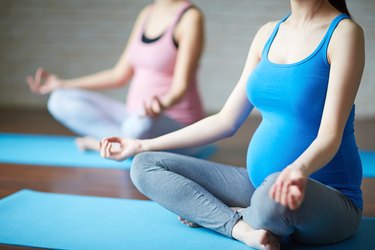
Pregnancy is an exciting time, but it also has its challenges as your body experiences changes. It's not uncommon to have aches and pains — such as symphysis pubis dysfunction — along the way.
Symphysis pubis dysfunction (SPD), also called pregnancy related pelvic girdle pain, can develop at any stage of pregnancy. This painful condition can impact your ability to do simple daily tasks, such as getting dressed and walking.
Video of the Day
Video of the Day
What Is an SPD Pregnancy?
Your pelvis is made of two large bones that form joints with the sacrum at the base of your spine. In the front, the pubic bones on the front of each half of the pelvis are joined by cartilage to form the pubic symphysis.
During pregnancy and subsequent childbirth, the ligaments that support the pubic symphysis become more flexible to allow the pelvis to widen. In addition, swelling frequently occurs, making this joint less stable, leading to SPD, according to the BabyCentre.
While pain in the groin and pubic area are the most common symptoms of SPD, you might also experience pain in your back or along your inner thighs. This condition can also cause clicking or grinding at the pubic symphysis.
Pain typically worsens with walking, climbing stairs, spreading the legs apart or standing up after lying down for a period of time. You will likely have significant pain in your groin and hips when you first get out of bed in the morning.
Read more: Abdominal Belt After Pregnancy
Try SPD Exercises
SPD exercises can help relieve pain associated with this condition, according to the Liverpool Women's NHS Foundation Trust. Be sure to check with your doctor before exercising to make sure it is safe for you.
Move 1: Pelvic Floor Strengthening
This simple movement will strengthen the deep muscles in your pelvis, or pelvic floor, to help decrease symphysis pubis dysfunction pain.
- Lie down or sit comfortably in a relaxed position.
- Tighten your pelvic muscles as if you are trying to stop the flow of urine.
- At the same time, tighten your anal muscles as if you are trying not to pass gas.
- Perform slow contractions, holding each contraction for up to 10 seconds.
- Rest 10 seconds between repetitions.
- Repeat until your muscles are fatigued.
- Perform quick contractions, tightening and releasing as quickly as possible, 10 times in a row.
Move 2: Pelvic Tilt
The pelvic tilt exercise is sometimes called the abdominal draw-in. This exercise targets the deep abdominal muscles.
- Recline in a supported position, on a firm surface. Bend your knees and place your feet on the floor.
- Place your hands on your hips.
- Tighten your lower abdominal muscles as if you are pulling your belly button back toward your spine. You should feel the muscles under your fingertips tighten and your lower back press into the ground.
- Hold for 10 seconds, while breathing normally; then relax.
- Perform 10 repetitions.
The pelvic tilt can also be performed in sitting, quadruped (hands and knees), side-lying and standing positions. Choose the position that is most comfortable for you based on your current stage of pregnancy.
Move 3: Bird Dog (Modified)
The bird dog exercise, or quadruped opposite arm/leg exercise, adds arm and leg movements to the pelvic tilt, as demonstrated by Princeton University Athletic Medicine.
- Position yourself in quadruped with your hands directly under your shoulders and your knees in line with your hips.
- Perform a pelvic tilt.
- Lift your right arm off the ground a few inches.
- At the same time, lift your left knee off the ground, but only a few inches.
- Hold this position for up to five seconds; then lower back down.
- Repeat on the opposite side.
Use caution during this exercise — if you have difficulty maintaining your balance or can't keep your pelvis level, lift one extremity at a time, leaving the other three on the ground for stability.
Move 4: Mountain Pose
According to a June 2015 article published in the Journal of Ayurveda & Holistic Medicine, yoga provides physical, emotional and mental benefits, improving your ability to adapt to the many changes that occur during pregnancy. The mountain pose helps elongate the spine and improve your posture.
- Stand with your feet together, with the base of your big toes touching each other.
- Spread your toes apart and shift your weight side to side until you feel it evenly distributed between both legs.
- Squeeze your outer lower legs in toward each other and tighten your thigh muscles.
- Tuck your tailbone and gently tighten your abs as if you are pulling your belly button back toward your spine.
- Press your shoulder blades down and back and open your chest.
- With your arms by your sides, straighten your fingers and tighten your triceps to keep your elbows straight.
- Elongate your neck with each breath. Hold this pose for up to one minute.
Read more: The 10 Best Post-Pregnancy Workouts
Tips for SPD in Pregnancy
In addition to exercises, changing the way you perform daily activities may help reduce SPD pain. Avoid activities that involve standing on one leg — this puts your body weight through half of your pelvis, increasing stress on the pubic symphysis.
For example, sit down while putting on your pants, socks and shoes. Climbing stairs can also be quite difficult with SPD. Rather than facing the stairs, climb them sideways. Step up with one foot; then bring the opposite foot up to the same step before continuing.
If you have pain while walking, take smaller steps to reduce movement between your pelvic bones. Consider walking in a pool to help maintain your fitness while reducing the amount of pressure through your pelvis. If you decide to swim, hold a pull buoy between your legs to help remind you not to spread your legs apart.
Place a pillow between your knees while sleeping on your side. When standing up from sitting, keep your legs close together —although, this could be a challenge later in pregnancy. SPD may also cause pain during sexual intercourse, which can be reduced by limiting the distance your legs are spread apart.
Is this an emergency? If you are experiencing serious medical symptoms, please see the National Library of Medicine’s list of signs you need emergency medical attention or call 911.