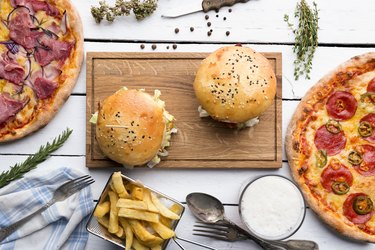
Often, it seems like food research experts issue dietary guidelines every day, leaving people confused by the often-contradictory recommendations. Much of this confusion is a result of different types of diets and products having both advantages and disadvantages — which is the case with healthy food and processed meals. But it remains clear that moderation is a critical aspect of any type of diet you choose to follow.
Read more: FDA Daily Nutritional Requirements
Video of the Day
Video of the Day
Advantages of Healthy Food
You can successfully age by avoiding medical conditions like heart disease and diabetes. Eating healthy food is the best way to prevent the inflammation and other consequences of these medical conditions, according to a 2017 report in Molecules. The authors note that healthy food can also play a positive role in fighting cancer.
Healthy food also has a beneficial effect on your emotional well-being. A 2014 review in BMC Psychiatry noted the relationship between food quality and mental health in young children. This positive relationship persists across the entire lifespan. For example, eating healthy food helps older adults fight depression and dementia.
Disadvantages of Healthy Food
A 2015 paper in Nutrition Reviews gave a detailed analysis of food prices. The article showed that vegetables and fruits had a higher per-calorie cost than sweets. So, it actually costs more to stay healthy and keep a healthy body weight through a diet that includes nutritious fruits and vegetables.
This higher cost of healthy food can, for some, make it less likely to appear on a grocery shopping list. Children might also find it less tasty. This poses a dilemma for parents since taste remains the best predictor of food choice from age 4 and on.
Read more: How to Eat Healthy on a Hundred Dollars a Month
Advantages of Processed Food
Researchers consider food items with high sugar, salt and trans-fat content as processed foods. Examples include potato chips and candy bars. People typically choose these foods because of their widespread availability and good taste. It also offers a low-cost way to feed yourself.
These energy-dense, low-cost food products affect your mind as well. Packaged food has a calming effect — even for infants. It also boosts performance on spatial learning tasks. Finally, it releases endorphins, generating feelings of euphoria.
Disadvantages of Processed Food
Scientists have correlated the dramatic rise in childhood obesity with highly-processed food consumption. Weight gained during youth often persists into adulthood, and it places adults at risk for medical conditions like diabetes.
Unhealthy eating also has a surprising effect on mental health. For example, researchers have found a relationship between processed foods and violent behavior. Fast-food intake has also been shown to correlate with suicidal thoughts.
If you're pregnant, the negative effects of eating these foods may even transfer to your children.
Making Your Best Food Choice
Researchers can't find an ideal diet. After all, each person has a unique physiology and different goals. Yet, basic principles exist in the scientific literature. You can use these principles to live longer.
A 2017 report in the Cleveland Clinic Journal of Medicine recommended that you choose a diet which respects your preferences, needs and current health status. Many doctors consider the Mediterranean diet the best way to prevent disease. The mechanisms behind these positive effects remain unknown. However, the harmonic combination of anti-inflammatory and antioxidant elements in the Mediterranean diet may offer you the best way to have a long, healthy life.
- Nutrition Journal: A Healthy Approach to Dietary Fats
- Molecules: Bioactive Nutrients and Nutrigenomics in Age-Related Diseases
- BMC Psychiatry: Food Policies for Physical and Mental Health
- Nutrition Reviews: Contribution of Food Prices and Diet Cost to Socioeconomic Disparities in Diet Quality and Health
- Food Quality and Preference: Predictors of Children’s Food Selection
- Kids Health: Word! Junk Food
- Journal of the Dow University of Health Sciences: Junk Food Consumption, Awareness and Its Health Consequences Among Undergraduates of a Medical University
- Preventive Medicine: Food Reinforcement During Infancy
- Regis University: Effects of Short-Term Consumption of a Western-Style Junk-Food Diet in Rats
- Progress in Nutrition: Feeding the Brain
- Journal of Family Medicine and Primary Care: Childhood Obesity
- Nutrition: Association Between Junk Food Consumption and Mental Health in a National Sample of Iranian Children and Adolescents
- Indian Journal of Science and Technology: Relationships Between Dietary Behaviors and Suicidal Ideation Among Korean Adolescents
- Diet, Nutrition, and Fetal Programming: Maternal Junk Food Diets
- Science: Optimizing the Diet
- Cleveland Clinic Journal of Medicine: Diabetes With Obesity: Is There an Ideal Diet?
- Current Opinion in Clinical Nutrition and Metabolic Care: Mediterranean Diet and Life Expectancy