
The Best Running Exercises to Increase Knee Lift
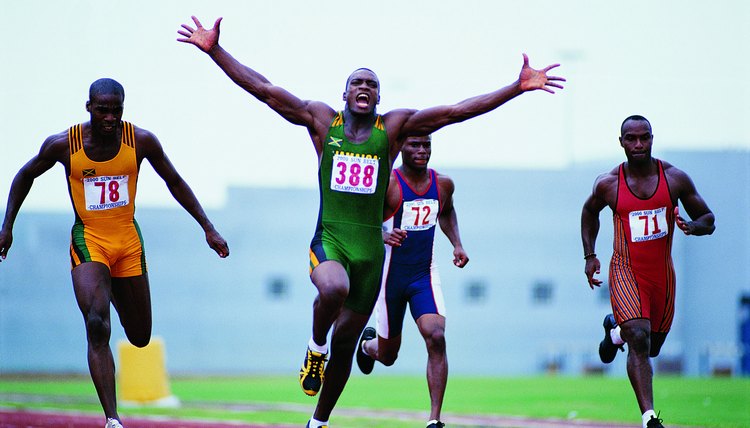
There is a simple way to easily become a faster runner, and if you are running, then you are already doing it: lifting your knees. Now, all you have to do is lift them a little higher. The ability to lift the knees when running is controlled by the hip flexors, a group of muscles that act together to lift the femur.
The Anatomy of Lift
Turnover, or how fast can you get to the next step, is what determines your speed in sprinting. Your ability to flex your hips determines how fast and far you pick up your feet. The iliacus is a muscle that allows for hip flexion up to a level parallel with the ground. The rectus femoris assists it and also allows hip flexion to 90 degrees. The psoas provides hip flexion above the 90-degree level as seen in sprinting with high knee lift. The psoas, which raises the knees past 90 degrees, can be strengthened to improve knee lift. Flexibility in the hip flexors decreases muscle resistance and allows runners to take advantage of the leg's full range of motion.
At the Gym
A great skill to get your hip flexors firing is the one-legged hip thrust with a tennis ball. Lie on your back. Put a tennis ball in the crease between your thigh and hip. Thrust your hips toward the ceiling while keeping the tennis ball in place, creating a bridge. Lower your hips to the ground and raise them again. Repeat 10 times, then switch and do the other side.
Non-Weight-Bearing Exercise
Hanging from a bar, draw your feet up to the bar while bending at the waist. Build up to three sets of 10. An easier version is to bring your knees to your elbows. Use a 12-inch diameter band, or double loop a longer one. Place the band under your left foot, and put your right foot in the loop. Pull your right knee up toward your chest 10 times. Repeat 10 times and then do the other leg. In waist- or chest-deep water, perform high knees in place for 30 seconds, recovering for 30 seconds. Repeat 10 times. You will work against the pressure of the water, strengthening your hip flexors without the pounding.
Weight-Bearing Exercise
There are several plyometric drills that can improve your knee lift and running form. When you do high knees, lift your knees as high as you can as you skip, focusing on bringing your knees up instead of how far you go forward. To intensify high knees, hop on your right leg and lift your left knee to your chest on every other hop. Your left foot will tap the ground every other hop for balance. Go for 20 yards, then hop on the left leg. Tuck jumps, alternating split squat jumps, box jumps and box steps with alternating knee drive all work your hip flexors. Running up every other step on stadium stairs or a steep hill can also improve knee lift.
Weights
Bulgarian split squat, overhead squats, walking lunges and spot lunges are all excellent ways to develop your hip flexors. Start by lifting just a PVC pipe, or broomstick, over your head and work to get depth and flexibility. Progress your way to dumbbells or an empty bar once you’ve achieved full range of motion. Always keep the bar positioned over your mid-foot when doing these exercises, keeping the weight light, up to 60 pounds total, and the reps high, about 10 to 12, for three sets.
References
Resources
Writer Bio
Carol Smolsky is a Registered Nurse, ACE Personal Trainer, Crossfitter and yoga practitioner. She finished 14 full Ironman Triathlons (four Hawaiian championships), and countless other running and stair climbing races. She writes workouts for all levels, from recovering patients to elite athletes, as well as Triathlon Training Programs for all distances.